

You just have to wonder what they were thinking. Ten young refugees — nine from the impoverished Himalayas and one from Baghdad — were introduced to Tucson's joyous bicycle dungeon.
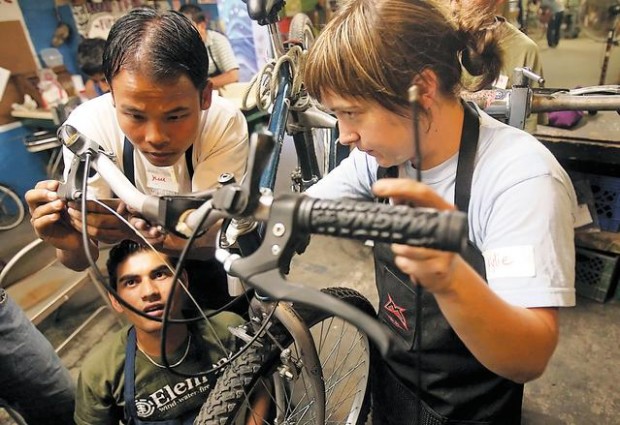
Through a program sponsored by Lutheran Social Services and supported by Bicycle Inter-Community Action & Salvage — better known as BICAS — each refugee was given the opportunity Sunday to get a free bicycle — and learn how to work on it.
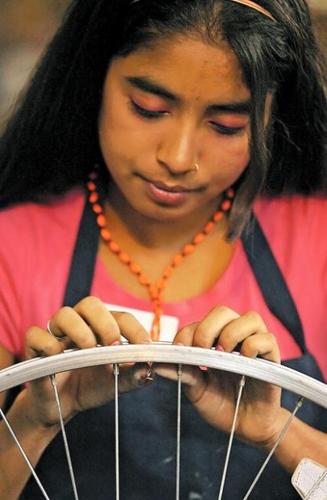
The group, nine males and one female from their teens to their early 30s, seemed at ease.
They were cheerful, for the most part, although varying degrees of facility with English may have left some of them grasping for the subtleties of the presentation when a translator wasn't conveying BICAS instructor Kylie Walzak's comments.
For Purna Adhikari, 25, a Nepalese refugee, attending the class would help as he adjusts to his new life in Tucson.
People are also reading…
"I have no job," said Adhikari, who has been in Tucson for 13 days. "I have no bike. I came here to learn how to make it."
BICAS is in the basement of an old warehouse, within a stone's throw of the Union Pacific mainline where it crosses East Sixth Street. The basement, slightly below ground level on the parking-lot side of the building, is an organized mess.
Except for a narrow shaft of daylight from the sunken doorway, the place is strictly shadows broken up by fluorescent light. Other than the concrete walls, ceilings and floor, everything is either bicycle parts, bicycle tools, kindly worded instructional signs or widely scattered, slightly grimy surfaces. That and friendly, usually slightly grease-smudged bicycle devotees.
The place roars with the sound of fans trying to cool the workers — and the occasional rumble of a passing train. Add the sound of hammers striking anvils, and, except for those cheerful smudged workers, it could be a Third World factory.
BICAS is about efficient, "green" transportation. For the sponsors of this program, however, it's about transportation for these newcomers to America.
"Everyone when they come here, we get them a bus pass. But it's still a challenge to get people around," said Lara Pfaff of Lutheran Social Services. Pfaff is a VISTA volunteer specializing in adult skill building, in this case helping these young refugees get the skills that will, in turn, help them become self-sufficient.
It's tough enough to find a job and keep it going for Tucson residents who know their way around and speak English natively, said Bria Dolnick, 27, of Lutheran Social Services.
And even after they find jobs, there are complications, Dolnick said.
"Some of them have jobs that end after the buses stop running," Dolnick said.
The deal at BICAS is you work 10 hours and they give you a bike. You have to fix the bike, but they give you the skills, the help and the parts to do it.
Adhikari worked for five years as a teacher in his homeland, educating children up to what third grade. He also has experience, personally and as a teacher, with disabilities. He has a withered right hand. Showing the hand, he said, "I used to do work that you could do with one hand."
Here, he doesn't know what he will do, but he figures he'll need transportation.
In the background, instructor Walzak tries to start the bike-building and repair class, asking Deo Chhetri — a Nepalese refugee and the acting translator — how to say, "Stop working on the bicycles."
Chhetri, 18, laughs and tells her the words, which Walzak makes a diligent effort of pronouncing like he just did — and for which she gets a good-natured round of polite laughter.
Chhetri, a good-looking young man with a disarming smile, speaks English well. He's an Amphitheater High School senior and has his eyes on a mountain bike. Walzak later turns him loose to find a brake cable for the bike.
He rode a bike to school back home, he said, and he'll do it again.

 Faculty concerned about changes to U of A admissions policy


