

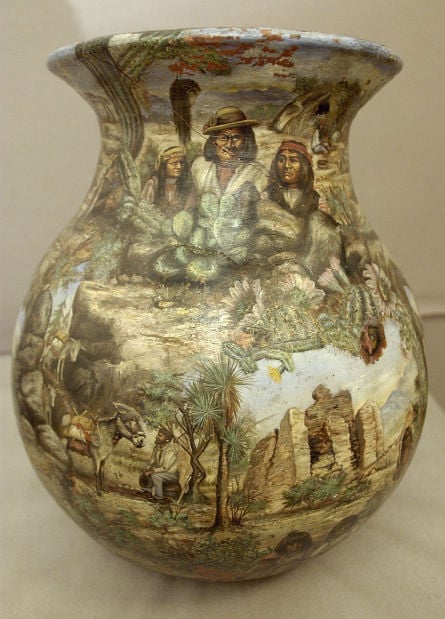
Laurette Lovell was born in San Jose, California, to Judge William and Mildred Lovell on Jan. 31, 1869. One of Laurette's legs was 4 inches shorter than the other. She was fitted with an iron brace that was supposed to stretch her leg, but it also prevented her from running and playing with other children, leaving her to spend much of her time alone. Her parents encouraged her aptitude in drawing and painting and sent her to school to develop her artistic skills.
In 1882, 13-year-old Laurette moved with her family to Tucson where she discovered that the ollas, or clay pots, crafted by the Tohono O’odham people were perfect canvases for her work. These unglazed containers were used as cooking utensils as well as storage vessels for grains, seeds and water. She acquired a kiln, which allowed her to use an overglaze technique on these simple pots, an application applied to pottery after it has been fired, then fired again at a low temperature to set the glaze colors.
People are also reading…
She painted desert scenes on the ollas along with portraits of Indian women and children. She decorated them with pictures of old Spanish missions, cactus and desert flowers. Sometimes she took photographs of her subjects before reproducing the images on the pottery.
Laurette was a fashionable young woman who enjoyed the town’s social life, even though dancing was not something she did with grace. She usually stood with one foot pointed outward to maintain her balance. Yet this dark-haired beauty captivated and enchanted the tiny hamlet of Tucson with her artistic talent and skills.
In November 1887 Laurette was asked to produce one of her elaborately designed ollas as a gift for Gen. Nelson A. Miles, who had negotiated the surrender of the Apache warrior Geronimo in September 1886.
Miles’ victory occasioned a celebration that included a parade through the streets of Tucson. Crowds waved flags and banners, and shouted and cheered as he passed.
That evening the Society of Arizona Pioneers hosted a large party of “dancing and literary exercises” for Gen. and Mrs. Miles and their staff. Various gifts were presented to the general but according to the Daily Star, “The presentation to General Miles by Miss Lorette (sic) Lovell of an artistically painted olla of her own design and painted descriptive of Arizona scenes and Indians, was the attraction of the evening.”
On Gen. Miles’ olla, Laurette painted scenes of the Mission San Xavier del Bac, Indian women carrying burden baskets, the prehistoric Casa Grande ruins, a portrait of Geronimo and an abundance of cactus and desert plants. Only 18 years old, Laurette claimed this was her “proudest moment.”
Her fame grew beyond the Old Pueblo when she visited the Mileses at their home in Washington, D.C. Laurette’s granddaughter, Laurette Lovell Johnson, said her grandmother held her debutante ball at the Miles home, that she was commissioned to paint a portrait of the general and that some of her paintings once hung in the U.S. Capitol Building. Her artistry of the desert, however, and her use of Native American pottery is what made her famous.
At age 21, and because of her national recognition as one of the first Anglo artists to utilize Native American pottery as an art form, President Benjamin Harrison appointed Laurette as Arizona Territory’s “lady manager” for the Women’s Pavilion at the upcoming 1893 World’s Columbian Exposition in Chicago. Of the seven managers selected to run the Women’s Pavilion, Laurette was the youngest. She was also commissioned to design the official seal for the Arizona Exhibition.
This was the first time women were part of organizing a national exposition, and the first time national funds were used to build a Women’s Pavilion to display women’s arts and crafts from around the world.
Women also left the fair with new ideas on many issues, and they entered politics at a greater rate than ever before. According to author Jeanne Madeline Weimann, who wrote “The Fair Women: The Story of the Woman’s Building at the World’s Columbian Exposition of 1893,” suffrage leader Susan B. Anthony said the exposition “did more for the suffrage movement than 25 years of agitating.”
Laurette stayed in Chicago until 1895 to help return exposition artifacts. From there, she traveled to San Francisco and Los Angeles before returning to Tucson. While in Los Angeles she met her future husband, Will Evelyn Francis, and the couple married July 6, 1895. They initially lived in Acton, California, where Will had large investment holdings. Their only child, Evelyne Laurette Francis, was born in a hotel room in Acton in 1896.
They returned to Tucson in 1897, where they remained until relocating to Los Angeles in 1908.
Laurette continued to paint well into her 60s, adding wallpaper designs and other commercial enterprises to her repertoire. She dabbled in oils, watercolor, inks and sepia, loved to paint landscapes filled with flowers, and implemented some of her best work on fine china. Many of her paintings and chinaware are housed at the Tucson branch of the Arizona Historical Society.
Only four of her beautifully decorated ollas are known to exist. Two are in California, including the one she decorated for Miles, and two are in Arizona. One is privately owned and the other is at the Historical Society in Tucson.
Laurette died in California on February 28, 1936, at age 67. “While California claimed her by birth, her adopted state of Arizona had her love,” her granddaughter said. “In Arizona she did her most prolific work and that for which she is best known.”
Jan Cleere’s latest book,“Levi’s & Lace: Arizona Women Who Made History,” (Rio Nuevo Publishers), is available in bookstores and online. Contact her at Jan@JanCleere.com.
Sources
Henry, Bonnie. “State History on a Water Jug.” Arizona Daily Star. June 23, 2004.
Hilpert, Bruce. “Laurette Lovell: Frontier Artist.” American Art Pottery, No. 47, April 1980.
Lovell, Laurette, 1869-1936 biographical file. Arizona Historical Society, Tucson.
The Congress of Women Held in the Woman’s Building, World’s Columbian Exposition, Chicago, U.S.A., 1893. Accessed at digital.library.upenn.edu/women/eagle/congress/congress.html
The Daily Star, Tucson, Arizona Territory. February 16, 1887.
The Daily Star, Tucson, Arizona Territory. November 10, 1887.
Weiman, Jeanne Madeline Weimann. The Fair Women: The Story of the Woman’s Building at the World’s Columbian Exposition of 1893. Chicago Review Press, 1981.


 Diner coming to Tucson's Sunshine Mile


