

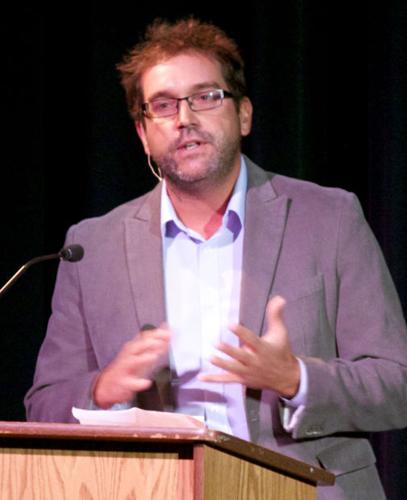
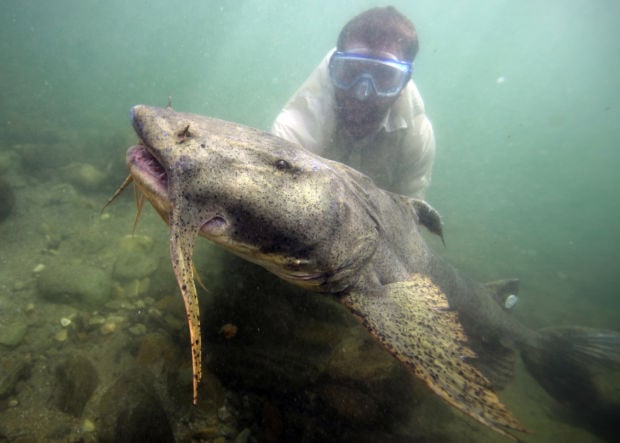
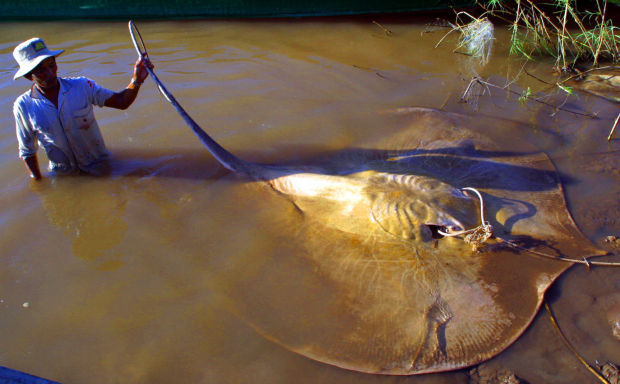
Zeb Hogan’s mission to find and study the world’s largest freshwater fish began about 20 years ago.
Hogan, host of National Geographic’s “Monster Fish” television show, researched native fish in the Colorado River in Grand Canyon National Park through the UA Undergraduate Biology Research Program.
He returned last week to share his journey with the current crop of student researchers at the program’s 25th annual conference.
The program was created in 1988 to give undergraduate students the opportunity to conduct hands-on biology research under the guidance of a UA faculty mentor. In its first year, the program supported 19 students and 13 faculty mentors drawn from six UA departments.
It has grown significantly, said program director Carol Bender, and now supports about 140 students a year with more than 240 faculty mentors.
People are also reading…
It collaborates with more than 40 UA departments, as well as other institutions such as the Arizona Science Center in Phoenix, she said.
Bender said the program has evolved into more than just an opportunity for students to get valuable hands-on experience.
“Because UA has more than 40,000 students, sometimes it’s hard to find a place for yourself ,” she said.
The program gives students “a way to plug into the campus,” developing relationships with faculty and others who can help them with career goals, she said.
Most important, though, the program teaches students critical-thinking and problem-solving skills, Bender said.
“Those are skills that you can use no matter what you do,” she said. “Those are skills that we need more American voters to have.”
Matt Groysman, a junior majoring in cellular and molecular biology and neuroscience and cognitive science, said the program has helped in many ways.
“First, you get exposure to actual scientists,” he said. Last summer, Groysman started studying genetic mutations in two types of lymphoma — a form of blood cancer, he said.
“In the lab I work with three postdoctoral students, three Ph.D. students and the principal investigator, who’s an M.D.
“They basically become your family on campus,” he said. “Not only do they help you intellectually and professionally, but they are also there for you if you need anything.”
He said the hands-on aspect of the program has helped him to become a better scientist, researcher and person in general.
“It’s taught me so many soft skills — how to work in a team, how to communicate about your work and how to pay close attention to detail,” he said.
His favorite part is “the opportunity to do research that’s cutting-edge and intriguing,” he said.
The program also provides funding for the students to conduct their research.
Elisa Namdarian, a junior majoring in cellular and molecular biology, said a lack of funding is a major problem for many laboratories.
The program covers research costs and pays the students.
“The program starts in the summer and they pay us weekly so we can stay in Tucson and work on our research,” she said.
Alec Perkins, a sophomore majoring in cellular and molecular biology, said the program has helped him “by providing opportunities and resources to learn science in the real-world context.”
Hogan credits the program for his success. “It had a profound effect on my life and my career choice, and it sparked my passion for fish,” said Hogan.
Hogan’s studies of native fish of the Colorado River led him to study migratory fish in the Mekong River Basin in Cambodia. Years later, he applied for a grant from National Geographic, which landed him the TV gig.
His studies for the last 10 years have been focused on the ecology and conservation of “megafish,” which are at least 6½ feet long and weigh at least 220 pounds, he said.
Hogan isn’t the only program graduate who’s had success.
Alumni have given more than 1,000 presentations at scientific conferences and have published more than 920 scientific articles since the program began, said Bender.
Bender remains enthusiastic after 25 years of running the program. “My favorite part about being the director of the program is the energy and excitement that students bring,” she said.
“I get to hang out with young people who are smart, excited about what they’re doing and who have a great future ahead of them — there’s nothing better than that.”
Joaquin Ruiz, dean of the UA College of Science, said the program is the highest-quality program an undergraduate can join.
“It’s structured in a way that a faculty member and an undergraduate get to know each other before they are engaged in research,” he said. “There’s already compatibility between the two before the research starts, so success will be higher.
“It’s a holistic program — students get experience in the lab and they are also part of a cohort,” he said.
Bender makes the program run well, he said.
“The force of her personality and her imagination about what makes a successful undergraduate program is what makes the program strong,” he said. “She comes up with ideas and gets them funded, then manages them to perfection.” Bender was recognized in 2011 as one of the UA’s 15 distinguished professors of outreach.
“What makes UA so special is that undergraduates can get involved in first-rate research,” Ruiz said.
Drew McCullough is a NASA Space Grant intern at the Arizona Daily Star.

 Faculty concerned about changes to U of A admissions policy


