

Lots of guys walk around with images of dinosaurs on their T-shirts. Few of those guys, however, share the same name as the dinosaur.
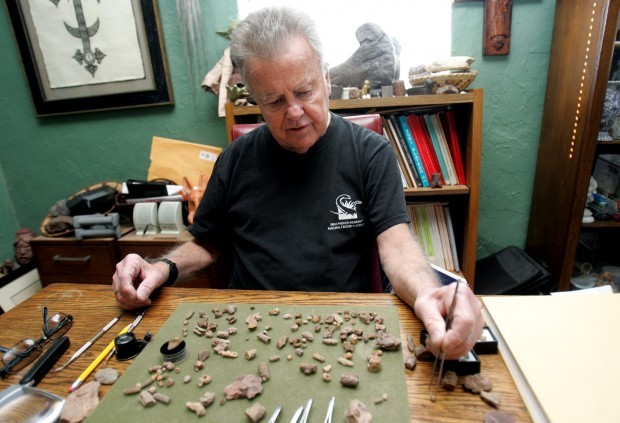
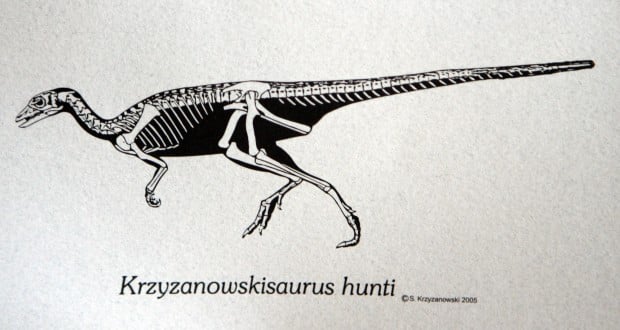
"I just call it Stan's lizard," says Tucsonan Stan Krzyzanowski, 72, whose T-shirt is emblazoned with one Krzyzanowskisaurus hunti, a 6-foot-long dinosaur - and ancestor of modern birds - that roamed Northern Arizona and New Mexico more than 200 million years ago.
Krzyzanowski found several of the creature's teeth in the mid-1990s in the Blue Hills of Northern Arizona, near St. Johns. He also oversees work there, weather permitting, at yet another namesake: the Krzyzanowski bone bed, a 60-foot-long site from the Triassic period.
"It's a really important bone bed, very different from other ages. It's almost like the first view of a new planet," says Spencer Lucas, curator of paleontology at the New Mexico Museum of Natural History and Science, where Krzyzanowski has been named a research associate.
People are also reading…
Also known as the dawn of the dinosaurs, the Triassic period began about 250 million years ago and ended about 50 million
years later with the advent of the Jurassic period.
Krzyzanowski discovered the bed in 1994 and has found at least 15,000
bones, teeth and trace fossils from there and elsewhere.
In 2005,
paleontologists who had worked with Krzyzanowski named the dinosaur found in the Blue Hills after him.
The honor came for his lifelong interest in Arizona's fossil record and his many contributions to that record - all the more astonishing because he has no college degree and has taken only one college course in geology. What he does have is an insatiable interest in and curiosity about fossils, gleaning knowledge from books, fieldwork and the minds of others.
Asked if those in academia ever question his lack of a formal education, Krzyzanowski answers, "Yeah, until I open my mouth."
"Stan is a very gifted collector, I almost think he was born with that," says Lucas, who's known Krzyzanowski for more than 20
years. "He's not scientifically trained, but his contribution to the science of paleontology is equal to or greater (that of) than many professionals."
Born at Tucson's Stork's Nest, Krzyzanowski later blew a mean sax in the Tucson High School swing band. After a stint in the Navy, he attended the University of Arizona for a couple of years.
"I hated it, except for that one course in geology," he says.
Instead, Krzyzanowski went into sales for a large pharmaceutical company on the West Coast. He also married and started a family.
By 1972,
he was back in Tucson, where he got into commercial real estate. Through his connections, he wound up owning the Plant Shack on North Stone Avenue by the mid-1970s.
He knew nothing about plants. Characteristically, he quickly learned.
"I found out real fast salesmen were going to use the botanical terms. I had to learn them," he says.
In time the Plant Shack morphed into Krzyzanowski and Co., with several locations, including its flagship site on North Oracle Road. But after 25 years in the plant business, Krzyzanowski finally closed up shop, eager to delve into other interests.
Already he was devoting more and more time to his real passion: fossils, an interest kindled as a young adult going out on archaeological digs.
In 1988, he started taking trips with the New Mexico Geological Society, which led to meeting Lucas and linking up with the New Mexico Museum of Natural Science and History, which secures his permits to collect on public land.
"You've got to be willing to walk for miles," says Krzyzanowski. "I will take someone out, and if they don't find a T. rex after a mile, they don't want to come back."
Three years ago, he bought a 950-square-foot mobile home in St. Johns, where he installed a lab. "I bring back the stuff for sifting. Then it goes to the New Mexico museum. Most of my finds are still being researched there."
College students regularly come out for field trips, and Krzyzanowski also has spoken to school kids in St. Johns and Tucson.
"To me, Stan is an outstanding citizen scientist," says Lucas. "Here's a guy going out on his own time. Nobody is paying him. What's driving him is his own fascination of the history of life."
Bonnie Henry's column appears Sundays and Mondays. Reach her at 573-4179 or at bhenry@ azstarnet.com - or write to P.O. Box 26807, Tucson, AZ 85726.


