

Tombstone mining operations directly affected the milling communities along the San Pedro River.
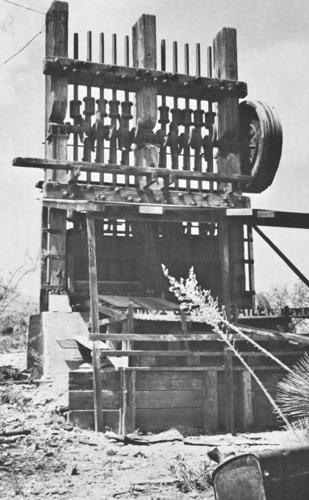
Lack of water for milling in Tombstone necessitated convenient access to the San Pedro River. Mills on the hillsides along the San Pedro created the towns of Contention City, Fairbank, Emery City, Millville and Charleston.
Silver ore was transported by wagon at a cost of $3.50 per ton from Tombstone to the mills. In 1882, 125 noisy stamps were operating at seven mills along the San Pedro, refining 400,000 tons of ore and consuming 47,260 cords of wood. The stamps erected by mill Superintendent Richard Gird at Millville alone processed $1.3 million in bullion between April 1881 and April 1882.
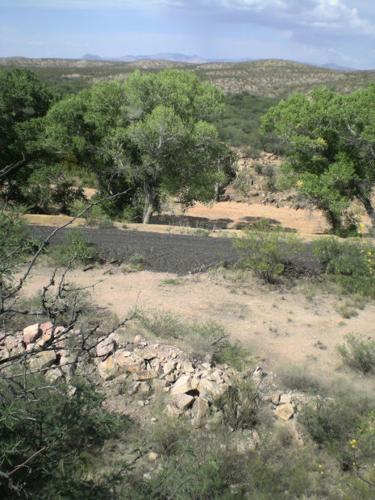
These towns were built upon the success of the Tombstone mines. When those mines flooded and nearby mills shut down in the mid-1880s, the infrastructure collapsed and the towns were abandoned. Scant evidence of most of them remains today except for some foundations, timbers and high terraces.
People are also reading…
FAIRBANK
The town was named for N.K. Fairbank, an affiliate of the Grand Central Mining Co. in Tombstone. Four different railroads — the New Mexico & Arizona (NM & AZ), Arizona & Southeast (AZ & SE), El Paso & Southwestern (EP & SW), and Southern Pacific (SP) — operated at Fairbank.
Fairbank served as a supply point and stage terminal, and it was the closest railroad depot to Tombstone until a spur by the EP & SW connected both points in 1903.
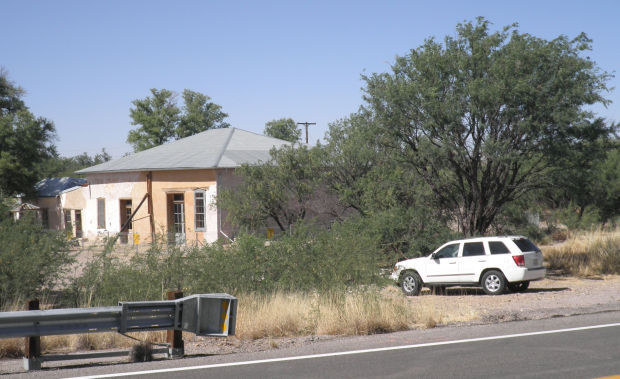
Today, Fairbank — formerly located on the San Juan de las Boquillas y Nogales Mexican land grant — lies within the San Pedro Riparian National Conservation Area. Managed by the Bureau of Land Management and open to the public, it includes several remarkably preserved structures: the Adobe Commercial Building, built in 1883, and a gypsum-block school building constructed in 1920.
On Feb. 15, 1900, an attempted robbery of a Wells Fargo express car occurred at Fairbank Station. Jeff D. Milton, a Wells Fargo Express messenger and ex-Texas Ranger, used a shotgun to hold off five outlaws posing as drunken cowboys, including Three-Finger Jack Dunlap and Bravo Juan Yaos. One outlaw was wounded, and the return fire with lever-action Winchesters shattered Milton’s left arm.
Although the robbers escaped empty-handed, within days a posse captured them. One escaped to Mexico, and another died on the run. Milton survived, threatening to kill the doctor who attempted to amputate his arm. He later owned a mining claim near Lukeville and, along with geologist Ira B. Joralemon, he reviewed the mineralized zone around Ajo. Joralemon reported positive findings to John Greenway, who later developed the New Cornelia Mine at Ajo.
CONTENTION CITY
Three miles north of Fairbank, east of the San Pedro River, the town of Contention City was established and in 1879 reached a population of 200 people. Two stage lines, Kinnear’s and Ohnesorgen & Walker, brought passengers to town from Tucson and Tombstone. The New Mexico and Arizona Railroad connected Benson to Contention City in 1882. Businesses such as saloons, hotels, a blacksmith shop and a Chinese laundry prospered for a decade.
CHARLESTON
Charleston, with a population of 423, was built nine miles southwest of Tombstone along the west bank of the San Pedro River. It lasted from 1879 until 1888. The 1882 gunning down of M.R. Peel, an engineer for the Tombstone Mill & Mining Co., added to Charleston’s reputation as a wild and lawless town.
Charleston, with four saloons hosting 24-hour gambling and prostitution, hotels and restaurants, catered to the soldiers stationed at nearby Fort Huachuca. During World War II, the town’s remaining buildings were damaged by the U.S. military while conducting war games.
Sources
David F. Myrick, “Railroads of Arizona, Vol 1,” North Howell Books, 1975
James E. and Barbara H. Sherman, “Ghost Towns of Arizona,” University of Oklahoma Press, 1969
Thomas E. Sheridan, “Arizona: A History,” University of Arizona Press, 1995
W.C. Disturnell, “Arizona Business Directory and Gazetteer,” Bacon & Co. Printers, 1881


