

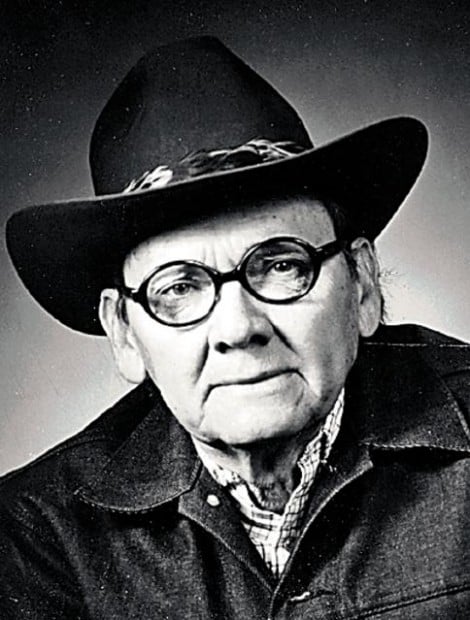
Fred Grove had a unique perspective on the American West.
Part Lakota Sioux, Osage, French and English, and raised on an Oklahoma ranch, Grove had a firsthand understanding of the cowboy-and-Indian way of life. He used that personal knowledge in crafting 30 novels and short-story collections.
"The typical, traditional Western novel has the stereotypical characters that are not really fleshed out and not really realistic," said Western novelist Johnny D. Boggs of New Mexico.
"Fred's stories were always character-driven, and they were characters you could believe really existed. They were flawed, and they didn't always make the right choices, so you could believe that they were much more based in reality than the mythical West."
Grove, an award-winning novelist, had his most recent book, "Trouble Hunter," published in 2006. His next book, "Savage Land: Western Stories," will be published in 2010. The collection of short stories Grove wrote during his 40-year career will be his last. Grove died on Sept. 11 after battling cancer for nearly two decades. He was 95.
People are also reading…
Grove was a Westerner through and through. He was born on July 4, 1913, in Hominy, Okla. His mother was born on the Sioux Reservation in Pine Ridge, S.D., and his father was a cowhand who drove cattle across Texas. One of Grove's grandfathers served in the Union cavalry during the Civil War. The other worked for Buffalo Bill Cody's Wild West show.
A seminal incident that occurred when Grove was 10 later turned up in two of his novels.
He and his family were living in Fairfax, Okla., in 1923 when an explosion rocked the town. They learned that nitroglycerin had been used to blow up the home of an Osage Indian, killing three people. The murders were commissioned by a greedy oil baron who eventually went to prison for the deed. The scandal made its way into Grove's "Warrior Road" and "Drums Without Warriors."
Grove didn't start out as a Western writer. He graduated from the University of Oklahoma in 1937 intent on becoming a sportswriter. He worked at newspapers in his home state and Texas for a decade, hoping one day to land a job writing for the Tulsa paper. Grove was a fan of Western pulp fiction, but he didn't consider working in the genre until he was assigned to interview several Oklahoma pioneers.
At about that time, Grove quit the newspaper business to take a public relations job at the University of Oklahoma. While on the staff, he signed up for writing classes and was taught by writer and historian Walter Campbell, better known to afficionados of Western fiction by his pen name, Stanley Vestal; and by William Foster-Harris, an author, illustrator and leading authority on the Old West.
"Working on newspapers, particularly in Shawnee, Okla., I interviewed a lot of Oklahoma pioneers, people who made land runs, and that got me going again on writing Westerns," Grove said in a 2000 Tucson Lifestyle magazine article written by Western novelist Boggs.
Boggs had read one of Grove's novels years earlier but hadn't met him before their interview. Their ensuing friendship lasted until Grove's death, with the elder writer becoming somewhat of a mentor to Boggs.
"He was always willing to help, share information," Boggs said. "It's easy to get pigeonholed if you're a writer, especially if you're writing about the American West."
Gunslingers, dusty desert towns, cattle rustling and horse thieving are easy to fall back on.
"Fred certainly went beyond that," Boggs said. "He was writing . . . short stories for Boys Life magazine. He was writing novels about Osage troubles in the 1920s. He was writing about contemporary horse racing in the West.
"A lot of times, maybe you weren't sure what you were going to get when you picked up a Fred Grove novel, but you knew it was going to be good," Boggs said.
Grove conducted in-depth research into each subject before he started writing. Historical accuracy was a priority.
He combined his interest in the Civil War and the Western way of life in a five-book series featuring the character Jesse Wilder, a Confederate captain who is captured and reluctantly joins the Union Army to fight Indians on the Plains rather than die in a Union prison camp. Grove's fourth Jesse Wilder novel, "Into the Far Mountains," published in 1999, takes place in Tucson, Fort Bowie and New Mexico.
Grove married his wife of 69 years, Lucile, in 1938, and they had one son, William. The couple moved from Oklahoma to the ranching and mining town of Silver City, N.M., in the mid-1970s and stayed for nearly 20 years. By then, Grove was writing full time and occasionally lectured at Western New Mexico University. About 12 years ago, the couple moved to Tucson to be closer to their son, as well as to the writer's doctors.
Lucile Grove never had any interest in penning her own novels or offering critiques on her husband's writing.
"I just kept people away from him and kept it quiet," she said. "He would spend almost a year on a book. He wouldn't run them right out like some people. He'd go over and over and over them until he got it just right."
Grove won five Spur Awards from the Western Writers of America — considered the Pulitzer Prize for Western writers, said Boggs, who is president of the group.
Past winners include Larry McMurtry, who has won two Spur Awards, and Louis L'Amour, who received one.
Grove also received the Western Writers of America Levi Strauss Golden Saddleman Award for lifetime achievement in Western literature; two Western Heritage Wrangler Awards from the National Cowboy Hall of Fame; and distinguished-service awards from Western New Mexico University and the University of Central Oklahoma.
Jon Tuska, of Oregon-based Golden West Literary Agency, represented Grove since 1996 and called him one of America's "finest Western writers."
"What distinguished Fred's books were the characters," Tuska said. "Authors offer readers different things. Fred offered readers, as he said himself, a balanced perspective between Indians and white men."
It was the love of the people, places and history of the West, not the money or accolades, that motivated Grove to write.
"I never got rich at writing, monetarily," Grove said in the 2000 article. "But to me, the Western story is the American story."
On StarNet: Did you know Fred Grove? Add your remembrance to this article online at azstarnet.com/lifestories
Fred Grove novels
• Flame of the Osage (Pyramid, 1958)
• Sun Dance (Ballantine, 1958)
• No Bugles, No Glory (Ballantine, 1959)
• Comanche Captives (Ballantine, 1961)
• The Land Seekers (Ballantine, 1963)
• Buffalo Spring (Doubleday, 1967)
• The Buffalo Runners (Doubleday, 1968)
• War Journey (Doubleday, 1971)
• The Child Stealers (Doubleday, 1973)
• Warrior Road (Doubleday, 1974)
• Drums Without Warriors (Doubleday, 1976)
• The Great Horse Race (Doubleday, 1977)
• Bush Track (Doubleday, 1978)
• The Running Horses (Doubleday, 1980)
• Phantom Warrior (Doubleday, 1981)
• Match Race (Doubleday, 1982)
• A Far Trumpet (Doubleday, 1985)
• Search for the Breed (Doubleday, 1986)
• Deception Trail (Doubleday, 1988)
• Bitter Trumpet (Doubleday, 1989)
• Trail of Rogues (Doubleday, 1993)
• Man on a Red Horse (Five Star, 1998)
• Into the Far Mountains (Five Star, 1999)
• A Distance of Ground (Five Star, 2000)
• Destiny Valley (Five Star, 2000)
• Red River Stage: Western Stories (Five Star, 2001)
• The Years of Fear (Five Star, 2002)
• The Spring of Valor (Five Star, 2003)
• A Soldier Returns (Five Star, 2004)
• The Vanishing Raiders: Western Stories (Five Star, 2005)
• Savage Land: Western Stories (Five Star, 2010)


 Nancy Guthrie's Tucson neighbors: Life with streamers 'unbearable'


