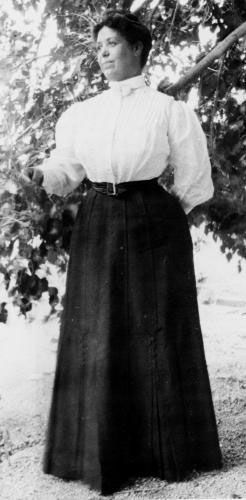
In 1870, Annie Box was born on the Cherokee Nation in Oklahoma Territory. Annie’s mother, Hannah, possessed both Cherokee blood on her mother’s side, and black heritage through her father. Her father, Wiley, was of English parentage on his paternal side, while his mother, who was from New Orleans, was of African American descent.
Annie’s mixed blood created a strikingly handsome girl with creamy tan skin and liquid ebony eyes. She would grow to 6 feet tall and held herself as regally as the most noble of queens. Her father called her his “Cherokee Princess.”
When Wiley came down with yellow fever, medical wisdom of the day prescribed the dry heat of the West to cure his ills. In 1879, the Box family joined a wagon train heading across the plains to Tucson.
While her parents prospected for gold across the territory, Annie attended St. Joseph Convent and Academy for Females in Tucson.
People are also reading…
She also took music lessons from Eva Mansfeld, wife of Jacob Mansfeld, who owned Arizona’s first bookstore. Along with teaching her the refinements of the piano, Mrs. Mansfeld encouraged Annie to pursue her flair for writing music.
Annie supposedly had two of her musical scores published, although neither piece can be found today, and only one titled score can be identified. Her sister Josephine claimed Annie composed a pieced called “Oklahoma March,” perhaps a remembrance of her trek across the desert from Oklahoma to Tucson.
Annie’s school years were brief. At the age of 14, her health deteriorated and she could not keep up with her studies. She left school and traveled with her parents while they searched for their pot of gold but within the year, she was back riding horses.
As soon as she was old enough to attend dances, Annie took to them like one of her wild steeds. She was often seen on the arm of a soldier stationed at Fort Lowell twirling around the dance floor at Carrillo Gardens, at one time the social center of Tucson.
Josephine, who was 18 years younger than Annie, said her big sister “was lively, high spirited and a born flirt.” Josephine also described Annie as “a beautiful girl. She grew tall and straight as a saguaro. Her dark beauty and her light step clearly showed her Indian ancestry.”
Around 1884, Annie married one of her dance partners, soldier James Lewis, who was assigned to Fort Yuma. But the marriage was brief. She married again in 1887 to William Easton, but that marriage also failed.
On January 4, 1892, Annie married William “Curly” Neal, 20 years her senior.
Neal was also a product of the Cherokee Nation with his family a mixture of Cherokee, African American, and Caucasian. After scouting for William Frederick “Buffalo Bill” Cody in the 1860s, Neal arrived in Tucson the year before the Boxes. At the time he and Annie married, Neal was running a lucrative business hauling freight and mail to and from the mines around Oracle. At one time, he was considered one of the wealthiest men in Tucson.
In 1894, the couple began construction on the Mountain View Hotel in Oracle. Opening Feb. 1, 1895, the hotel became not only the showplace of Oracle, but well-known throughout the west. Situated on 160 acres against the northern slopes of the Santa Catalina Mountains, encircled with verandas and porches that offered cool breezes on hot Arizona nights, one could stay there for $2.50 and day or $12.50 a week.
The Los Angeles Herald gushed over Annie’s graciousness, lauding her as “one of the most charming, genial and appreciative of landladies, who understands how to perform the difficult art of providing the best accommodations including a bill of fare, so as to make all feel pleased, at home and perfectly at ease.” The Tucson Citizen claimed she was “the queen of hostesses.”
The famous and infamous stayed at the Mountain View. Actors and socialites roomed across the hall from miners and those just passing through. Even Pearl Hart, the notorious stagecoach robber, supposedly spent a night at the Mountain View after her capture in May 1899.
Annie also looked after the health and well-being of her clientele. Physicians sent their tuberculosis patients to the Mountain View knowing that between the dry mountain air and Annie’s good cooking, they would recover from the debilitating illness.
She started a school for her patrons’ children, baptized the newborn babies of Oracle with the blessings of the Catholic Church, and could outshoot practically any man. The one exception, she claimed, was her husband’s old scouting partner, “Buffalo Bill” Cody, who owned property in the area and often stayed at the Mountain View.
Racial prejudice eventually rode into Arizona changing the lives of African Americans across the territory, including Annie and Curly Neal.
The couple was no longer invited to gatherings, no longer hailed when neighbors passed by. Only when money was needed for a cause were they acknowledged.
The long waiting list for a room at the Mountain View dried up and the magnificent lodge fell into disrepair.
Curly Neal died in 1936. Annie sold the hotel in 1938 although she continued to live in the boardinghouse until her death in 1950 at the age of 80.
The little girl who was a mixture of races and cultures is remembered as a tall, soft-spoken woman who cared deeply for the people around her.
Today, what remains of the old Mountain View Hotel is part of the Oracle Baptist Church.
Jan Cleere is the author of four historical nonfiction books about the early people of the Southwest. Email her at Jan@JanCleere.com.


 For sale: Tucson's Park Place mall