

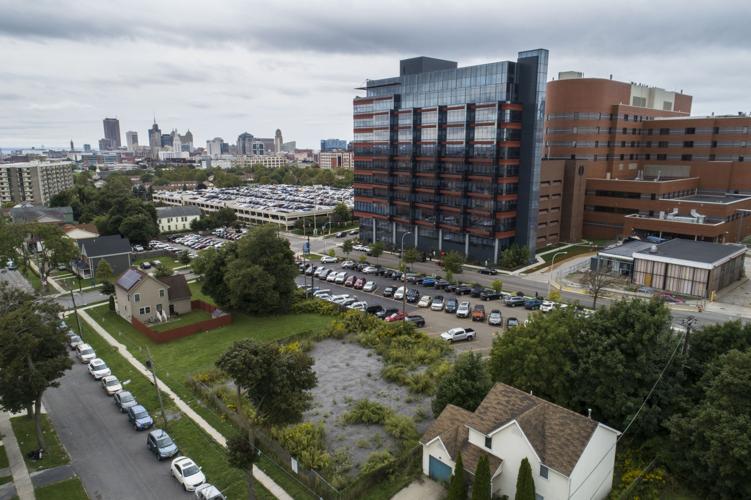
The development boom around the Buffalo Niagara Medical Campus is finally making its long-anticipated push into the neighboring Fruit Belt.
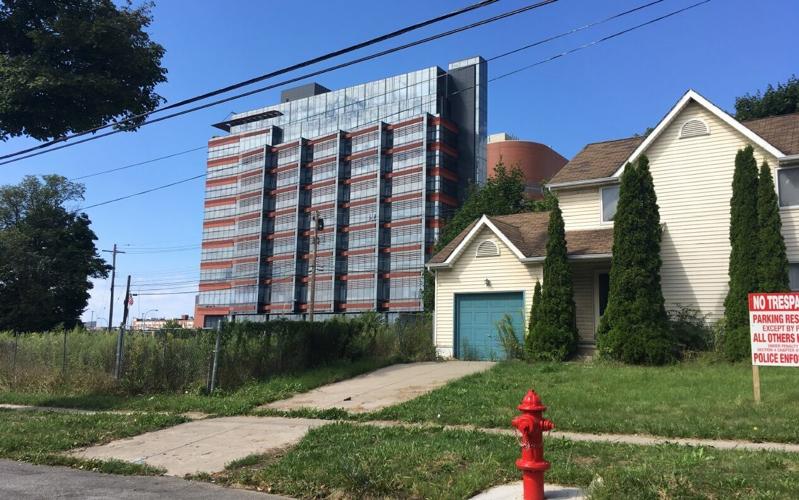
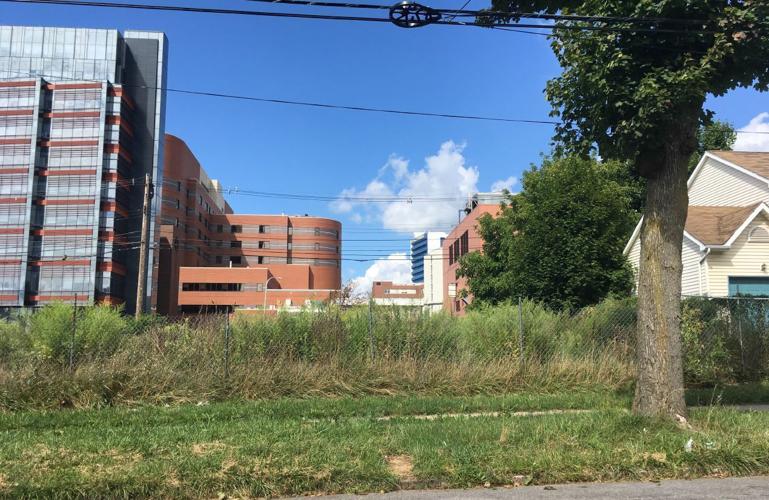
A five-story apartment complex across Michigan Avenue from Roswell Park Comprehensive Cancer Center is the first project proposed that would extend the recent flurry of development near the Medical Campus into a residential neighborhood that has been bracing for what residents fear will be a wave of gentrification that will eventually price them out of their homes and change the character of the area.
Symphony Property Management, owned by Timothy Leboeuf, wants to create 131 units of market-rate housing, plus enclosed parking, in a structure to be built across from Roswell Park's Scott Bieler Clinical Sciences Center. It's aimed at medical professionals, students and service workers.
The jagged, polygon-shaped complex would feature three sections totaling 29,716 square feet, with the main building along Maple, a second building on Michigan, and a small connector building between them, with patios alongside.
People are also reading…
The site is on the edge of the historic residential district where some have long feared encroachment by the medical institutions and developers. Neighbors fear that could lead to demolitions, drive up prices, values and taxes, and ultimately push out longtime residents who can no longer afford to live there. Activists are currently engaged in a battle to save a historic house at 204 High St. that dates to the 1800s.
The new project also would extend the rash of recent development eastward. Last week, developer Dr. Fadi Dagher started construction on a $35 million project to build 217 apartments on the Main Street site of a run-down former motel just north of the Medical Campus. In July, Greenleaf & Co., which previously developed the nearby Bosche Lofts apartments, acquired former Hyatt art store properties on Main and North Pearl streets, across from the Medical Campus, with plans to convert them into apartments and retail space.
And William Paladino's Ellicott Development Co. is working on a trio of buildings at the former Our Lady of Lourdes site, just north of the Medical Campus, including new medical office space, parking and other features.
“It’s been great to see. You wouldn’t have thought five years ago that somebody would be building a new housing project right there in the Fruit Belt,” Paladino said. “I think it’s just the beginning. I think we’ll see a lot of new housing and medical-type developments over there.”
In the latest $25 million project, Symphony plans to build a mix of apartments on the complex's upper four floors, with 35 studios, 52 one-bedroom units and 44 two-bedroom apartments. Some of the apartments would be reserved for "limited-stay" visitors – such as patients' families – rather than permanent residents. Rents will fall within state guidelines for middle-income housing, but Leboeuf said he does not intend to apply for state funding "because the project is viable without it."
The ground-floor parking garage would include 74 spaces. The first floor above it would include a fitness center, offices for the building manager and 31 apartments. The rest of the apartments would be divided equally among the upper three floors. Two lobbies, on Michigan and Maple, would also be accessible from the ground level.
Dubbed "The Lawrence," Leboeuf said the project's name is inspired by well-known artist Jacob Lawrence to "celebrate his contributions to the Harlem Renaissance," by using local artists to "depict and capture what the Buffalo Renaissance looks like through their own creative lenses." The artists will be led by Edreys and Alexa Wajed, who joined the development team and will oversee the artistic elements of the project, including creation of a series of art to be hung in the building.
The design features synthetic stucco, brick, stone masonry and Hardie board siding of various shades, jutting in and out to break up the facade, with painted wood and synthetic cornices along the roofline.
Symphony plans to host a community information session Monday to present the plans to the public for feedback, and has notified nearby residents and businesses. Leboeuf said his team will be working with community groups helping to revitalize the Fruit Belt, including through a neighborhood training and employment program overseen by Tracy Jordan Cardwell to provide local residents with construction jobs for the project or permanent positions with Symphony.
"The development team and project stakeholders look forward to working with the city of Buffalo to create a project that bridges the medical campus and the adjacent Fruit Belt neighborhood in a manner mutually beneficial for all," Philip J. Snyder, partner at Stieglitz Snyder Architecture, wrote in the letter to city Director of Planning Nadine Marrero.
The project would occupy a little more than an acre of land, comprised of 15 parcels that Symphony assembled in 2017 on the two streets under a December 2016 designated-developer agreement with the city. Those include 983, 985, 989, 993, 995, and 997 Michigan, and 228, 230, 232, 234, 240, 242, 244, 248 and 250 Maple.
Most are vacant one- or two-family lots where homes were previously demolished, but two vacant residential structures at 240 Maple and 995 Michigan would be taken down as part of the project. The building would front on Michigan and Maple, but the site is also bordered by High and Carlton streets.
Design work by Stieglitz Snyder is still underway, but the project would require approval from the Zoning Board of Appeals and the Planning Board, as well as building, water and sewer permits. LiRo Group and Petrilli Engineering PC are handling civil and structural engineering.
Symphony is asking the ZBA for 10 variances from the Green Code for density, height, lot width, lot coverage, setback and other factors. According to the company's application, the properties along Michigan are zoned as "mixed-edge," while those on Maple are neighborhood residential, but the Green Code "fails to consider larger lot sizes that straddle two zones."
Symphony acknowledges in its application that the variance request is "substantial," but says the density and scale are needed "to provide a financially feasible project that does not rely on public funds to sustain itself." And the size is "not out of character" with the nearby Medical Campus, officials wrote.
The developer also argues that it will mitigate any "adverse impacts to the physical and environmental conditions" of the Fruit Belt by including enough parking for residents and designing the building so that its facade on Maple would "reduce the scale of the building to neighboring residential streets east of the site." Patios will be located internally to the building, and the developer will not put balconies on either Maple or Michigan to reduce noise. Trash receptacles will be kept inside.
The total cost was not disclosed, but the developer said the project will not use any state funding for completion.
If approved by the city, the developer plans to complete construction documents by February 2020, and then close on financing in April. Construction would begin in May 2020, with completion in April 2021.
Symphony is the successor to Somerset Cos., a 20-year-old development and property management firm that was formerly owned by Brett Fitzpatrick and his father, who purchased their first properties in 1985, according to the firm's website. Leboeuf, a former M&T Bank executive, acquired the company and changed its name after previously serving as its chief financial officer and principal. Leboeuf is also Fitzpatrick's brother-in-law.
The firm oversees about 2,000 market-rate, affordable, student housing and senior housing apartments, as well as medical offices, historic office space, retail space and a recreational facility. It also has a brokerage affiliate. In all, it manages more than 150,000 square feet of commercial and residential space, and employs 70.
Its residential portfolio includes the Coventry, Brookhaven, Park Lane, Piotr Stadnitski Gardens, Riverview Manor, Red Jacket and Tanglewood apartments, Linwood and Park Lane South senior housing and the Park Place student housing at SUNY Fredonia. It also owns commercial properties on Grant and Allen streets in Buffalo; Youngs Road in Amherst; and Orchard Park, as well as the Dome entertainment facility on Wehrle Drive.
Fitzpatrick was a partner on at least two properties – Morgan Ellicott Apartments in Buffalo and Rugby Square Apartments in Syracuse – with Rochester developer Robert C. Morgan, who has been indicted along with Buffalo mortgage broker Frank Giacobbe for mortgage, wire and insurance fraud. Fitzpatrick also co-owns Amherst Gardens Apartments in Buffalo, for which Giacobbe arranged financing.
Fitzpatrick has not been charged with any crime. But all three properties have been cited by prosecutors as examples of mortgage fraud in their federal case against Morgan and Giacobbe.


