


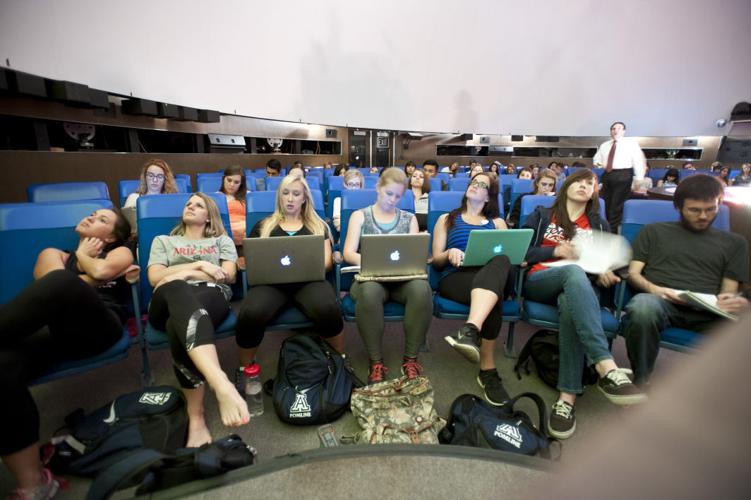
Astronomy is a very visual subject. Most of the students we teach in astronomy and planetary sciences are in general-education courses to fulfill their science requirement.
Many of them tend to be visual learners who process information in more concrete, rather than abstract (mathematical), terms.
My colleagues who teach at Flandrau Science Center and I feel that the planetarium’s new “full-dome” projector suits the learning styles of these students well. We can illustrate many astronomical concepts in three dimensions, allowing students to view from several vantage points.
But beyond the pedagogical reasons why the full-dome projector is an effective tool for teaching students, it also stimulates the “wow” factor.
The projection system allows us to employ the conceit of the “spaceship of the imagination,” which was used so effectively in the “Cosmos” television series by Carl Sagan and Neil deGrasse Tyson.
People are also reading…
My students travel all over the universe in our imaginary spaceship to explore and study the science of astronomy. By raising a student’s interest and excitement about a subject, we motivate students to pay attention and learn the course material.
I have seen an increase in student performance since moving my course to the planetarium theater. For example, the number of students earning a grade of “A” has increased by 20 percent compared with when my course was taught in a traditional classroom.
In August 2014, thanks to the generosity of Linda Lohse and the Tucson Foundations, the EOS Foundation and many other generous donors, the planetarium theater at Flandrau was upgraded to a full-dome, 4K digital projection system, which now puts you at the center of the universe with movie theater-quality sound and images.
The computer hardware/software and projectors, as well as the new sound system, was installed by the Swedish company SCISS AB, which installs full domes worldwide.
The computer servers literally contain a three-dimensional, digital model of our universe, based on actual astronomical, planetary and geologic/geographic observations and data. These images and other data can be projected onto a hemispherical dome to give the audience a panoramic, “surround-view” of the data.
The audience, immersed in the imagery, can view any part of the universe from any perspective at any time in its history.
The old analog planetarium projector, which was in service at Flandrau from 1975-2014, could display a view of the night sky from any place on Earth, at any time, on any date.
With the new full-dome projector, the audience can leave the Earth, look down at its surface, and fly out into space to explore our solar system, the Milky Way galaxy, other galaxies and the universe.
The impact of full-dome on Flandrau’s planetarium programs for the public is obvious.
We now provide the people of Tucson and Southern Arizona access to state-of-the-art planetarium programs that play in big-city markets such as New York and Chicago.
However, there are those of us at the Steward Observatory and the Lunar and Planetary Laboratory who recognize the power of full-dome technology and how it could enhance our teaching and research mission in the College of Science.
With an eye to procuring a full-dome projection system, we started teaching college-level astronomy, astrobiology and planetary science courses in the Flandrau planetarium theater 3½ years ago.
There were challenges in turning a planetarium theater into a classroom, such as students being able to take notes in the dark. Our courses could only meet in the afternoon, so as not to interfere with elementary and middle school field trips in the mornings or public shows at night.
The same qualities that make the full-dome projector a useful tool in education makes it useful in carrying out our research mission. Large datasets from telescopes, space missions and theoretical computer-generated models can be projected on the dome, allowing researchers to visualize the data, putting themselves “inside” the data, more effectively than they could on a two-dimensional computer monitor.


