

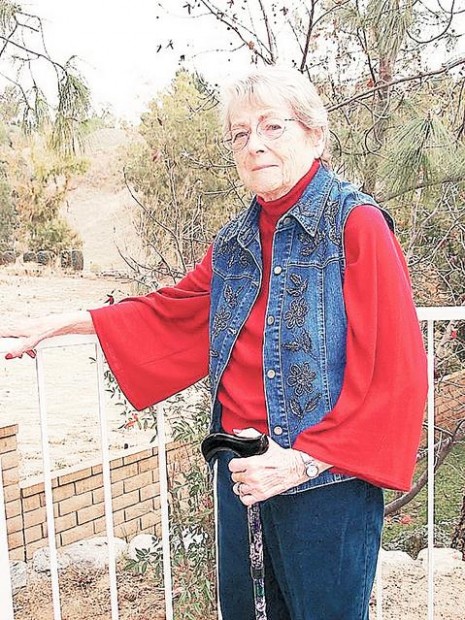
Gwen Lacy composed her first poem at age 2.
"The wind blew up. The wind blew out. The wind blew my hair about."
She couldn't write, read or spell at the time, but her knack for combining words into lyrical verse was already present — and it continued throughout her 78 years.
First her mother, an English teacher, recorded young Gwen's poems. Then, for many years, Lacy put pen to paper to craft her rhymes. Later, she tapped them out on a computer keyboard. When Parkinson's disease grabbed hold of Lacy, she had her keyboard modified to accommodate her shaking hands, and she wrote a poem she called "My Parkinson's Dance."
My Parkinson's Dance
My hands move involuntarily
To the rhythm of a Latin beat.
People are also reading…
They catch the pulse of a Samba
Or a Mambo's sizzling heat.
My arms do the Funky Chicken
My shoulders join right in.
My face, so it won't be left out
Plays a solo with my chin.
The rhythm of my body
Moves with a style of its own,
With an awkward grace it carries me
To the dance floor all alone.
My feet have their own ideas
As they shuffle across the floor
And dance me into a corner
I've never seen before.
I don't really need a partner
To do this mixed-up dance.
I move along with the music it plays
Without a backward glance.
It's my own body's rhythm,
I once danced to youth's demand.
Now I'll dance on down the road
To the beat of Parkinson's band.
Lacy's poems were inspired by personal experience, current events and unbridled whimsy.
The poetess wrote her last verse two months before her death on July 17 from the neurological disorder. It was called "Waiting."
Waiting
My computer doesn't write right.
My fingers won't type the words I choose,
My head won't think the way I'd choose
So guess I'll take a snooze.
How much time shall I allow?
Just 'til the cows come home?
Do I have that long to wait?
It's not for me to know.
Long enough to write a poem
Long enough for me to kiss my love
Long enough to hold my grandchild,
and the others that I choose.
Long enough to see a kite fly,
I'd love to see the war won.
To see the rain come down in rivulets
As in the past it used to come.
Snuggled close in the night
To seek the warmth of my black puppy
Not a bark and not a whisper
She doesn't even break the quiet
These things I have loved and laughed at
But these are only some …
Many more I hope to experience
I will wait until they come.
The end.
Lacy had written poetry her entire life, said her sister, Nancy Small. It was a talent she inherited from their parents.
"My mother would write poetry," she said. "But life was hard for my parents, and they had to think more about surviving than doing other things."
Lacy was the first of three children. Eight years later, her sister was born, followed by a brother, Jon Gepford. Their parents were schoolteachers in Oklahoma before they moved to California, where her father took a job as a carpenter and her mother worked in a school.
"She was kind of my surrogate mother during the Depression," Small said of her sister. "I came along, and she filled in when my mom and my dad were out doing what they could to help us survive."
Lacy enjoyed staying busy, her sister said, but she became a much more prolific writer after her 1989 Parkinson's diagnosis, which forced her to reduce her physical activity.
Lacy self-published two books about her family history, wrote a novel about a young girl growing up in Kentucky and was preparing to publish a collection of her poems, said Judi Hewes, one of her four children.
Lacy survived childhood poverty, sexual abuse, Parkinson's and financial setbacks in her later years. She and her husband, Merton, an orthodontist, retired to Arizona from California 19 years ago. The couple once lived in a home overlooking the Pacific Ocean but spent much of their retirement living in a mobile-home park after making some bad investments. Yet her mother never questioned fate, Hewes said.
"She said, 'Look at all the wonderful people I would have missed meeting if I hadn't lived here,' " Hewes said. "She always looked at the positive, but not in an unrealistic way. If she had a problem with someone, she would tell them and move on."
Jenny McBride, the pastor at Catalina Hills Fellowship, a Seventh-Day Adventist church on the Northwest Side started by Gwen and Merton Lacy and two other couples, admired the poet's upbeat outlook.
"Gwen was one who was very positive and always saw the good in everybody," McBride said. "She never got discouraged. No matter what the situation was, she put a positive face on it. I never saw her waver on that.
"I tend to see what's wrong with the world," McBride said. "She'd help me see what's right."
Lacy wrote "She'd Wish Us to Dance" for a cousin who died, but Hewes said the poem could just as easily apply to her mother.
She'd Wish Us to Dance
If there was a song to sing
She'd sing it ...
If she didn't know it
She'd wing it
If the sky held a star
And there was gas in the car
She'd dance.
When the sun came up
She met it
When it went down at night,
She 'set' it
As long as there's light or
Way into the night ...
She'd dance.
If Fate gave her a thorn
She'd exchange it.
If you'd wish for a star
She'd arrange it.
If we sit sad and gloomy
She'd shout "don't do this to me!"
"Let's Dance!"
On StarNet: Find a photo gallery of this Life Story at azstarnet.com/slideshows
Life Stories
This feature chronicles the lives of recently deceased Tucsonans. Some were well-known across the community. Others had an impact on a smaller sphere of friends, family and acquaintances. Many of these people led interesting — and sometimes extraordinary — lives with little or no fanfare. Now you'll hear their stories. Past "Life Stories" are online at go.azstarnet.com/lifestories

 Lake Mead's drops raise prospect of unaffordable Hoover Dam electricity


