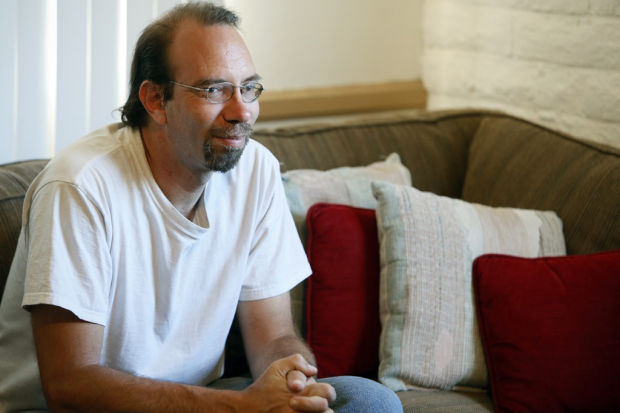
About a decade had passed since Mark Greiner got out of the Army. He worked with computers and software, and had been at his job for about five years when he was laid off.
Two months later he was evicted. He lived on the streets for a while and ended up on suicide watch at a hospital. After being released, he bounced from shelter to shelter.
One day he heard food was being given out at La Frontera, 1101 E. Broadway, and stopped by for a sandwich. While he sat alone with his lunch, he said, someone approached him.
“I’m kind of isolated. I don’t tend to approach people. To rely on people is not my forte,” Greiner said.
But this time, he ended up talking to Abel Moreno, the veterans-services administrator with La Frontera, a local social-services agency.
People are also reading…
“It moved pretty quickly from there.” Greiner said. “I got into Sonora House that same night.”
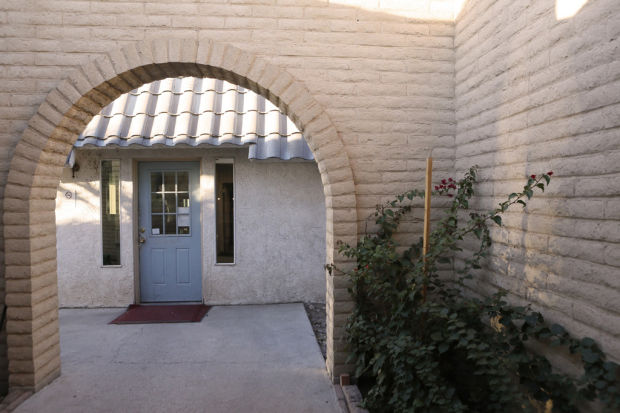
Sonora House is the housing facility of La Frontera, which, combined with the organization’s veterans initiative, Rally Point, has just launched the Bridge Gap Housing program.
The program keeps veterans like Greiner off the street while the staff works with them to figure out what kind of help they can get, and from where. Sometimes it’s just a matter of showing someone how.
“If they’re VA-eligible, we want to get them enrolled,” said Moreno, an Army veteran.
He said that in one case he helped a veteran who had been homeless for five years and never used VA services get into housing and sign up for assistance programs. “Within three months, he was housed independently,” Moreno said.
But when the Department of Veterans Affairs’ hands are tied, as in the case of a dishonorable discharge or inadequate time on active duty, like Greiner, the Bridge Gap staff has to get “creative.”
“This is a new program, and so we are learning a lot,” said Robert Kayser, a Navy and Army Reserve veteran and recovery facilitator with La Frontera, who works on Bridge Gap.
“There’s a lot of things we’ve never dealt with before. In Mark’s case, we needed to reach out to the community. There’s resources, but they’re limited, and it takes time.”
And it’s that time, when a homeless vet is suspended between the VA and whatever might come, that is the gap the program aims to bridge. If such people walk out the door, being able to find them when help is ready is very unlikely, said Kayser.
In the year or so since the program unofficially began, Laney Nunez, case manager for Sonora House and Rally Point, said 28 veterans had used the two-fold service— one part housing, one part what Moreno called “resource navigation.”
Of those, she said 16 have been discharged to independent-living situations, eight are still at Sonora House, and two are awaiting discharge. Four, however, “weren’t quite ready to make the transition.” Nunez said. “We had to make some really difficult decisions.”
That transition involves many steps, but the very first one can sometimes be too much to get past, Nunez said.
“Their first goal here is to adapt to living inside,” she said. “To move from the streets to an inside setting can be overwhelming. But rushing these folks is probably the worst thing you could do for them.”
Kayser agreed.
He said adapting to the conditions of homelessness often means abandoning normal social behaviors and thinking only of yourself and what you need to survive. One of the key features of Sonora House, they said, is that there is no limit on how long a person can stay there.
It’s also not required to show up sober, or to stay sober the whole time to keep a spot one of the 15 beds (10 for men, 5 for women).
Laney said the facility is Pima County’s only “damp-wet” shelter, and one of only two in Arizona. This means a person can’t drink or do drugs on property, but if they show up intoxicated, they won’t get kicked out.
“Here, we’re going to ask you to go to your room and sleep it off. If you’re able to do that, then tomorrow’s a new day,” Nunez said.
Staying at Sonora House means getting help from Nunez and the Rally Point navigators, Moreno and Kayser, to any services they can find, such as treatment for substance use and for mental-health issues, access to health-care providers and education programs.
“So many people walk through my door with absolutely nothing. So my job is to coordinate and get them hooked up with any and everything they’re eligible for.” Nunez said. “We look under every rock.”
Since La Frontera doesn’t receive VA funds, its programs are not tied to VA eligibility requirements. In fact, the majority of their clients are sent by the VA when there’s nothing it can offer.
In Greiner’s case, the “Three Musketeers” as Nunez calls herself, Moreno and Kayser, are working on getting him on the Arizona Health Care Cost Containment System, looking into school and of course, getting his own place.
“I don’t think he realizes the great skills that he has.” Nunez said, remembering the day — and the date — Greiner arrived at Sonora House. “He’s made leaps and bounds from Aug. 6 to Nov. 7.”
“A lot of it is me learning how to deal with people and crowds,” said Greiner. ” I’m opening up a little bit, I’m not as isolated.
“It’s a battle within myself that I’m fighting every day. Some days, it’s really tough to tell who’s winning. If it wasn’t for La Frontera and Laney and Kayser, I’d probably be out on the street.”


 Second wall planned across Arizona as Trump administration doubles down on border