

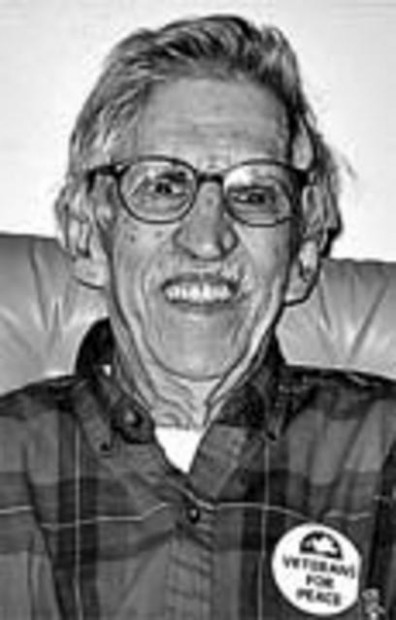
Gerald "Jerry" Robinett always thought there was more he could do.
More letters he could write about social injustice. More picket lines he could join in support of farmworkers. More love and compassion he could bestow on the homeless he served at Casa Maria soup kitchen.
He once even tried to give his house away to his friend, United Farm Workers leader César Chávez. But his wife, Ellie, put the kibosh on that plan.
"César stayed overnight at his home when he was in town," said Nancy Gallen, who met Robinett in 1972, when she came to Tucson on behalf of the UFW. "Jerry was an idealist and dreamer, and Ellie was very much down-to-earth. At one point Jerry said he wanted to give their house to the farmworkers, and Ellie said, 'Jerry, we have five kids. We're not giving our house to the farmworkers.' It took César to tell Jerry, 'No, we don't need your house. I won't take your house.' "
People are also reading…
Even two days before Robinett died in his sleep at 87, the longtime member of the Catholic Worker Movement was writing letters of gratitude to those who had donated to Casa Maria.
"He had his worries that he wasn't giving enough, wasn't compassionate enough," said one of his five children, Joe Robinett. "He was a very humble guy."
Robinett's compassion was inherent, but his approach to community outreach is something he formed over time.
He was born in Chicago in 1920, and it was in the Windy City that the World War II Army aircraft mechanic met and married his wife, Eleanor. The couple had their first three sons while living in Illinois, and it was there the free-thinking Robinett's activism began to develop, said the couple's only daughter, Mary Sanchez. In 1949 a friend took him to a meeting at Friendship House, an organization that started as a missionary movement to promote interracial justice.
"That really got him thinking about social issues," Sanchez said. "It really didn't radicalize him at that time, but he really started to recognize there was an injustice in equality in the way people were treated."
In 1954 the family moved to Tucson, hoping the change of climate would help with Ellie's health problems. Robinett got a job as an electrician at a copper mine near Sahuarita, and in his free time he wrote letters voicing his beliefs to the editors of newspapers and magazines; Amnesty International and other human-rights organizations; and death-row prisoners.
"He was absolutely against the death penalty," Gallen said. "It really didn't make a difference to Jerry whether they were guilty or innocent. He just wanted to console them."
Robinett became "really radicalized" in the mid-1960s, said his daughter, after he read about Chávez and the farmworkers movement. He wrote a letter to Chávez asking permission to start the Friends of Farm Workers support group in Tucson. That led to peace marches on behalf of farmworkers and picketing at local grocery stores that were selling grapes and lettuce during the farmworkers' boycott.
When Gallen was sent to Tucson by the UFW in the early '70s, "I was told on my first night in Tucson I should meet the two best supporters of the farmworkers. That night we went to see Jerry and Ellie."
Ellie would make telephone calls and organize the picketers, Gallen said, and, "Jerry worked at the mines all day and would come out to picket after work. They were saints."
Sanchez recalls Chávez and 30 or so UFW organizers bedding down at the Robinett home.
"I can remember Mom was cooking up a storm to feed everybody. I was only in high school at the time, and I didn't realize the real significance of that until later," she said.
When Casa Maria was established in 1981, Robinett pitched in to help feed, clothe, house and find employment for those in need.
Brian Flagg, who now runs Casa Maria, met Robinett in 1983.
"I've known Jerry since the first day I got off the bus in Tucson with my backpack on," and turned up at Casa Maria, Flagg said.
"He was the most spiritual and non-violent and gentle guy I've ever met, and at the same time he was really, really, really firm in his beliefs. He lived out his beliefs to the nth degree. He was real humble and unassuming and it spoke volumes to people."
Robinett also wrote volumes to people. Whenever any of Casa Maria's 4,000 or so supporters made a donation, it likely was Robinett who replied with a handwritten thank-you note. He and his wife, who died in 1999, were honored last year during the 25th anniversary celebration of Casa Maria by having a house for low-income workers named in their honor.
"Jerry influenced an incredible number of people that he never knew," Flagg said.
Becky Boyed Miller is one of those people affected by Robinett's compassion. Her late father, James Boyed, got to know Robinett when they were co-workers at the copper mine.
"Mr. Robinett was very humble about his work behind the scenes that he did for people who were impoverished," Miller said. "My dad was really was touched by Mr. Robinett."
During Christmastime, Miller's parents took food baskets to Casa Maria, and Miller remembers Robinett's huge smile when her family arrived with their donations. Now living in California, she continues the tradition with her own children.
"He probably never even knew that his presence during the holidays would be so impressionable on me that I now make sure my family does the same thing," she said.
Robinett made an impression on his longtime neighbor and co-worker, Allan Bazar, too.
"He cared about the poor, the homeless, the hungry and was not only an advocate for them but active in helping them. He was a good man," Bazar said.
Those who attended Robinett's memorial service earlier this week spoke of the union man and pacifist's zeal for justice and equality. But, said his daughter, her father was a realist.
"He was an idealist, but he wasn't naive. He realized to make social change it takes time; it doesn't happen overnight. It's something you have to work at," she said.
Life Stories
This feature chronicles the lives of recently deceased Tucsonans. Some were well-known across the community. Others had an impact on a smaller sphere of friends, family and acquaintances. Many of these people led interesting — and sometimes extraordinary — lives with little or no fanfare. Now you'll hear their stories. Past "Life Stories" are online at go.azstarnet.com/lifestories

 Faculty concerned about changes to U of A admissions policy


