

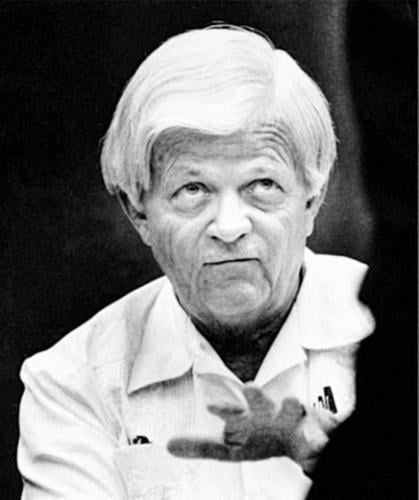
Former Tucson Mayor and longtime Superior Court Clerk Jim Corbett — a member of a prominent, pioneer Tucson family and an always colorful character — died Saturday morning of heart-related problems. He was 82.
Corbett, a Democrat who dedicated several decades of his life to serving residents through his wide-ranging political career, died in a hospice, said Bill Sheldon, a long-time friend speaking on behalf of the family.
His health had been declining for the last couple of years before he went in to hospice care Thursday, Sheldon said.
Corbett, whose great-uncle J. Knox Corbett had also served as a Tucson mayor, was mayor from 1967 to 1971, and began his 20-year-career as the elected clerk of the court in 1979.
Corbett served as a Coast Guard officer from 1942 to 1946. He was also a member of the Arizona House of Representatives from 1956 to 1958, then the Tucson City Council from 1963 to 1967, Sheldon said.
People are also reading…
"He was somewhat of a legend in political circles," Sheldon said. "To my knowledge, he was one of the few in the state who served in all three branches of government."
Former City Manager Joel D. Valdez, who worked in the library system when Corbett was mayor and is now a vice president at the University of Arizona, remembers, "Jim was an honorable individual. He was a very colorful mayor, but he was a tough cookie. He told it like it was and was not afraid to take on the big boys.
"He advocated for the poor people in the city and wanted to annex the whole valley. It was a joy watching him work."
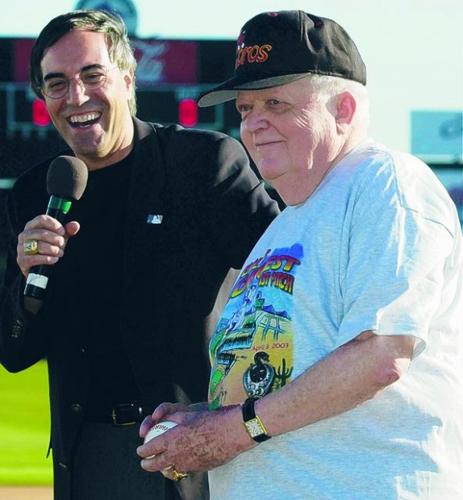
Corbett was instrumental in bringing the Toros baseball franchise to Tucson, where Hi Corbett Field is named for his uncle.
He was active in obtaining urban renewal funds and in the Model Cities program.
But he was perhaps best known for his feisty personality, saucy quotes and one sensational incident while he was on city business in the nation's capital. Here's how an Arizona Daily Star clip summarizes his stormy term as mayor, before Republican Lew Murphy ousted him:
"For a time he had stationed a police officer in his office to shoo off reporters. He said he had licked his drinking problem, and continued to deny the allegations in Jack Anderson's syndicated column about him biting a woman on the leg at a League of Cities convention in Washington, D.C."
When reporters called during those years, it amused him to look at the clock, pronounce, "It's 4:12 p.m. Never let it be said I didn't give you the time of day," and hang up.
After he retired from the courthouse, where he had loyal employees, Corbett spent his time with friends and family. He enjoyed sports, particularly baseball, and stamp collecting.
Until he died he served on a board for an organization that raised funds and provided programs for handicapped children, Sheldon said.
"Jim had a deep feeling for our community and the welfare of its citizens," he said. "He should be remembered for his colorful personality, his leadership and the contributions he made to this community."
Services will be private, his family said. He is survived by his wife, Jeanne; his brother, John Corbett of El Paso; four children; six grandchildren; and nine great-grandchildren.
Obituary
DID YOU KNOW ...
The home of J. Knox Corbett, who was Jim Corbett's great-grandfather, is marking its 100th anniversary this weekend.
The home at 179 N. Main Ave. has been open to the public since Nov. 24, 1996, after it received a $200,000 restoration.
Docent-led tours and other anniversary events will be held there today from 1 to 3 p.m., at no charge to the public.
The 4,400-square-foot home, with Spanish and Victorian influences, was restored and decorated by the Tucson Museum of Art to stand as a local model for the Arts and Crafts movement of the early 20th century.
J. Knox Corbett was a lumber and hardware dealer who also served as Tucson's postmaster for 23 years and was mayor from 1914 to 1917. Other members of the family who lived in the home included Hiram "Hi" Corbett, Jim Corbett's uncle, for whom the baseball field at Reid Park is named.
The home is in Downtown's Snob Hollow, where Tucson's elite built their mansions around the turn of the last century.
— Source: Star archives


 U of A acceptance rate rises to 90% as applications plunge


