
David Blair's plan to build nine townhouses and four duplex units on an inner-city lot hard by the railroad tracks was nearly derailed before his plans were drawn.
The city of Tucson, which had just professed a desire to speed and ease development in the area where Blair hoped to build, wanted him to first make about $50,000 worth of upgrades to an artist-filled warehouse he did not own and had no intention of ever owning, before it would allow the lot split that would create his project's building site.
Blair decided to test the city's commitment by writing letters about his plight to Councilman José Ibarra, whose ward includes the Dunbar-Spring Neighborhood where Blair wants to build, and to city Development Services Director Ernie Duarte. Duarte's department was demanding that Blair fireproof the warehouse and bring it up to residential code before granting his lot split.
People are also reading…
Duarte got back to Blair first, suggesting a slight adjustment in the lot line to solve the problem.
The project is back on, for now.
Blair's project wouldn't usually make the news. He's not developing 100 luxury lofts or proposing some New Urban mixed-use streetscape, but Blair is, in some ways, the typical Tucson infill developer. He doesn't wear a suit, and he doesn't have deep pockets.
He has progressed from building a rental guest house behind his home in Midtown to building three duplexes behind a supermarket on the north side of town, where he now lives in one of six rental units. His current project is the largest thing he's tackled, and the notion of borrowing $2 million to complete it is a bit daunting.
Blair doesn't have a PR firm to sell his plan to the neighborhood, and he can't hire a consultant to ramrod his plans through the city bureaucracy.
He does those chores himself, and he's learning as he goes along.
Dealing with development services — the agency charged with making builders comply with the city's zoning, building and land-use codes — is frustrating if not baffling at times, Blair said, though he is quick to add that the people who work there are very nice.
Architect Frank Mascia, who has been building infill projects in Tucson since 1972, said the problem is not the personnel but the code itself. Once, when he was chairman of the city's Board of Adjustment, he had it memorized. Now it is 500 pages long, and many of its sections contradict each other, Mascia said.
The city has tried to simplify things inside its Downtown Area Infill Incentive District. It drew a line around Downtown and extended it up the transportation corridors it considers gateways to the area. It is offering to speed approval of plans, handle variances to the code administratively and reduce or waive some city fees in an effort to lure residential development.
Blair's development is inside the boundaries. It sounds good, he said, but he remains skeptical. "It's that free cookie thing," he said — you don't know what it will cost in time and money.
The infill incentive district also requires consultation with the neighborhood. Blair doesn't think he'll need neighborhood approval. He has the zoning and the land for what he's doing, but he asked for time Monday before the Dunbar-Spring Neighborhood Association to outline his plans.
He knew the saga of One West, which has been trying for 18 months to win approval for its mixed-use project. The project's progress is currently stalemated by the neighborhood's inability to reach consensus on requiring affordable housing.
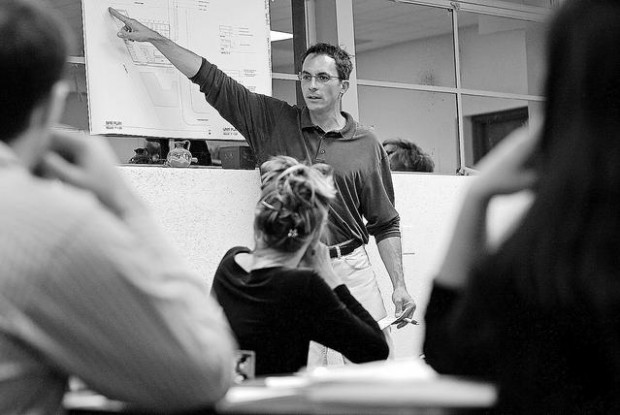
Blair and his partner, land owner Janelle Curry, met with Dunbar-Spring on Monday and fielded questions about building materials and design.
He took notes when neighbor Brad Lancaster asked if he would consider tying in to a planned neighborhood bikeway. "This is exactly the reason we came here tonight," said Blair.
Nobody asked about affordable housing.
On his last project, Blair said, he secured the blessing of the neighborhood association, then argued with his closest neighbors about building heights. "All three gave me hell. I'm 50 feet away from the houses. I'm totally legal. I planted a few trees."
Blair said he likes the challenge of building in town. "I know why builders go out to the edge. It is much easier. You have land and you just plop it in there. This brings more challenges, and a better chance of failure. But the infrastructure is already here. It will improve the community."
And each project, he said, brings him closer to his goal of owning a small boutique hotel and brew pub. Somewhere Downtown, of course.
The neighbors: Everything looks different at ground zero, where even the best-planned development is an unwelcome intruder in your backyard.
Mixing it up: Proposals for mixed-use development in Tucson have split neighborhoods. (If you missed those stories, find them at www.azstarnet.com).
The risk-takers: Not all developers wear suits or have deep pockets.
The rule-makers: Promoting development while pleasing neighbors is a difficult if not impossible task.
● The director of the city's Development Services Department has a job that a juggler might envy. Page A7

 U of A president declines to sign shared governance contract with faculty