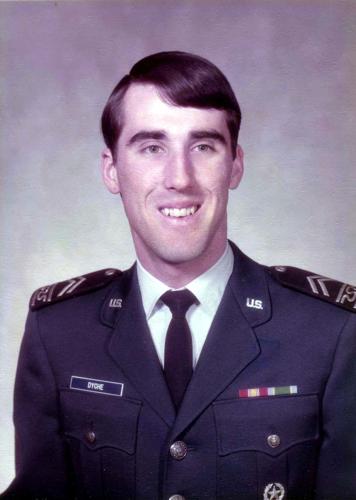

USAFA Cadet David Dyche
Watching the TV coverage of the moon landing and later actually seeing Neil Armstrong first step out onto the lunar surface are memories that are vividly etched into my mind. The events of July 20th, 1969, stood as the pinnacle of America’s space program which had come so far in the less than a decade. While I was only 17-years old at the time, I had grown up with the space program as a guiding light for what I wanted to do when I "grew up." My mom had allowed me to stay home from school for every manned space launch (early "space sickness") because I was so interested in space.
My step-father was an Air Force "rocket scientist" and one of his close friends was Gordon Cooper, one of the original Mercury 7 astronauts. Cooper had visited our home several times, including one stay not long after his first space mission, Faith 7, in 1963. I was in seventh grade when he come to our home I was simply in awe. Here was a true hero sitting right next to me and talking about his space capsule and all the cool things he did during his 22 orbits! When I went back to school, I was a celebrity because I had actually been with a real astronaut. That’s how revered those first space pioneers were to America.
People are also reading…
Now flash forward to the summer of 1969. I graduated from high school in June and, after a too-short vacation, I was off to the US Air Force Academy in Colorado to join the cadet wing and begin my intended journey to space. Now summer Basic Cadet Training or "BCT" (aka “Beast” for good reason) was quite rigorous and we had very few luxuries during the summer. No TV, no radio, and only one phone call home per week. But on Sunday, July 20th, all of the 1,400 or so freshman cadets (“Doolies”) were put into small groups and sent to the homes of Academy staff members (often professors), to finally relax and enjoy a home cooked meal, as well as watch TV for the first time all summer. It was there I witnessed history as Apollo 11’s lunar module, Eagle, touched down in the Sea of Tranquility. We all held our collective breath listening to the Eagle’s radio transmissions during the descent and then erupted in joyous cheers after hearing Neil Armstrong’s famous words; “Houston, Tranquility Base, the Eagle has landed.”
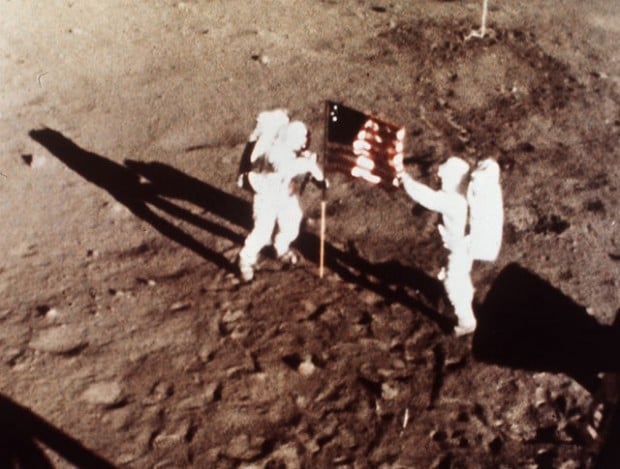
Some 6 hours later, we were back in the cadet dormitory and again subject to the rigors of basic training. But about 8 p.m. that evening, the 100 or so of us in our basic training squadron were ordered out of our rooms and ushered to an assembly room where a single black and white TV beamed the network feed to us. Over the next hour, we watched in rapt amazement as Neil Armstrong finally stepped out of Eagle and on to the lunar surface where he uttered his immortal statement; "that's one small step for a man, one giant leap for mankind." America, indeed mankind, had arrived on the moon.
That was the only time I ever watched TV that summer but I’ve always felt so blessed that I was able to watch such an historic event along with over 600 million other people. And while I never did become an astronaut myself, I did become a pilot. During my career I flew to over 50 foreign countries and lived in four of them, married a wonderful Tucson woman with whom I raised a great family, and served 30 years in our Air Force, retiring in 2005 as the Professor of Aerospace Studies here in Tucson at the University of Arizona. So, I’m very content with my life and career but I also know we owe so much to our nation’s space program, especially to the many brave astronauts, past and present. The scientific and economic gains have brought countless advances to all our lives. I can only hope we continue to explore and discover, not just in Earth orbit, or even by returning to the moon, but in going to Mars and someday well beyond. But no matter were we as humans go, I will always remember that warm July evening in 1969 when I watched a ‘small step’ and ‘giant leap’ simultaneously. None of our lives will ever be the same again.
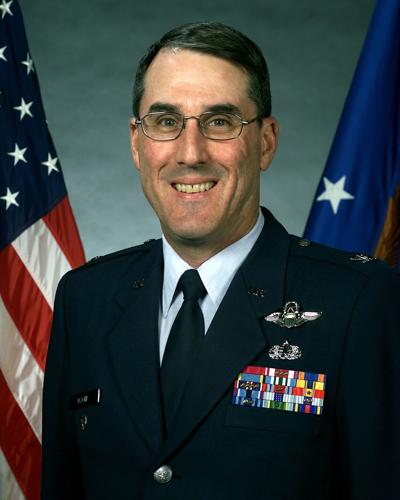
David D. Dyche, Col, USAF (Ret)



 Tucson official: Air Force won't pay for D-M groundwater cleanup now