
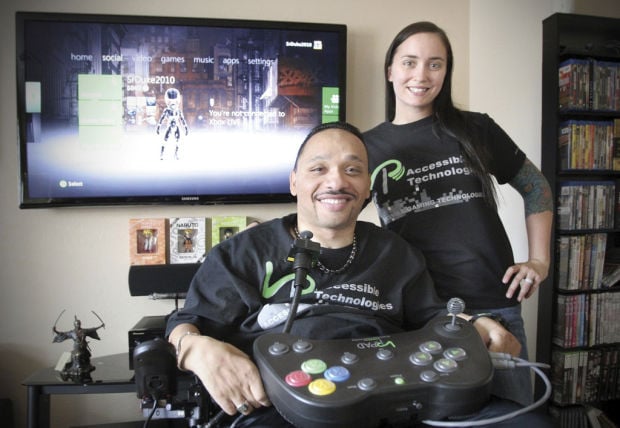
A former U.S. Border Patrol agent in Casa Grande has created and patented a video game controller for people with severe spinal cord injuries.
Luis Peña formed LP Accessible Technologies and created the controller out of necessity. He was injured on the job in 2007 and is a quadriplegic.
His company focuses on building video game controllers that disabled people can use.
A longtime video game buff, Peña missed playing games after he recovered from the accident.
The result is the LP Pad, which Peña says is just like an Xbox remote control except for its size. It operates like a regular remote through Bluetooth technology and is fully compatible with the Xbox 360 gaming system.
It weighs less than a pound and is made specifically to sit on the user's lap. The controller features large buttons that are activated simply by brushing a hand across them.
People are also reading…
"People who are like me can only push with like 3 or 4 pounds of pressure," Peña said.
Or, users can plug a "chin stick" into the LP Pad, and they're ready to play any video game made for the Xbox.
Peña said he is working hard to get the controller available for use on PS3 gaming systems and hopes to have one developed within a year.
For now, he is taking his controller all over the country to show people with disabilities how they can again enjoy playing video games.
"I'm hoping eventually we can get a licensing agreement from Microsoft so we can sell these game controllers at a lower cost at Best Buy, GameStop, Wal-Mart, anywhere," Peña said.
Peña's controllers sell for $399.99. The controller can be purchased at www.lpaccessibletechnologies.com.
On Oct. 18, 2007, Peña reported to work at the Border Patrol station in Casa Grande and was en route to back up another agent in the desert - but he never made it there.
His vehicle rolled over as he crossed the Tohono O'odham Nation.
"I was driving on a straightaway - you could see skid marks go right and come back left and then I rolled over," Peña said. "The assumption is that perhaps cattle or horses got in the way, and that's what made me roll over. We'll never know for sure."
Peña woke up a month later at University Medical Center in Tucson and was told he was paralyzed from the chest down. Doctors immediately sedated him after he woke up.
"Knowing what my body looked like before - when I woke up and looked at my arms and saw the atrophy, I really freaked out," he said. "It's one of those things that because of my training in martial arts and so many people coming to help me out, I just was able to say 'OK, this is what it is, and it's time to move on to a new chapter in my life.' "
Peña was officially retired from the Border Patrol in 2012. Before his accident, Peña was active in martial arts, a fourth-degree black belt in four different styles and also fought in mixed martial arts.
His caregiver and best friend, Kaylin Winkelmann, is also Peña's business partner in LP Accessible Technologies.
"It's hard not to get excited, and at the same time we're nervous because we spent so much time and money just trying to get the prototype pad working correctly," he said. Peña and Winkelmann travel to hospitals, rehabilitation centers, trade shows and conventions to demonstrate the controller.
"Everybody that has used it absolutely falls in love with it," he said. "There is nothing out there at all for people like us."

 U of A president declines to sign shared governance contract with faculty