This is the second in an occasional series on David Tineo, noted Tucson muralist, who is losing his sight.
David Tineo's compadres give him a lot of support in his battle with blindness, but their banter is lovingly brutal.
"How many fingers am I holding up?" asks Jesús Gomez as Tineo walks into The Cup Cafe at Hotel Congress.
It's become a running gag with this group of men, mostly educators, who have been meeting for breakfast for years. They have a theory: Tineo, Tucson's most prolific muralist, is not going blind; he made up the story to sell his paintings.
At times, when he spots a dime on the sidewalk or announces that a friend has just pulled into the parking lot outside the cafe, it seems Tineo sees more than he lets on.
It's a peculiar, but not uncommon, phenomenon for those with reduced vision who, like Tineo, qualify as legally blind.
People are also reading…
His central vision is gone and his peripheral vision has weakened, but he can still make out "images, contrasts, colors," said Dr. Richard Ober.
His brain receives those images, collected by photoreceptors in the eyes and relayed through the optic nerve, and pairs those visual hints with memory to assemble a facsimile of vision.
Proper lighting also makes a big difference, something Tineo has learned over time and saw even more clearly last month in a visit to Alvernon Optical.
An "ah-hah moment," sort of
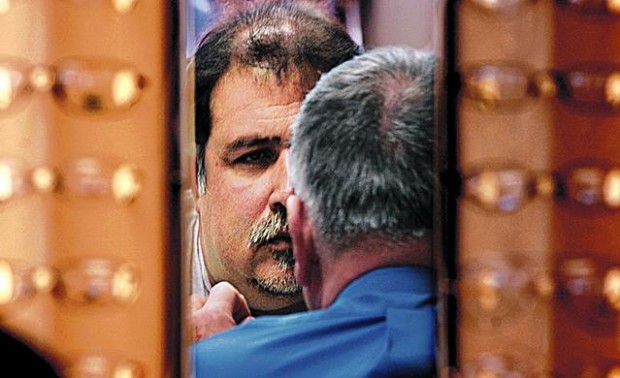
Slipping on a pair of orange-tinted lenses, Tineo has an "ah-hah moment," though what he actually says isn't "ah-hah."
Gary Scheer, president and owner of Alvernon Optical, has just clipped a pair of deep orange Corning lenses to an eyeglass frame. Tineo, looking through them, can read the advertisements across the room.
His vision has been neither cured nor corrected.
The glasses simply filter out some of the light that has been causing confusion in the picture Tineo's brain composes from information received by the photoreceptors on his damaged retina. Most of the damage is in the macula, the sweet spot at the center, which is responsible for straight-ahead vision, color and clarity.
Scheer, who is neither an ophthalmologist nor an optometrist, has made a special study of the effects of these lenses because his brother-in-law and two nephews have vision problems similar to Tineo's macular degeneration.
When Scheer, who owns a chain of optical stores, read Tineo's story, he called to offer his expertise, checking first with Dr. Ober.
Scheer takes Tineo outside where the sun of a cloudless day glints off cars in the parking lot.
It's the most difficult time of day for Tineo, but now he has traded his "Family Dollar store" shades for a pair of Scheer's high-end polarized sunglasses with side panels and a tight fit that eliminates glare. Tineo can see the curb and gauge the drop down to the pavement. "I can see the stones and the gravel," he says.
Tineo had been limiting his walking and his painting to early mornings since the symptoms of his eye disease asserted themselves last spring. He enjoyed the rare, cloudy day in Tucson. The difference made by good sunglasses is a revelation.
He re-enters Scheer's office, switches to the orange lenses and notices the three young women working inside.
"When I walked in, you were all gorgeous," he says. "Now, I can be picky."
It's a variation of a joke he's been telling on himself for nearly a year. One of the benefits of near blindness, he says, is that all women are beautiful.
He scans the room again. "Nah, you're all gorgeous," he concludes.
Staying healthy
Back at The Cup, Gomez grills Tineo about a painting Tineo had promised him. He wants it now, Gomez says, especially since he heard Tineo also has cancer.
He doesn't. During a recent physical exam, Tineo's doctor found his prostate enlarged — not a huge surprise for a 50-year-old-man. The doctor ordered blood tests, but Tineo hasn't gotten the results yet.
Gomez and Tom Castillo, a former Tucson Unified School District board member, then warn Tineo about drinking the healing teas offered him by former TUSD administrator Ralph Lim, part of the breakfast group. Lim has a large collection of Tineo's paintings, he notes. "They'd be worth more if you're dead."
Tineo has been trying to eat better and drink less coffee and alcohol, in addition to seeking out homeopathic remedies for his vision loss.
He walks daily and has enrolled in a fitness program at a Downtown gym, seeking to shed the pounds he has packed on since his days as a cross-country runner at Cholla High School and his three-year stint in the Army.
At times, Tineo is convinced that his blindness is curable with healthy living, that it is related to elevated blood pressure, or the diabetes that runs in his mother's family, though previous blood tests found no evidence of diabetes.
The more thorough examination he is currently getting from the VA should settle those questions, though Dr. Ober has already told him that the loss of vision he has experienced is not reversible with current medical technology, and he can't guarantee that it has stopped.
Public acclaim, private pain
Tineo rides a roller coaster of hope and despair. He's always upbeat in public, but the pressure of that has worn him out a few times lately.
After his story was published in the Sunday paper on Jan. 22, his cell phone rang until it burned up his minutes. He was offered painting jobs and exhibit space.
But Tineo needs to control the lighting when he works, and can't take on outside jobs.
He didn't have a huge inventory of paintings, so he worked early and late to produce more, and asked friends and family members who had collected his works to loan or give them to two shows at La Sirena and Raices Taller galleries.
By Wednesday of that week he was exhausted. But he showed up smiling and gracious at the art openings.
La Sirena Gallery owner Sherry Teachnor sold 11 of his paintings, some of which she had bought years ago and donated back to him.
"They've been in show after show," she said.
Tineo had similar success at Raices Taller, 222 E. Sixth St., where he is a member of the cooperative gallery. He donated $400 from that show to establish a fund for artists who can't afford the membership fees.
And then, for two weeks, Tineo stopped painting.
The children inspire
On Feb. 16, he visited Booth-Fickett Magnet School as part of TUSD's Love of Reading Week. Booth-Fickett has two of his murals: one painted by him and another by grade-school students and his mural class from Pima Community College, where he taught until his vision became too dim.
Tineo had already begun a painting by then and he was inspired to begin another.
"The kids really motivated me. I've been working with kids all my life, and that really got me going."
The children had peppered Tineo with questions — about art and about his struggles with decreasing vision.
He told them they were fortunate. He told them he felt fortunate to have enough vision left to paint and he'd still feel fortunate if it all went away.
"The thing I miss most," he said, "is reading."
And he told them of his dream. More than a decade ago, Tineo proposed a huge mural for the United Nations building in New York, painted by two children from every member nation. The current refinement is a huge computer screen, on which the art could be displayed and updated.
"I will need your help on this," he told the sixth-graders. "I need you to be my eyes."
On StarNet: Find the first installment in this series of articles at www.azstarnet.com/specialreports

 Faculty concerned about changes to U of A admissions policy