
Editor’s note: This is the second of two stories exploring mercury mining in Arizona.
Known as quicksilver because it is a silver liquid, mercury or Hg on the periodic table is derived from the Latin term hydrargyrum, meaning “watery silver.”
When heated, cinnabar — also known as HgS or mercury sulphide, an important ore of mercury — releases mercury as a vapor that when cooled and captured is liquid mercury.
Commonly associated with rocks of volcanic origin, mercury use dates back over 3,500 years ago found in vials inside Egyptian tombs and as cinnabar in the silver mines in Greece. The world’s greatest mercury deposits are found in Almadén, Spain, with over 250,000 metric tons of mercury produced over the past 2,000 years.
While mercuric chloride — also known as calomel — is a mercury compound that once had medicinal value for teething among babies, a purgative, and beauty creams, its toxicity readily absorbed by the skin has been known to adversely affect the nervous system, causing kidney damage and death.
People are also reading…
The phrase “mad as a hatter” was derived from the effects of mercury nitrate used to treat the felt and fur that lined hats on hat makers whose exposure culminated in their erratic personality traits.
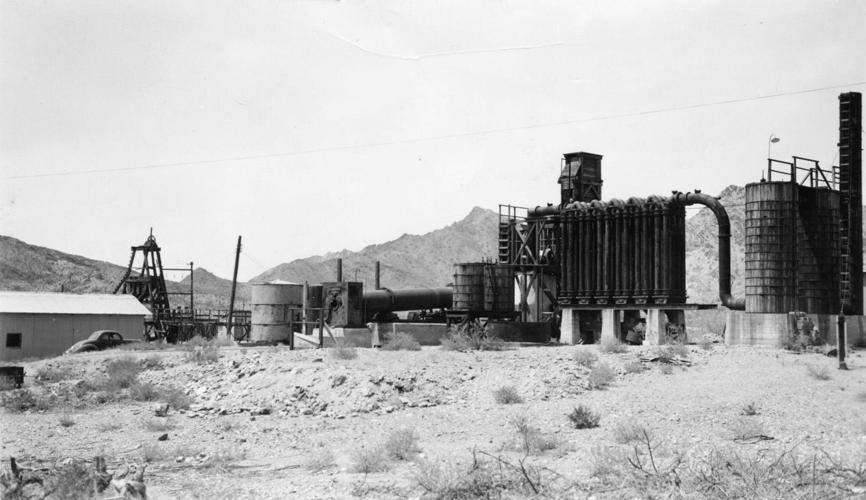
Mercury mining in Arizona is well documented with mercury used in the manufacture of fulminate of mercury, an explosive found in caps that set off heavier explosive charges of dynamite. Up until 1927, the Dome Rock Mountains near Quartzite yielded the largest share of mercury in Arizona. Discovered in 1875, several hundred flasks of mercury were produced from mines in the Dome Rock Mountains by 1914.
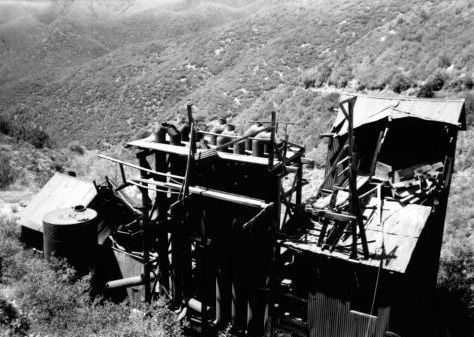
The Mazatzal Mountains district hosts 95 percent of the mercury recovered in Arizona, including the Pine Mountain Mine, Sunflower Mine and the Rattlesnake Mine — with the average production of 1,000 flasks apiece.
Wesley Goswick located the Ord Mine on the eastern slopes of the Mazatzal Mountains, about 60 miles northeast of Phoenix, in 1925. It was soon optioned by the Mercury Mines of America Co. and Uranium Enterprises, Inc. Activity lasted through 1955, with 2,100 flasks of quicksilver produced.
Mercury and copper deposits were discovered by L.L. Brunson on the east slope of Squaw Peak in the Phoenix Mountains in 1916, an area dominated by agricultural and residential interests.
A collection of claims followed known as the Rico, Mercury and Constellation Groups with the Rico the most actively mined.
The Rico Mine, a small-time mercury mining operation, began in 1916 when Sam Hughes, a Phoenix miner, discovered cinnabar deposits nearby the present location of Northern Avenue and Arizona 51 at the Dreamy Draw Recreation Area. That resulted in the establishment of the Rico mercury mine.
Production figures are small and it remains uncertain whether Hughes profited off his investment, operated by Texas investors through 1933.
The remains of the mine — including the visible furnace piers, cabin foundation and dump site — were paved over in 1991 for the Piestewa Freeway, known today as Arizona 51.
The mine is credited with having named the nearby Mercury Mine Elementary School. A buried mine shaft lies below the school’s softball backstop.
Total production of mercury from the Phoenix Mountains consisted of 65 flasks, an equivalent of 4,973 pounds of mercury mined.
Mercury mining in the area declined in the 1940s as it did over the next fifty years in the United States due to market price and health concerns.
Although the closure of the McDermitt Mine, in Humboldt County, Nevada, in 1992 resulted in mercury no longer a principal mineral commodity in the United States, mercury continues to be recovered as a byproduct from several gold-silver ore processing mining operations in Nevada.
Archivist, historian and author William Ascarza’s forthcoming book is “In Search of Fortunes: A Look at the History of Arizona Mining.” For more information, contact M.T. Publishing Co. at 1-812-468-8022 or go to goo.gl/FS545A online.