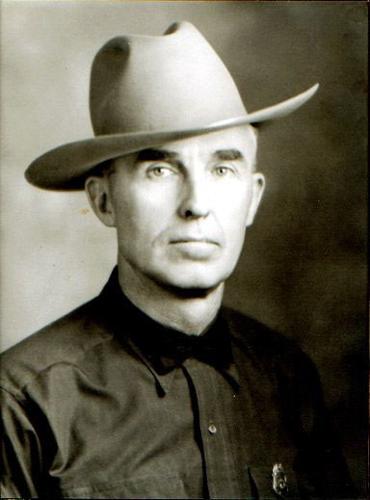
Fred W. Croxen was born Oct. 17, 1887, to Charles C. Croxen, a farmer in Atalissa, Iowa, and Anna (Moore) Croxen a housewife and former teacher.
Croxen hated farm work and, after graduating from high school, decided to go west. His mother, who had been born in 1864, had vivid memories of the news of the Battle of Little Bighorn] (aka Custer’s Last Stand) and believed the West was wild and untamed. She wanted to keep her son at home, but he was determined.
He left his family’s farm and found work on a ranch in Wyoming, then moved on to Tonopah, Nev., where he sold newspaper subscriptions for a paper put out by his cousin.
He moved to Flagstaff in 1909 and two years later began his career as a forest ranger. He worked at the Coconino and Tonto National Forests until February 1930, with some time off from May 1916 to March 1917. As a ranger he fought fires, surveyed homesteads within the boundaries of the national forests and managed the sale of cordwood.
People are also reading…
During his time as a forest ranger, in the winter of 1915-16, U.S. Marshal Joe Dillon deputized him. From Flagstaff, Dillon and Croxen traveled over five feet of snow, in a horse-driven bobsled before switching to a Model T Ford, to Tuba City on the Navajo Indian Reservation to guard against a potential Indian uprising. It never took place after police killed renegade Taddi Tin.
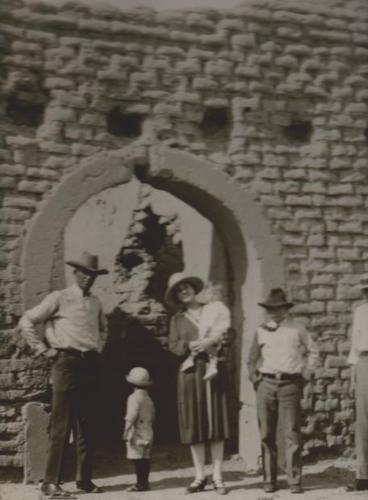
In 1916, after about four or five years of dating, Croxen married Edith Lamport in her parents’ house at Flagstaff. She had been born in 1892 in Flagstaff and had graduated from Northern Arizona Teachers College (now Northern Arizona University) in 1914. She taught for seven years in Arizona before having the couple’s two children, Charles L. Croxen, in 1924, and Fred W. Croxen Jr., in 1926.
From 1930 to 1936, Croxen was employed by the U.S. Border Patrol, stationed out of Hereford and Nogales. He chose to patrol the borderlands on horseback rather than by automobile, and his main duties were capturing smugglers attempting to bring alcohol into the country during the years of Prohibition and looking for people crossing the border illegally.
In the early 1930s, with anti-Chinese sentiment strong in Mexico, the states of Sonora and Sinaloa carried out mass expulsions of Chinese men and their families, including some who were born in Mexico. Some of the families crossed into the United States.
In an interview in the early 1970s, Croxen said, “They’d come across any time and they’d sit right on the immigration steps at the port of entry at Nogales or Naco, either. We’d have to treat them just the same as any other — we’d have to fingerprint them and then ... make their picture. The government leased a big warehouse up in Bisbee and they keep them there. They’d deport them to Frisco (San Francisco) and from Frisco to China.”
From 1936 to 1942, he served as chief of police on the Navajo Indian Reservation, followed by his role from 1942 to 1946 as a member of the horse-mounted guard force at the new Navajo Ordnance Depot (a federal munitions supply depot now called Camp Navajo).
In 1946, Croxen accepted a job as head of married veterans student housing at the University of Arizona. It was a role that never completely fit him, but he stayed with it for 10 years due to the good pay.
In his later years, he joined the Tucson Corral of the Westerners, a historical group whose mission is to encourage the continued interest in the history of the American West.
He spent his time writing for the group’s publication, The Smoke Signal. Some of his writings included his experience in the U.S. Forest Service in the 1920s and ‘30s and an article about the surrender of Geronimo, as told to him by two old-timers many years before.
As late as 1976, Croxen was still active and working to secure a headstone for the unmarked grave of Joseph McLernon, a U.S. cavalryman killed by Apache warriors in the Battle of Big Dry Wash.
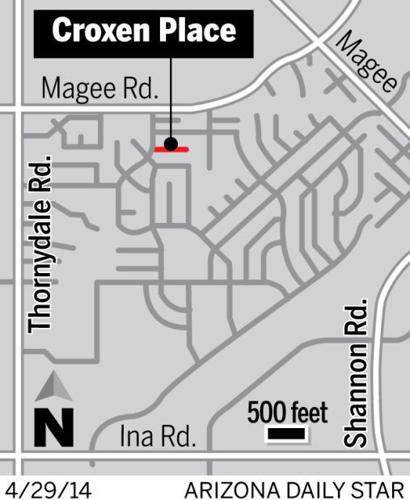
Fred W. Croxen died in 1977 and the following year, on July 11, 1978, Westfal Place southeast of Magee and Thornydale roads was renamed Croxen Place in his honor.
As his niece Patricia Stephenson put it, “Croxen lived a life out of a Hollywood Western, and actor Gary Cooper would have been perfect in the role of my uncle.”
Sources:
Special thanks to Gowher Jamshedi of the Tucson Corral of the Westerners; Interview with Patricia Stephenson (niece of Fred W. Croxen) on March 12, 2014; Charles R. Ames, (and Fred W. Croxen et. Al) “A History of the Forest Service,” The Smoke Signal, Fall, 1967; Anthony J. Davis, “Fred Croxen dies, ending long romance with state,” Tucson Citizen, Sept. 28, 1977; Julia Maria Schiavone Camacho, “Crossing Boundries, Claiming a Homeland: The Mexican Chinese Transpacific Journey to Becoming Mexican, 1930s-1960s,” Pacific Historical Review, Vol. 78, No. 4, November, 2009; John S. Westerlund, “Bombs From Bellemont: Navajo Ordnance Depot in World War II,” The Journal of Arizona History, Autumn, 2001; Stanley C. Brown, “Whatever Happened to Joseph McLernon, Killed at the Battle of Big Dry Wash?,” The Journal of Arizona History, Spring, 1998; Fred Wilmer Croxen biofile (AHS); Oral history interview with Fred W. Croxen, on Nov. 26, 1973 (AHS) [pgs. 35-38]; Charles Lamport Croxen birth certificate (Office of Vital Records); Fred W. Croxen birth certificate (Office of Vital Records); Pima County plat maps MP29028 & MP29073

 U of A president declines to sign shared governance contract with faculty