

WASHINGTON – Democrats and Republicans in the Senate have come together on a bipartisan infrastructure package that could bring unprecedented amounts of money to Western New York for roads, bridges, lead pipe removal and much more.
There's $110 billion nationwide for roads and bridges, of which $11.5 billion would go to New York State. Nearly a billion would go to airports in the state, including $37.5 million to projects at Buffalo Niagara International Airport. Other pots of money that could end up helping Western New York include the $65 billion set aside to bring broadband internet to underserved urban and rural areas, as well as $3.85 billion aimed at rebuilding land ports of entry at the northern and southern borders.
Senate Majority Leader Charles E. Schumer, a New York Democrat whose patience and prodding is being credited for creating the environment in which 10 senators from both parties sealed the deal, said it would have a vast positive impact on his home state.
People are also reading…
“The bipartisan infrastructure deal will be a building and jobs boon for critical New York needs from Plattsburgh to Jamestown and everywhere in between,” Schumer said.
Senators and the White House were locked in intense negotiations Tuesday to salvage a bipartisan infrastructure deal, with pressure mounting on all sides to wrap up talks and show progress on President Joe Biden’s top priority.
That was just part of the praise, much of it guarded, that the bipartisan deal won on Thursday.
“It’s guaranteed to be the kind of legislation that no member on either side of the aisle will think is perfect, but it’s an important basic duty of government," said Senate Minority Leader Mitch McConnell, a Kentucky Republican who voted to begin debate on the proposal on Wednesday rather than trying to round up the votes to kill it. "I'm glad to see these discussions making progress," he added.
Rep. Brian Higgins, a Buffalo Democrat, is among those who thinks the bill is less than perfect.
"Something is better than nothing," said Higgins, who has been pushing for a massive federal infrastructure package for the better part of a decade. "But the top-line numbers are suboptimal and it doesn't include a lot of the priorities that cities like Buffalo are needing."
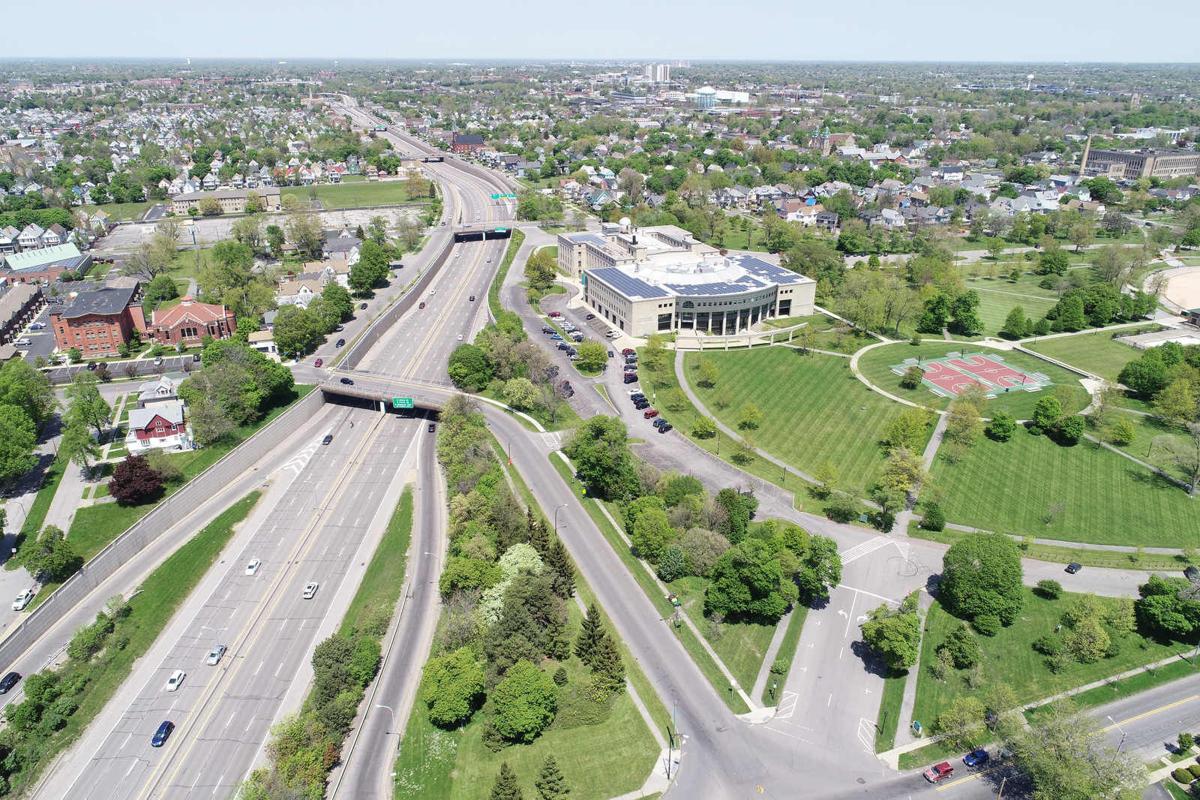
Higgins' main concern is one raised a month ago when the bipartisan negotiators revealed their first infrastructure framework. The final deal, like that initial outline, trims Biden's proposed $25 billion fund to replace highways that destroyed neighborhoods to $1 billion.
The Buffalo congressman has been hoping that fund would be big enough to fund replacing the Kensington Expressway with a rebuilt and much more neighborhood-friendly Humboldt Parkway. Now he's hoping he can boost the size of that fund when the bill makes its way to the House, but it's unclear whether amendments will be allowed or if the House will simply take an up-or-down vote on the bill the Senate eventually passes.
There's one other possible source of money for the Kensington replacement effort: a $17.5 billion fund aimed at paying for projects that are too big or complex for traditional highway funding programs. Higgins said that pot of cash "potentially" could be used for the Kensington, but that there's no way to be certain of that because the deal is little more than an outline at this point and has yet to be drafted into legislative language.
Higgins also said he was unhappy that a fund aimed at paying for the replacement of every lead water pipe in the nation had been cut from $111 billion in Biden's original infrastructure proposal to $55 billion in the Senate deal.
"It's a big concern," said Higgins, who represents a city with more than 100 miles of remaining lead water pipes. He worries that the massive cut in the proposed funding will mean that it will not be enough to replace every lead pipe in the nation, even though they pose the potential of leaking lead into water supplies.
The bipartisan negotiators also trimmed Biden's proposed $85 billion in mass transit funding to $39 billion, making it less likely that new transit initiatives like a proposed Buffalo streetcar system would ever be funded. Nevertheless, negotiators said that $39 billion still would be the largest federal investment in mass transit ever.
Higgins was among the few lawmakers to raise concrete concerns about the proposal on Thursday. Many either voiced cautious support or said they would wait until the deal is drafted into a bill before commenting in detail.
Among those proceeding cautiously was Rep. Chris Jacobs, an Orchard Park Republican.
“I am encouraged that the Senate was able to take another step in the process to address our nation’s infrastructure needs like roads, bridges and broadband," Jacobs said. "Like any major legislation, however, the devil is in the details, and we haven’t seen all of them yet."
Nevertheless, documents provided by the White House and Schumer spelled out a few other line items that could mean money for Western New York. For example:
• New York State would get a $1.9 billion share of a new program aimed at repairing aging bridges.
• Some $142 million would come to the state for electronic vehicle charging stations.
• Local Amtrak service could improve thanks to the $12 billion set aside to bolster intercity train service.
• The Army Corps of Engineers would get an additional $9.55 billion for waterways projects nationwide.
• Billions were set aside nationwide to remove contaminants that are especially common in New York State, such as PFAS, as well as for correcting sewer overflows.
Schumer is also planning to push a budget bill of more than $3.5 trillion to invest in social programs, but on Thursday, he seemed happy with the Senate's emerging brick-and-mortar infrastructure effort.
“Whether it’s critical bridge or highway repairs, safety improvements at our airports or for water systems, this deal represents massive investments that will rebuild and revive the Empire State’s infrastructure," he said.


