

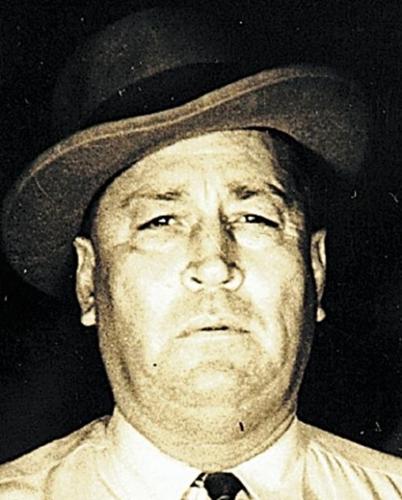
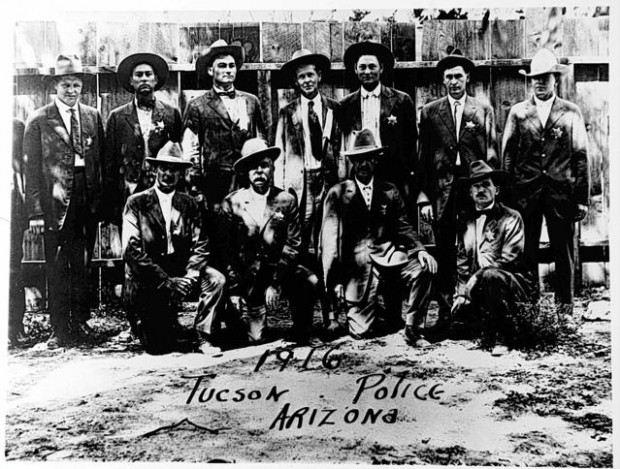
Jesús Camacho wasn't afraid to crack a few skulls if it meant keeping the peace on his beat.
He patrolled the Old Pueblo's red-light district Downtown during his days as a Tucson police officer. He joined the force in 1910, when prostitution was legal, opium dens were common and shootouts were routine.
During his 33 years of service, Camacho was involved in gunbattles, killed two ne'er-do-wells and apprehended several high-profile murderers.
Camacho was born in 1883 and grew up working in his family's restaurant on Meyer Street. He quit school in the sixth grade and worked for the Southern Pacific Railroad and as a carpenter while volunteering with the Fire Department as part of a team that pulled the 1,000-pound hose cart to fires. He married Ramona Valenzuela in 1900 and they had four children before Camacho joined the police force at 27.
People are also reading…
Standing more than 6 feet tall and tipping the scale at 215 pounds, the strapping Camacho had fallen behind on his bill at Andy Martin's drugstore. Camacho offered to do carpentry work to pay his debt, but the owner had another idea.
"Jesús, you would make one hell of a fine policeman," Martin told him. "You know the language, the people and every alley in this section of town."
Martin called in a favor and the next day Camacho had a badge pinned to his chest.
He was assigned to cover the district where he grew up — south of Congress Street between Church Avenue and Meyer Street, south to 17th Street. The neighborhood was home to gambling dens, 48 saloons, Chinese markets, small hotels, pimps, petty thieves and 250 or so ladies of the evening who plied their trade along the two blocks of Sabino Street known as Gay Alley — named for Tucson pioneer Mervin G. Gay.
Before joining the force, Camacho patronized the saloons, so many customers had little regard for the newly appointed lawman's authority.
Camacho quickly earned the respect of the red-light district denizens. He developed a rapport with the residents, treating people fairly, looking the other way when widows made ends meet by selling tequila during Prohibition and pumping stool pigeons and drug addicts for information on crimes. Eventually, he earned the nickname, "The Mayor of Meyer Street."
Camacho worked his way up the ranks to become a detective and even filled in as police chief for a couple of days in 1915.
His first big capture came in 1922 when he nabbed Los Angeles "hammer murderess" Clara Phillips, who'd bludgeoned her romantic rival. Tucson police received a tip that Phillips might be aboard an eastbound train headed for El Paso. Camacho searched the train when it pulled into Tucson and found Phillips sleeping in a berth.
A decade later, Camacho was one of the detectives assigned to investigate the kidnapping of a Tucson banker. Camacho and his partner followed marks left in a dusty road by worn tires that led to the kidnappers who were sweeping away the tracks in front of a small ranch house. The kidnappers opened fire and the detectives retreated to get their rifles. By the time Camacho and his partner returned to the house, the kidnappers were gone, but they found the banker, bound and gagged, at the bottom of a dry well.
Camacho didn't let border issues interfere with capturing a fugitive, when he ventured into Nogales, Sonora, sans extradition papers, to capture a man who'd murdered a Chinese storekeeper. Camacho tracked the killer south of the border and convinced the local mayor and the police chief to lock up the prisoner for a few hours until he was ready to transport the man to Arizona.
"At midnight I get them to turn him over to me. I put him in a taxi and take him to the Arizona side and put him in jail, and the next day I take him to Tucson," Camacho said.
"The day after I brought the murderer … across the line, the authorities put the Mexican chief, the mayor and a corporal in jail and sent word to me to stay away from there," Camacho said. "I didn't go back for four years, until the administration changed."
During his career, Camacho killed two men and made what was then the largest narcotics bust in Arizona. He and two other detectives seized more than $85,000 worth of narcotics stolen from a Nogales Army hospital by two men who hid the stash in their car trunk.
Camacho shot and killed his first criminal in 1911, a year after joining the force, when he caught the man breaking into a bank vault. Later in his career he killed a man who wounded a fellow police officer.
"I shot him through the side of the jaw with the .45 I've been carrying for 35 or 36 years," Camacho said. "The bullet came out his ear. He died."
Camacho was shot at many times but wounded only once — with his own gun. Camacho and another detective were speeding along Meyer Street, then a rutted dirt road, in their police-issued Model T when Camacho's gun discharged and the bullet hit him in the butt.
Camacho retired in 1945, but continued working for then-Sheriff Ed Echols, transporting prisoners from Tucson to the prison in Florence until Camacho's death four years later at age 66.
"He was one of the typical, old-style police officers," Echols said. "He learned this job by hard knocks and experience."
Life Stories
Life Stories usually chronicles the lives of recently deceased Tucsonans. But, at this time of year, when the veil between life and death is thin, and thoughts are near of loved ones long passed away, Life Stories steps back in time to remember a man whose impact resonated throughout the community. The information was compiled from Arizona Daily Star and Arizona Historical Society archives.
Past "Life Stories" are online at go.azstarnet.com/lifestories.

 $25M distribution center to be built in Tucson


