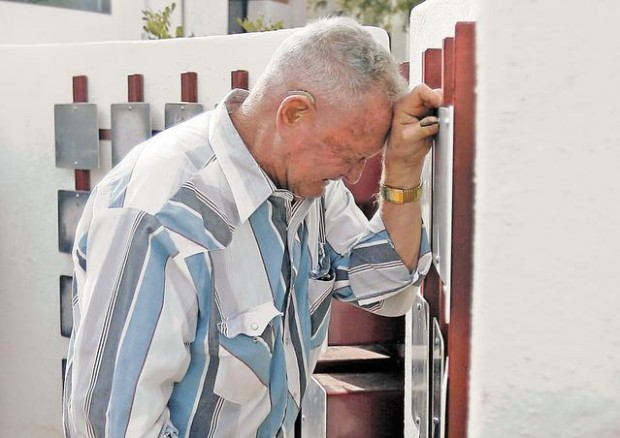

George Reynolds can't forget what he saw in the eyes of the dying soldier he cradled in his arms 57 years ago.
"Don't look in the eyes," the more-experienced medics told him. But the then-17-year-old from Douglas — the youngest of 14 brothers — couldn't help himself. He was in a foreign place, on the front line of what some vets now call "The Forgotten War." Men were falling in the pitched battle, and the soldier he held was beyond mortal help.
It was Christmas 1950.
Reynolds was a Navy corpsman embedded with the 1st Marine Division, A Company, in South Korea. The unit was trying to push back North Korean soldiers and take control of Hill 102 — 100 miles north of Inchon.
His inability to provide medical care for the soldier in his arms has haunted Reynolds, who now lives in Tucson with his wife of 39 years, Cheri.
People are also reading…
Each year, in the weeks leading up to Christmas, Reynolds would become sullen and moody, reliving in his mind the final moments of that soldier's life.
"He died in my arms," Reynolds said. "It's extremely difficult for me to think about and go through it again. My soul has been hurting for a long time."
This year, however, his anguish was eased a little by the intervention of a Tucson bereavement counselor and psychic-medium and by a recent memorial service they organized for the soldier.
Psychology experts cannot say how many grief workers practice this dual specialty, and views on incorporating "mediumship" into the therapeutic process vary from helpful to harmful. But the combination has a positive effect on some who seek such treatment.
Reynolds, now 73, wasn't looking for a way to ease his decades-old guilt as he sat in a pew at the Christmas Eve service at Sunrise Chapel in 2006. And Janna Excell, who sometimes incorporates mediumship into her grief practice, wasn't expecting to receive a message from beyond the physical plane when she and her husband sat next to the Korean War vet and his wife.
Suddenly, however, Excell said she was contacted by a wounded soldier who insisted that she deliver a message to the man seated next to her.
" 'Tell him he was my light in the darkness,' " Excell said the soldier-spirit begged her to tell Reynolds.
"A lot of people will tell you they never deliver a message this way," said Excell, who usually doesn't approach strangers with messages from the dead.
Yet, following the candlelight service, Excell felt compelled to speak with Reynolds.
"I said, 'Sometimes I get messages from spirits, and there is some young man who is here tonight,' " Excell said.
Pastor Frank Rose, now retired, conducted the chapel service that night. He's known Excell for years through her bereavement work and suggested the couple hear her out.
"I think it was just a matter of her sitting in church with this beautiful Christmas Eve service, and all of the sudden she gets this soldier visiting her, and it's one of those unbidden things, but she knew she had to talk to George about it."
Reynolds was surprised by Excell's insights, and a little confused. "For her to read my mind was shocking to me. I was not at all expecting anybody to say anything like that," he said.
It had taken the Navy vet more than 30 years to tell his wife about the death of the soldier with strawberry blond hair and gray eyes.
"His head was the only part of him that wasn't torn apart. He didn't have his helmet on. I think it got blown off," he said.
"I try to forget things like that. I try to forget the whole thing. I've tried to cut that out of my mind, but it doesn't help," said Reynolds, sobbing. "I was holding him, and I didn't know what to do or say. I did everything I could to keep his pain down, but there was nothing I could to do save him. All I could say was, 'Don't worry, don't worry,' and he reached up and patted me on the cheek, and he said, 'It's OK, Doc,' and he died."
During the war, it was customary for soldiers to refer to the corpsmen who served as medics as "Doc." Reynolds was one of only seven in his 200-member company who survived the Korean War.
"When that life slipped away, it almost drove me crazy," he said. "To have this utterly helpless feeling, I couldn't handle it. I've never been able to forget seeing the life go out of his eyes. It's haunted me.
"He couldn't have been more than a year or two older than me. We were two kids there. We didn't know what was happening, why it was happening. We were just doing what we were supposed to do.
"For the first 15 or 20 years, I thought about him every day and I had a lot of nightmares for a long, long time."
Though his encounter with Excell allowed Reynolds to start purging the memories he'd bottled up all these years, some in psychology say claims of communication with the dead can further harm the grief-stricken.
"I can say with 100 percent certainty that there is no scientific evidence that individuals are capable of channeling with dead relatives or that channeling with dead relatives would potentially improve the course of people's recovery," said David Sbarra, an assistant professor in the University of Arizona psychology department.
"My biggest concern about it is, it can unwittingly do harm. It can teach people that they don't need to deal with their own emotional experiences; they can put it out to the spirit world," he said.
"To date, there is no known evidence that it is possible to communicate with the dead. In contrast, there is very clear evidence that there are effective forms of psychotherapy for complicated grief."
But Patti Harada, an adjunct faculty lecturer in the same department who knows Excell, said she doesn't think there's any harm in believing.
"None of us know for sure, so why not believe it?" she asked.
Tucson clinical psychologist Sean Flynn, chairman of the Arizona Psychological Association's ethics committee, said people should seek licensed counselors and psychologists when feeling overwhelmed by grief.
"There are a lot of people who really don't know the difference between someone who's hanging out a shingle and someone who's a licensed professional," Flynn said.
"I think there are probably some people out there who legitimately believe they've got these abilities and are using them to help people, and there are people who are hucksters and don't really believe that, but it's a way to make a living."
Despite the criticism, some people obviously believe.
Kelly Reed is a client of medium Ana Maria Piña, who works closely with Excell. A chance encounter with Piña helped Reed cope with the death of her father, photographer William J. Plank, about 18 months ago. A month after her father's death, Reed was visiting a mutual friend when Piña stopped by.
"I was talking to her, and all of the sudden she couldn't keep quiet because my dad was coming through to her very strong," Reed said.
She had been searching a storage shed for her father's military medals and memorabilia to make a shrine. With Piña's guidance, Reed found what she wanted.
"However the universe put that together for the three of us, I'm glad it happened," she said. "Ana Maria brought peace."
Neither Excell nor Harada has a degree in psychology, but Piña has a bachelor's in psychology. Her approach to skeptics and believers is: "I'm not here to convince you. Just take from it what you want."
In Reynolds' case, he's still not sure how Excell knew so much about his war experience, but he hopes her insights can help lessen his anguish.
As part of his healing, Reynolds — with Excell's help — organized a memorial service for the unknown soldier.
Earlier this month, surrounded by a dozen relatives and friends, he wept as he installed a plaque in the memorial garden at Sunrise Chapel. Pastor Rose read psalms, family and friends spoke about the fallen soldier they never met, and a Marine Corps bugler sounded taps.
Before the service, Reynolds confided, "I had nightmares before, but now the dreams are returning, and I don't see the death and destruction.
"I've been looking for closure for a long, long time, and maybe I'm finally going to get that."
On StarNet: Find a photo gallery to accompany this story at azstarnet.com/slideshows.
Choosing a therapist
• Talk to close family members and friends for their recommendations.
• Contact the Arizona Psychological Association (www.azpa.org) for a list of licensed and competent mental health providers.
• Ask a primary-care physician or other health professional for a referral.
• Inquire at your place of worship.
• Look in the phone book for the listing of a local mental health association or community mental health center and ask for referrals.
• Call recommended therapists and ask about: their licensure and level of training; approach to psychotherapy; and participation in insurance plans and fees.
Source: American Psychological Association

 Second wall planned across Arizona as Trump administration doubles down on border