

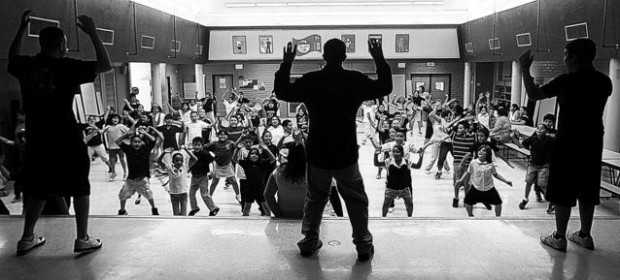
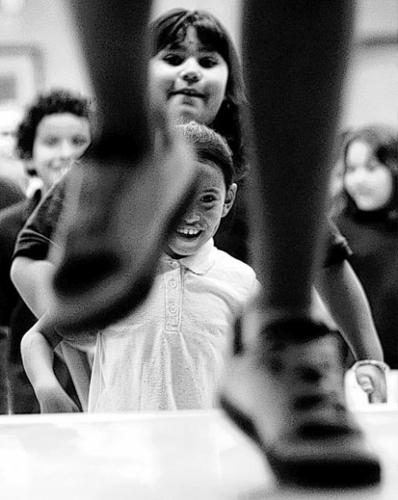
A young boy draws a crowd by doing a handstand. A girl does cartwheels around the multipurpose cafeteria at Santa Clara Elementary School.
"Get in line. Make sure you have arm space," fifth-grade teacher and folklorico adviser Bertha Estrada shouts to a room full of eager children.
Third-, fourth- and fifth- graders piled into the cafeteria to get their folklorico groove on.
The room's echo changed from a boisterous laughter to a fleeting moment of silence. When the dancing commenced, there was a rhythmic sound of clapping and stomping feet.
After a two-year absence, the students were noticeably excited to have their folklorico program reinstated.
Estrada had been asked for a few years to bring the program back to Santa Clara, 6901 S. Santa Clara Ave.
People are also reading…
She said she had to put it off until the timing was right, when the students of Sunnyside High School, 1725 E. Bilby Road, came to her with a proposal to let them teach folklorico.
Six Sunnyside students from the Mexican-American Social Culture Club are teaching 83 Santa Clara students traditional folklorico-style dances.
The program caters to a spectrum of young dancers. There are those who have never even danced, while others have been doing folklorico for years.
Fifth-grader Stephen Narcho had never been exposed to folklorico before joining this group.
"I joined because I think it's fun, the different types are fun," Stephen said.
In folklorico there are several styles; each region of Mexico has its own costumes and style.
The lessons go beyond the simple steps. Students also learn the historical significance of every dance and costume.
"You learn about the culture, how they celebrate weddings and what the steps mean," Sunnyside senior and folklorico mentor Jessica Villa said.
Mariachi and polka are a few examples of the styles Santa Clara students are learning.
Polka-style folklorico comes from Nuevo Leon and is a favorite of Sunnyside senior and student-mentor Luis Valencia.
"It is a beautiful region and dance," Valencia said. "It is also difficult and dangerous because someone could break an ankle."
Student-instructors are also taking a folklorico class. They are in a group known as the Diablitos Azules, an advanced folklorico course offered at Sunnyside.
Valencia said he wanted to do this because he likes his culture and wants to learn more. He also mentioned that teaching these students was rewarding.
"You get to have fun with kids. And besides, what's a better gift than having a kid smile?" Valencia said.
There were plenty of smiles during practice — until the kids were paired up with a partner of the opposite sex.
Once the mentors got wind of the kids' complaints, they stopped their routines. The student-mentors demonstrated that the "X" and "Y" chromosomes have to get along, at least while dancing.
Students were told that if they wanted to be in the advanced group, they would have to be comfortable dancing with girls if they were boys, and vice versa.
Estrada was surprised at the number of boys who joined the program. She estimates between 20 and 30 boys are part of Santa Clara's folklorico program.
"We didn't even need to bribe the boys to join," Estrada said. "Once they saw the high school students, they were impressed."
The program looked more appealing when Santa Clara students saw how talented their mentors were at a Sept. 22 performance. This was the kickoff to the school's folklorico program.
The group practices Mondays and Fridays for 45 minutes. Because there is a variety of skill levels, the mentors have considered reserving Friday for the fourth- and fifth-graders.
Maria Moreno has two daughters in the program and is thrilled it made a comeback.
"I like the folklorico program. It keeps 'em out of trouble and off the streets, and it gives them something to do without them knowing it's exercise," Moreno said. "I just wish they had it here last year."
Estrada mentioned that academic benefits are also associated with the program.
"It motivates them to do well in class. Students have to turn their work in on time, and it gets parents involved," Estrada said. "Statistics show those who are exposed to the arts typically do better in school."
South Side
"It motivates them to do well in class. Students have to turn their work in on time, and it gets parents involved."
Bertha Estrada
fifth-grade teacher and folklorico adviser


 Nancy Guthrie's Tucson neighbors: Life with streamers 'unbearable'


