On the day Abdul Basir moved into his new home in Amherst and was getting it ready for when his wife and three of his children returned from an extended trip to Afghanistan, he received alarming news:

Abdul and friends here have been making desperate calls to leaders in Congress trying to find a way to get his family to safety.
Kabul had fallen to the Taliban.
Distraught, he reached out to a friend, Annie McCune of Orchard Park – who had worked on many humanitarian efforts – to help him find a way to get his family home.
For two agonizing months, as McCune worked every angle she could find, Basir worried and waited.
Then last week, after countless emails and phone calls, frantic messages in the middle of the night on WhatsApp and hours of prayer, Basir's wife and children came walking down the concourse at Buffalo Niagara International Airport and into his arms.
"You're here!" cheered McCune, hugging the children.
People are also reading…
The Basirs and McCune shared their escape story with The Buffalo News.

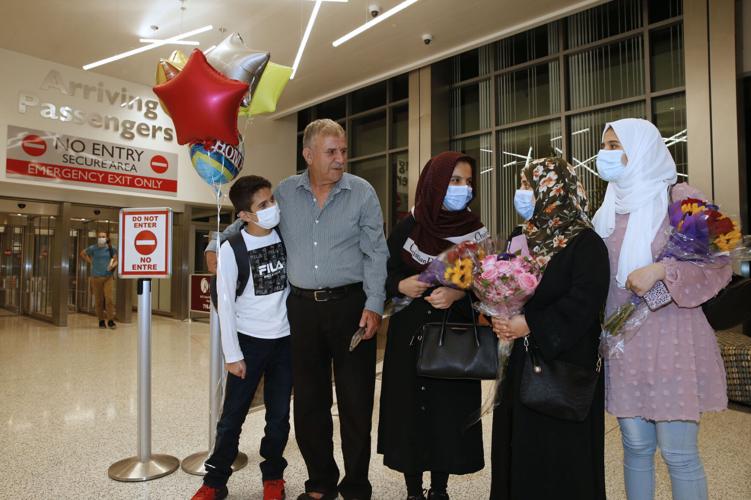
Basir family members from left, son Riaz, 12, father Abdul, daughter Rabia, 22, mother Palwasha and daughter Rohina, 15, gather on arrival at the Buffalo-Niagara International Airport on Oct. 14, 2021.
Abdul Basir brought his family to Buffalo in October 2019 after his Special Immigrant Visa was approved. He qualified after decades of work with various U.S. agencies, the most recent with U.S. Agency for International Development. Basir was able to bring with him his wife, Palwasha, and three youngest children, Rabia, 22, Rohina 15, and Riaz, 12. Two older sons, Satar and Qahar Fazli, who are in their 30s, remained in Kabul. An older daughter lives in Toronto.
The family was sponsored by the International Institute of Buffalo and first lived on the West Side.
The family was close to McCune. The children called her "Nonnie." Previously, she had taken in another member of their extended family and also helped the Basirs find their new home in Amherst. She is Christian and they are Muslim.
"It's all the same God," McCune said.
The Basirs agree.

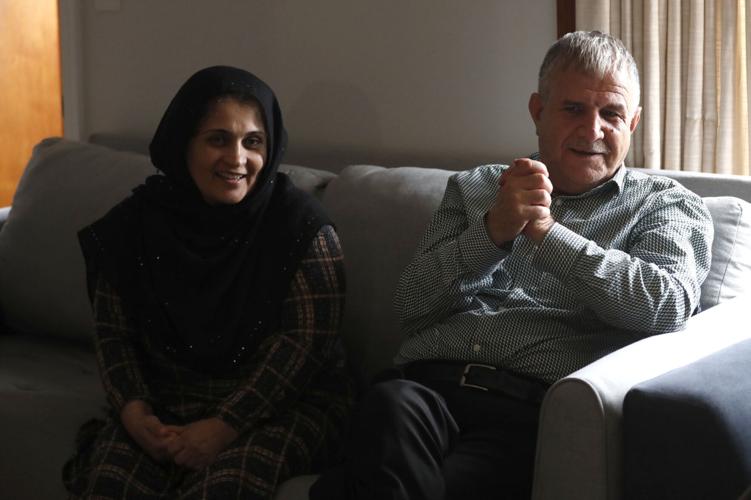
Palwasha Basir , left, and husband Abdul talks about what it was like to be trapped in Afghanistan after the Taliban took over.
In early July, Palwasha Basir and her three younger children returned to Afghanistan, knowing that with the U.S. pulling out by Sept. 11, it might be a long time before it would be safe to return again.
The trip started out joyously. There was a wedding for a cousin and an engagement party for Rabia Basir and her fiance in Kabul.
"We did a lot of dancing," Rohina said.
The girls went shopping at the mall. Their uncle, a tailor, made them traditional Afghan dresses.
They saw on the news that the Taliban was taking over different parts of Afghanistan. But they thought Kabul would be safe. Then, at 9 a.m. Aug. 15, they awoke to learn that the Afghan president had fled the country and Taliban fighters were pouring into Kabul.
"We were so scared and we were so worried," Rabia Basir said.
The family hunkered down, terrified to leave the one brother's house. They could hear sporadic gunfire. Their uncle told them that the Taliban came to his tailor shop and told him it was no longer necessary for him to make dresses. They painted over his pictures of models with black paint.
They watched the news and heard rumors about what was happening in other cities.
"We heard that they kill all the men and boys and they married all the girls," Rohina said.

In early July, Palwasha Basir and her three younger children returned to Afghanistan, knowing that with the U.S. pulling out by Sept. 11, it might be a long time before it would be safe to return again.
Thousands of people flooded the airport in Kabul, desperate to get out. The world watched in horror at the chaotic scene, as Afghans who had worked with the coalition forces and the U.S. government clamored to get on flights.
The Basirs had plane tickets out of Kabul for Aug. 26. As green card holders, they didn't have to worry about obtaining special visas, as did so many other Afghans.
But the Taliban shut down commercial traffic at the airport and only a handful of planes – mostly military aircraft doing evacuations – were being allowed. Then those stopped. The day of what would have been the Basirs' flights, suicide bombers attacked one of the airport entrances, killing 60 Afghans and 13 U.S. troops.
McCune texted with the older brother, Satar Fazli.
"The Congressman says to please not try for the airport on your own. They said all operations are halted for now after the blast this morning. It will be especially dangerous for you and Qahar to go without embassy protection," she wrote him on WhatsApp.
He replied that he was worried about waiting. "I don't know if we do nothing right now, we might regret it later," he said

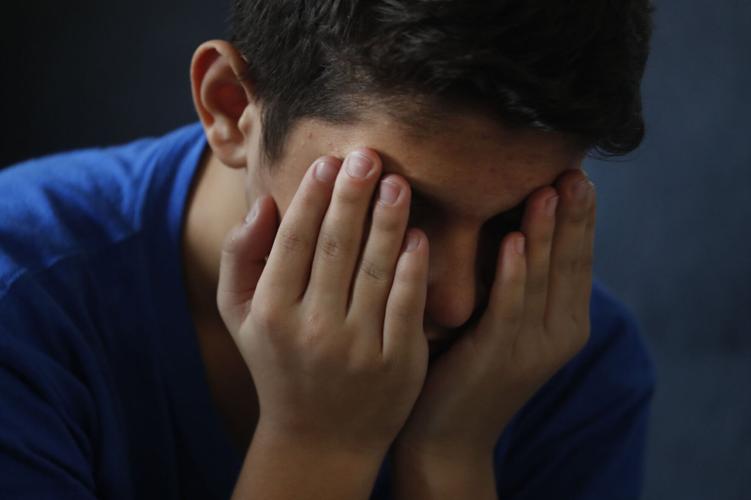
Riaz Basir listens to his family what it was like to be trapped in Afghanistan after the Taliban took over.
The family tried twice to get to the airport. But it was too dangerous. They got caught in a stampede at one point, and the youngest son, Riaz, got hit in the forehead with shrapnel.
McCune made call after call to the State Department and filled out forms for each family member to get them on evacuation lists. She worked with organizations in Buffalo, including Journey's End. She talked to local congressional leadership and went to The News to draw attention to the Basir family's plight. She communicated with anyone in Afghanistan, often waiting until 1 a.m. in Buffalo because of the time difference.
She sent daily emails to her friends who were trying to help, which she shared with The News.
"I spoke with the family in Kabul today," she wrote Sept. 7. "They are safe and grateful for your thoughts and prayers. They said the violence seems to be increasing in the city as various groups take to the streets in protest against the Taliban."
Meanwhile, in Kabul, things were getting desperate. Business had come to a standstill. Food was becoming scarce.
McCune eventually came into contact with a group called Task Force Argo, a U.S.-based volunteer group that was working on evacuating Afghans. They agreed to help. But McCune was told to be patient
On Sept. 11, as the world mourned the 20th anniversary of the terrorist attacks on the United States that would inspire the war that would follow, McCune sent an email: "I am sad to report that I ... had a sick heart this morning. The 30-hour window in which our family was told they would be evacuated has come and gone. The exhaustion of being on alert, ready to move for almost 2 days has everyone's nerves a bit frayed."
Then two days later, Fazli received word from a contact that they should get ready to move to another city in northern Afghanistan. They were told they could bring only one backpack per person and be ready to be picked up at any moment. They were to scrub their phones of any messages or phone numbers from the United States. They gave McCune an Afghan code name: "Fereshta," which means "angel."

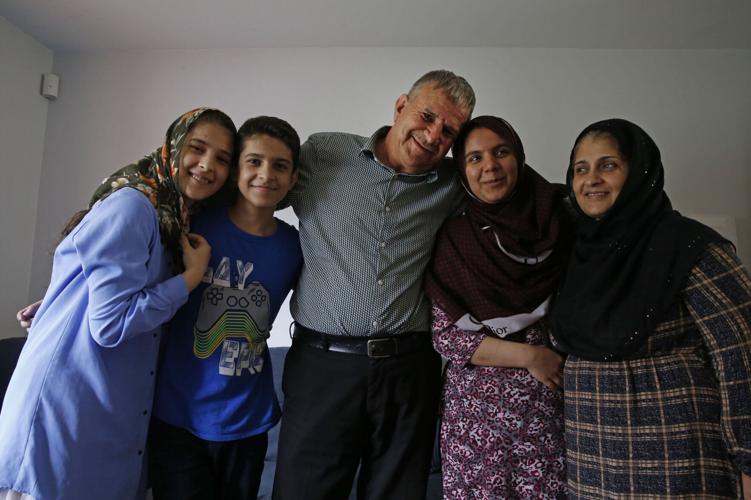
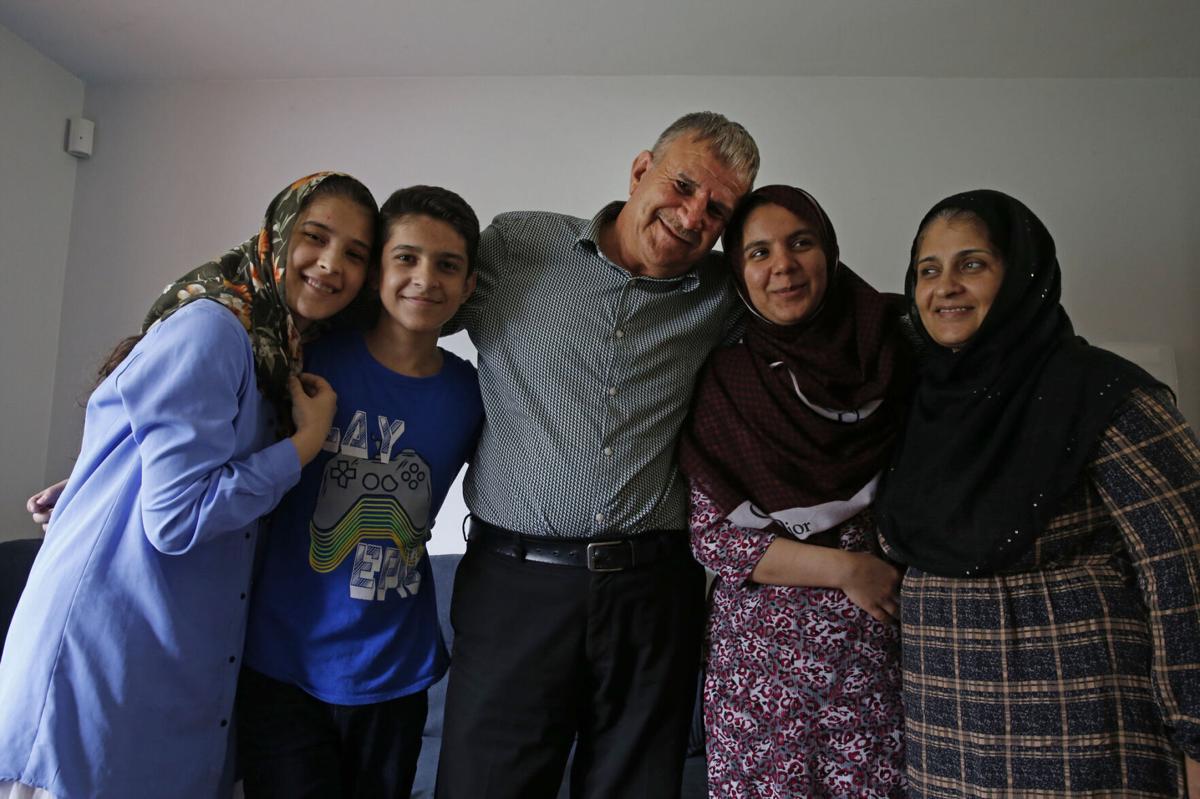
The Basir family at their home finally reunited. From left, Rohina, 15, Riaz, 12, father Abdul, daughter Rabia, 22, and mother Palwasha.
The daughters cried. They had to leave behind the dresses their uncle had made, including Rabia's wedding dress.
They rented a van, and as they made the journey north, they learned that their destination was compromised. They had to make another plan. Fortunately, they had a relative who lived nearby, but they could stay with them for only one day. They then went to another safe location, and then to another one. Argo was working on getting them on a plane.
"Today we pray for all those involved," McCune wrote in her emails.
On Sept. 24, they were put on a bus with other evacuees.
"Wheels up!" McCune wrote to her email group after hearing from Satar. "I can hardly breathe. All six are at the airport holding boarding passes."
The family was exhausted, but thrilled. They couldn't sit together and Riaz had to share his seat with another child. But they smiled at each other, filled with joy. They were especially excited that the two older brothers were able to get out with them, too. But they also felt grief. They were leaving behind so many family members in such uncertain circumstances and they would never see Afghanistan again.
They arrived in the United Arab Emirates and were put up at the Emirates Humanitarian City, a sprawling compound for refugees. They stayed in clean, dorm-like quarters and waited for word on when they could make their next step.
They had a potential exposure to Covid-19, so the family had to quarantine for 18 days. There was nothing to do, and while they were fed, it was all spicy Indian food, which wasn't to their liking. They all longed for Riaz's kid-friendly meals – plain chicken nuggets.
Then, last week, a man from the U.S. embassy came to their door and said they could leave shortly. Only the mother and three younger ones with green cards could go. The older brothers were on a list but couldn't go yet. The family was given the option to stay and wait, but they all decided it would be just a matter of time before the older brothers could come too.
They flew from Abu Dhabi, landed in New York and flew into Buffalo Niagara International Airport late on Oct. 14.
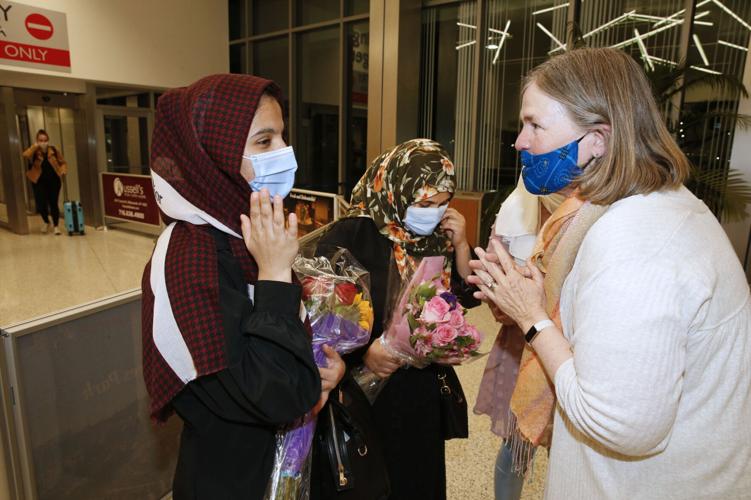
McCune was there with her husband and mother, carrying bouquets of flowers and balloons. The flight arrived early and Abdul Basir was just a couple of minutes late.
Riaz appeared first as the family came down the concourse. They erupted into laughter and tears.
Rohina wrapped her arms around McCune.
"You got us out," Rohina said, squeezing McCune and crying. "You got us out."

Rabia, 22, left, and her mother Palwasha are greeted by American family friend Annie McCune upon arrival. Afghan-American Abdul Basir's family was trapped in Kabul when Afghanistan fell and they were finally reunited at Buffalo-Niagara International Airport on Oct. 14, 2021.