

If you're not a criminal, you don't need to worry about the much-discussed spillover of violent crime from Mexico's drug wars.
That's the unanimous opinion of 10 Southern Arizona law-enforcement officials interviewed by the Arizona Daily Star in the last two weeks.
"The average individual has nothing to fear in regard to what has happened," said Santa Cruz County Sheriff Tony Estrada.
"Generally speaking," Pima County Sheriff Clarence Dupnik agreed, "it's criminals killing criminals."
While police officials are increasingly cautious because of the paramilitary and violent nature of the Mexican drug cartels, most doubt there will be cross-border spillover of the war between drug cartels and the Mexican government that has claimed thousands of lives in Mexico during the last two years.
People are also reading…
"Spillover crime would be bad for business," Douglas Police Chief Alberto Melis said. "And they're businessmen."
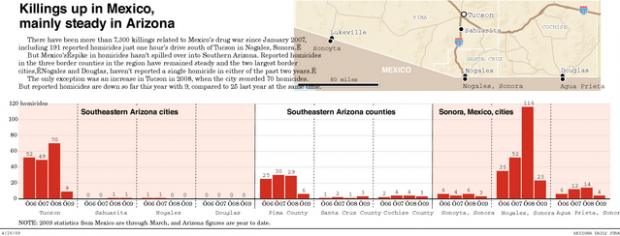
Conspicuously absent are the mass killings that have defined the Mexican drug wars. The two cities called Nogales offer a stark example: Last year there were a record 116 homicides in the Mexican city, but in its Arizona sister city there were none.
Some crimes have escalated in Southern Arizona: home invasions targeting traffickers, kidnapping of people involved in the smuggling. But nearly all perpetrators and victims in the surge are involved in smuggling.
These types of crime — not a new surge in cartel-war violence — have been cited as evidence of a spillover in recent congressional hearings and news reports.
For example, The New York Times reported on March 22 that rising home invasions in Tucson show a spillover of violence from Mexico's drug wars. But Tucson Assistant Police Chief Roberto Villaseñor said that's not so.
"The arrests we've made on home invasions, not one of them is an active cartel member from Mexico," Villaseñor said. "The majority of them, upwards of 90 percent of them, were local criminals."
Still, Southern Arizona police welcome the attention paid to border-related crime, even if some of the concern seems exaggerated. That's because it means money.
"I've told my people let's put in for everything we can because we have to ride the wave," Estrada said. "Finally, some recognition and some funding is coming down here to the border."
Santa Cruz County crime
In the early-morning hours of April 11 west of Nogales near Bartolo Canyon, two or three masked men dressed in black and carrying AK-47-type assault rifles stole $500 from a group of 19 illegal immigrants.
Reports of armed robberies such as this one have risen in Santa Cruz County from three in 2007 to 10 in 2008 — and eight through the first quarter of 2009, Estrada said.
Santa Cruz County has seen the residual effects of drug cartel activity in Mexico for years in the form of armed robberies and assaults among criminals, Estrada said.
But, he said, "The drug war pushed it up to a higher level. It added more gas to the fire. It added another ingredient to what was happening along the border and that was an increase in violence and competition."
In Pima County, home invasions have increased. The Pima County Sheriff's Department reported 56 in 2008, up from 39 and 44 the previous two years, said Lt. Michael O'Connor. In Tucson, 34 home invasions were reported from Jan. 1 through April 24, 2008, compared with 33 for the same period this year.
The robberies and home invasions share two characteristics. One, direct links to the drug cartels are tenuous; and two, nearly all of the victims are either criminals or people being smuggled.
So far, the chance of criminals hitting the wrong house is very low, O'Connor said. More than 95 percent of the home invasions they investigate are bad guy on bad guy, he said.
Some neighborhood-association presidents in Tucson said they have seen increasing violence in their areas. But despite occasional rumors of connections to Mexico, it is connected to local gangs.
"We do see a lot of violence, a lot of shootings, a lot of drug violence," said Beki Quintero, president of the Sunnyside Neighborhood Association. "We really don't know if that's a direct cause or link" to violence in Mexico, she said.
The assertion that law-abiding residents are safe but that police need more resources to fight the increasing threat from the drug and people smugglers can seem contradictory.
"We walk a fine line in that we agree this is a serious problem, the influx of narcotics, the effect of the cartels in a general sense on our community," said Villaseñor of the Tucson police. "We also don't want to portray it that we have these hordes of invading cartel members attacking our community members, because that's not the case."
Spillover contingencies
While law enforcement largely discounts the danger to average residents, it is nevertheless mounting precautionary defenses.
The U.S. Department of Homeland Security had local law enforcement make contingency plans last year in the case of a spillover.
The perceived threat of Mexican drug cartels has escalated in the last two decades as they've become what many label paramilitary organizations. The National Drug Intelligence Center has identified the cartels as the top organized-crime threat in the United States.
That, say officials, is what makes it necessary to prepare.
Tables have turned since Nogales, Ariz., Police Chief William Ybarra was a rookie in the 1980s.
"Back then, we had the training, we had the bulletproof vests, we had the armament, we had the communications and numbers," Ybarra said.
"It's turned. They have the high-caliber military weapons, they've got the unlimited cash flow to buy bulletproof vests.
"They have grenades; we run from grenades."
During the April 20 Senate committee hearing in Phoenix on border violence, Sen. Joe Lieberman, I-Conn., compared the Mexican drug cartels to Islamic terrorist organizations and warned that the cartels have the money, the weapons, the networks and the "utter disregard for human lives" to mount an attack.
Arizona Sens. John McCain and Jon Kyl and Arizona Gov. Jan Brewer have requested that the National Guard be sent to the border because of the violence.
But Mexican drug traffickers are unlikely to cross the border with guns blazing — the sort of attack that soldiers on the border could stop, said former Douglas Mayor Ray Borane, who served as a border-issues aide to former Arizona Gov. Janet Napolitano.
"They want to depict the situation as one where you could be literally invaded," he said. "That's unreality."
If the Mexican drug wars spur violence in the United States, Borane said, it likely will come in the form of a phone call from a Mexican drug trafficker telling an associate in some U.S. city to go after another U.S. drug dealer.
"The Army can't stop the telephone call to Phoenix," he said.
The real deterrent for the cartels is fear of U.S. law enforcement and prison time, said Lee Morgan, a retired U.S. Customs agent long stationed in Douglas.
"Our law enforcement system is honest and it works. In Mexico it's mostly corrupt," he said.
That doesn't stop border police chiefs from worrying.
"If we didn't take it seriously, we would be fools," said Sahuarita Police Chief John Harris.
Bolstering cops on border
Melis, the Douglas chief, has seen little violence of any sort in the quiet border town. There have been no reported murders for several years, and Melis doesn't expect that to change — even as drug-cartel violence surges on the other side of the line.
"I'm concerned because it's my job to be concerned," Melis said. "It's my job to worry about things so others don't have to."
One possible benefit to the special attention to border violence is money, border experts and law-enforcement officials said.
Like so many police chiefs along the border, Melishopes to get federal money to bolster his force from 37 officers to 42.
He's not alone.
Villaseñor, the assistant Tucson police chief, said problems connected to drug trafficking aren't new, or even caused by the Mexican drug wars, but Tucson police will accept help fighting them.
"We need assistance with that," Villaseñor said. "We never turn our nose up at any assistance."
Ybarra, from Nogales, called federal funds paramount to their work and said he sees increased attention on border violence as an opportunity for more funds.
"Without the federal government's attention and involvement and commitment, there is no way we could handle this on our own," Ybarra said.
Dupnik used the Senate hearing in Phoenix to pitch an idea for a task force to slow the flow of guns, cash and ammunition south into Mexico.
"We don't get a chance to talk to the people who are in control of our government and our country," Dupnik said. "It was a tremendous opportunity."
Miguel Levario, an assistant professor of history at Texas Tech University in Lubbock, says he thinks news reports are exaggerating the threat from Mexico for an age-old reason: Fear sells.
"The New York Times is one example I've been using," Levario said, citing the March story from Tucson headlined 'Mexican Drug Cartel Violence Spills Over, Alarming U.S.' "They use that headline, then they say in the article that we can't really link the drug violence we're seeing in the cities to the violence in Mexico."
Borane, of Douglas, agreed.
"The media can make or break an issue. They keep using the word spillover, spillover. It's so trite. They keep putting that issue in the minds of the American public," he said.
Contact reporter Brady McCombs at 573-4213 or bmccombs@azstarnet.com or reporter Tim Steller at 807-8427 or tsteller@azstarnet.com.
Contact reporter Brady McCombs at 573-4213 or bmccombs@azstarnet.com or reporter Tim Steller at 807-8427 or tsteller@azstarnet.com.


