

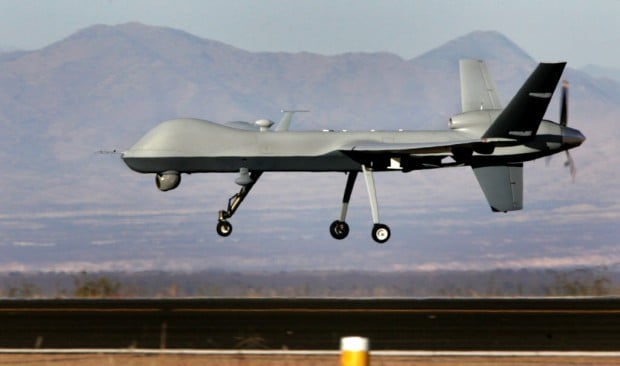
If you missed it, I wrote an in-depth story for Sunday’s Arizona Daily Star about Homeland Security’s burgeoning unmanned aerial system program and the Predator Bs they fly out of Sierra Vista: "Unmanned craft aid border effort."
As often happens during research for a story like this, we couldn't fit all interviews, statistics and photos in the print version of the story. So, here's some more on the Predator Bs:
------------
More photos and video of the Predator B
People are also reading…
• Here's a link to more images taken by Star photographer Benjie Sanders during our recent visit to Sierra Vista to give you an idea of what the plane and ground control center looks like:
----------
The General on the program's future
During my reporting for the story, I interviewed Maj. Gen. Michael Kostelnik, assistant commissioner of the Customs and Border Protection Office of Air and Marine. I included much of what he said in the story but didn’t have room for the following he said about the program's future:
The long-term goal is grow the fleet of Predator Bs to 24, up from what should be 10 by the end of 2011. The agency also plans to open two more launch sites in New York and the Pacific Northwest. Currently, they can launch and land Predator Bs out of Sierra Vista, Ariz.; Grand Forks, N.D; and Cocoa Beach, Fla. They plan to open a fourth site next year in Corpus Christ, Texas.
The planned six sites would allow the Predator B to be within a three-hour flight of any part of the country, Kostelnik said, in case of a national security emergency. If there were a terrorist attack, the Predator B would be sent above to collect information about what was going on without risking pilots. If you'll notice from the pictures
“We would risk that aircraft to see what the threat on the ground really is and to make sure we could bring the right law enforcement response to bear,” Kostelnik said.
At the current funding rate, the agency could afford to buy one additional unmanned aerial system a year, Kostelnik said. Each system costs about $18.5 million. At that rate, it would take until 2024 to get to the goal of 24 Predator Bs but that’s okay, he said, because the growth of the fleet has outpaced the growth of the number of experienced pilots.
“The number of aircrafts really isn’t our constraint,” Kostelnik said. “The real issue is being able to train enough pilots to fly the aircraft as much as we would like to fly it.”
Nobody is suggesting that the Predator Bs patrol the border alone: unmanned aerial systems are designed as part of the larger border enforcement strategy, Kostelnik said.
“They are very useful in augmenting and making more powerful the manned aircraft capabilities we have on the Southwest,” Kostelnik said.
Another thing to watch: Kostelnik is in talks with the Department of Defense about integrating four Predator Bs that are coming back from overseas into the border security mission
---------
Cost per hour middle of the road
As I mentioned in the story, the Predator B is in the middle of the pack among Customs and Border Protection Air and Marine aircrafts for the cost per hour to operate, according to figures from the agency.
The per-hour costs below for the other Air and Marine aircrafts include fuel, airframe, engine, avionics (cockpit), avionics (mission), equipment, support and services cost. The per-hour cost below for the unmanned aerial system (UAS) includes the satellite time, the maintenance, pilot training, etc.
Here's the list:
1) P3: $7,034
2) C12: $5,245
3) Blackhawk: $5,233
4) Chet: $4,448
5) King Air: $3,994
6) AW139: $3,744
7) UH1H (Huey): $3,476
8) Citation: $3,395
9) UAS: $3,234
10) PC-12: $2,781
11) Dash 8: $2,568
12) Astar: $1,932
13) MD-600N: $1,841
14) 210: $1,727
15) EC-120: $1,617
16) OH6: $1,441
17) 210: $1,144
18) PA-18: $1,141
Source: U.S. Customs and Border Protection Air and Marine
----------
Stats: 2009 best year yet
Here are statistics, by fiscal year, of what the Predator B flying out of Sierra Vista has done in support of the border security mission:
(Note: it's important to remember that the Predator B isn't used solely for border security missions, and has to squeeze in training and software testing along with operational missions)
Operational hours flown:
2006: 959
2007: 433
2008: 897
2009: 1,324
2010: 1,004.3
2011*: 106.5
Total: 4,725.8
Assists on pounds of drugs seized:
2006: 8,267.15
2007: 7,734.12
2008: 6,671.93
2009: 12,600.22
2010: 4,241.45
2011*: 465.60
Total: 39,980.47
Assists on apprehensions of illegal immigrants:
2006: 2,309
2007: 1,003
2008: 1,466
2009: 1,557
2010: 777
2011*: 11
Total: 7,123
Notes:
- 2006 figures from Oct. 4, 2005 to April 24, 2006.
- 2007 figures from Oct. 30, 2006 - Sept. 30, 2007.
- 2011 figures from Oct. 1, 2010 - Nov. 15, 2010.
For what it's worth, the president of the Border Patrol agents' union, T.J. Bonner, said to view the drug seizures and apprehension statistics with skepticism. In some cases, agents on the ground would have made the seizure or arrest without the help of the Predator B. And in other cases, Bonner said, officials give credit to the Predator B if it is anywhere near where agents made an arrest or seizure.
Bonner is not a fan of the program, and would rather see the money spent on ground-based mobile surveillance systems, which cost about $800,000 each.
---------
FAA concerns
Here are transcripts of the two Congressional testimonies submitted by the FAA regarding their concerns with unmanned aerial systems:


