

His urn is simple: A brown box labeled John Doe No. 159 because no one knows who he was in life.
He was cremated April 5, and his ashes stashed in a columbarium at the paupers cemetery, along with those of 15 other unidentified men. At least some are believed to be illegal immigrants who died trying to cross the desert.
The urns were in a batch of 47 placed last week in the structure's niches at Evergreen cemetery on North Oracle Road. With few exceptions, Pima County now cremates the remains of all unidentified people, including illegal border crossers and others whose bodies go unclaimed.
A state law that allows such cremations went into effect in late 2004, as the number of poor dead stretched burial plots to the limit.
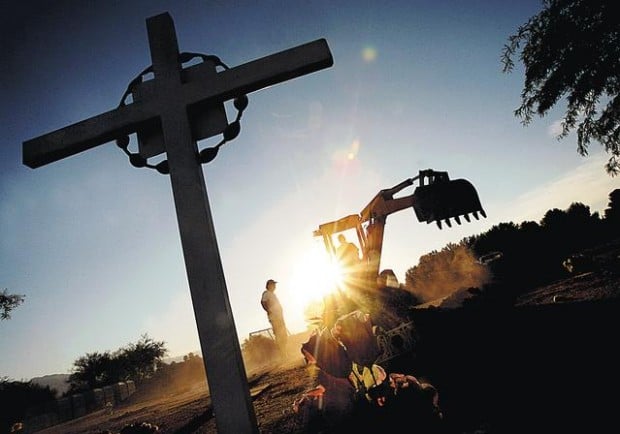
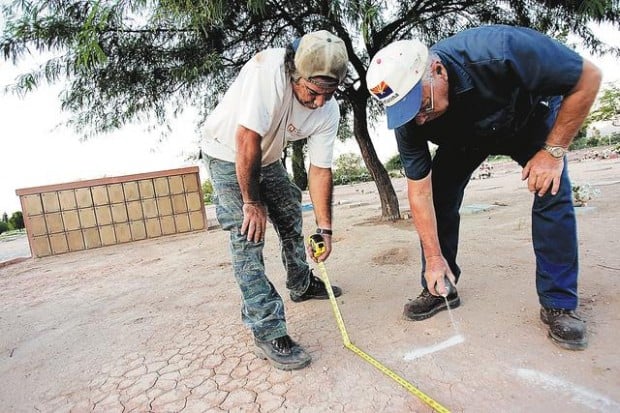
"We ran out of land," said Raymond Rodriguez, who runs the public fiduciary's indigent burial program. His boss, Anita Royal, said the county last year added a patch of land for about $110,000. There, the columbarium rises like two thick concrete walls.
People are also reading…
Royal said her office does not break down the cost of cremating people believed to be border crossers.
Said Rodriguez: "A lot of people are dying. People that are here have family, but with no resources."
Illegal immigrants still are the minority among the dead, but they are leaving their mark on the county cemetery. Rodriguez said another 20 people believed to be border crossers will be cremated soon.
Dr. Bruce Parks, the county's chief medical examiner, on Monday said the morgue has about 55 unidentified bodies. Some date to 2004, he said, but most of the remains were brought in last year.
Once his office releases the remains, Rodriguez can proceed with cremation. The practice will save the county money, Rodriguez said, noting cremation costs about $475, while a basic burial is about $1,800. That includes the plot, marker and installation.
Family members can either choose burial or cremation for their loved ones, Rodriguez said. The county makes the decision for the unknown deceased, or those with only a name but no known next of kin.
Rodriguez said he resorts to cremation only after an exhaustive search for identity and relatives turns up nothing.
When it comes to illegal border crossers, Rodriguez works closely with the Mexican Consulate to try to identify remains.
Information on John Does is kept on a tag attached to the urns. Case numbers and dates of death lead to files in the Medical Examiner's Office and law-enforcement agencies. Perhaps someday they will lead survivors to their whereabouts, Rodriguez said. The niches containing the urns of the deceased who have at least a name will be identified on the niche's exterior.
But name or not, Rodriguez said, his job is to find a dignified last resting place for poor people, regardless of their origin.
"There's a moral value to here, that we have to provide for those that don't have anything," he said, pointing to the columbarium and the plain graves around it.
Rodriguez said he doesn't take his job lightly, given potential liabilities and concerns about the religious aspect. As a Catholic, Rodriguez said, he knows that cremation is widely accepted in his faith. But not everyone prefers it, he added.
The Mexican consul in Tucson, Juan Calderón Jaimes, said that most Mexicans still opt for burial of family members who die in the United States and whose identified remains are shipped back home.
"The majority, at least 90 percent, for religious and cultural reasons have yet to accept cremation," he said. "Our people want to see their loved ones one last time."
But the consul said he understands why the county is cremating the unknown dead. "All we ask for is information on where the remains will be put to rest."
Maybe one day, he said, a family will find a long-lost relative in the ashes. Before cremating the remains, a DNA sample is preserved in case a potential family member surfaces in the future.
"There are people who are looking for their missing loved ones and never lose hope," he said.
● Pima County now cremates all its unidentified bodies.
● The ashes of 16 John Does — at least some believed to be illegal border crossers — and 31 others whose bodies went unclaimed are now in a new columbarium at the county cemetery.
● The county expects another 20 probable border crossers to be cremated soon.
● As of Monday, the Pima County Medical Examiner's Office had the remains of about 55 unidentified border crossers in its morgue.


