Skip to main contentSkip to main content
Register for more free articles.
Log in Sign up
Back to homepage
Subscriber Login
Keep reading with a digital access subscription.
Subscribe now
You have permission to edit this collection.
Edit
Arizona Daily Star
66°
  • Sign in
  • Subscribe Now
  • Manage account
  • Logout
    • Manage account
    • e-Newspaper
    • Logout
  • News
    • Sign up for newsletters
    • Local
    • Arizona
    • Business
    • Crime
    • Nation & World
    • Markets & Stocks
    • SaddleBrooke
    • Politics
    • Archives
    • News Tip
  • Arizona Daily Star
    • E-edition
    • E-edition-Tutorial
    • Archives
    • Special Sections
    • Merchandise
    • Circulars
    • Readers' Choice Awards
    • Buyer's Edge
  • Obituaries
    • Share Your Story
    • Recent Obituaries
    • Find an Obituary
  • Opinion
    • Submit a Letter
    • Submit guest opinion
    • Letters to the Editor
    • Opinion & Editorials
    • National Columnists
  • Sports
    • Arizona Wildcats
    • Greg Hansen
    • High Schools
    • Roadrunners
  • Lifestyles
    • Events Calendar
    • Arts & Theatre
    • Food & Cooking
    • Movies & TV
    • Movie Listings
    • Music
    • Comics
    • Games
    • Columns
    • Play
    • Home & Gardening
    • Health
    • Get Healthy
    • Parenting
    • Fashion
    • People
    • Pets
    • Travel
    • Faith
    • Retro Tucson
    • History
    • Travel
    • Outdoors & Rec
    • Community Pages
  • Brand Ave. Studios
  • Join the community
    • News tip
    • Share video
  • Buy & Sell
    • Place an Ad
    • Shop Local
    • Jobs
    • Homes
    • Marketplace
    • I Love A Deal
  • Shopping
  • Customer Service
    • Manage My Account
    • Newsletter Sign-Up
    • Subscribe
    • Contact us
  • Mobile Apps
  • Weather: Live Radar
  • Facebook
  • Twitter
  • Bluesky
  • YouTube
  • Pinterest
  • Instagram
© 2026 Lee Enterprises
Terms of Service | Privacy Policy
Arizona Daily Star
News+
Read Today's E-edition
Arizona Daily Star
News+
  • Log In
  • $1 for 3 months
    Subscribe Now
    • Manage account
    • e-Newspaper
    • Logout
  • E-edition
  • News
  • Obituaries
  • Opinion
  • Wildcats
  • Lifestyles
  • Newsletters
  • Comics & Puzzles
  • Buyer's Edge
  • Jobs
  • 66° Clear
Share This
  • Facebook
  • Twitter
  • Bluesky
  • WhatsApp
  • SMS
  • Email

Top 10 most-shared Tucson stories of 2015

  • Dec 29, 2015
  • Dec 29, 2015 Updated Jan 6, 2016

The 10 items people shared most on social media this year.

Top 10 most-shared local stories of 2015

The ten most-shared stories from tucson.com this year have one thing in common — Tucson.

These are the ten items people shared most on social media this year. The stories and collections are newsy, foodie, nostalgic, informational (remember those giant mosquito-like bugs from the spring?) and local. 

The most-shared story is about Faith Christian Church, a religious group based on the University of Arizona campus that former members accuse of being a cult.

Click through to read that story and the other most-shared items from 2015 in order from 1 through 10.

Star investigation: Tucson ministry a cult, former followers say

The University of Arizona is investigating a religious group that more than 20 former members and staffers describe as a cult.

Faith Christian Church, which is led by a self-proclaimed former criminal, has operated on the UA campus for 25 years. It is initially welcoming, then slowly imposes control over most facets of members’ lives, an Arizona Daily Star investigation found.

The Star interviewed 21 former employees and church members — most of them UA alumni — and nine of their parents. Their stories include reports of hitting infants with cardboard tubes to encourage submission, financial coercion, alienation from parents, public shaming of members and shunning of those who leave the church or question its leaders. Some say that since leaving, they’ve spent years in therapy for panic attacks, depression, flashbacks and other symptoms of post-traumatic stress disorder.

Methods the church has used, as described by former members and staffers, meet all five warning signs for “religious practices gone awry” listed on the website of the UA’s University Religious Council.

“The best word I can think of is ‘insidious.’ It starts off subtle,” says ex-member Scott Moore, 32, who graduated from the UA in 2005 with a degree in agriculture.

Moore says his self-esteem hit rock bottom after he joined Faith Christian in 2000 at age 17. Church leaders’ criticism and authoritarianism caused him near-constant anxiety during his five years as a member, he says.

Some ex-members and their parents say the UA should have acted long ago to investigate the church and the campus ministries it lists as affiliates: Wildcats for Christ, Native Nations in Christ and the Providence Club. But the university must abide by an Arizona law requiring all state agencies to “neither inhibit nor promote religion,” says Melissa Vito, the UA’s senior vice president in charge of student affairs.

The UA wasn’t previously aware of what the Star’s investigation found, Vito says. It doesn’t monitor groups for signs of trouble, but relies on formal complaints related to current students. Former Faith Christian members say the way the church operates makes that difficult because the church often tightens its grip after students graduate.

The UA can restrict the activities of student groups on campus if they’re not following UA’s standard of conduct. All groups, religious or not, are expected to provide “a positive experience for students,” Vito says.

The investigation began a few weeks ago after the mother of a UA junior from Los Angeles contacted university administrators, alarmed by a “radical” shift in her son’s personality and behavior since he joined the church two years ago. Kathy Sullivan’s son told her he intends to abandon his planned career in business to become a campus minister for Faith Christian after graduation, she says. Their relationship has become so strained that she worries about losing him completely.

“They get their members to believe that any questioning, any scrutiny, it’s the devil,” she says. “I want to get my son out of there. I want to do whatever I can to prevent other families from letting their children get in a situation like this.”

Neither the group’s founder and head pastor, Stephen M. Hall, nor Hall’s neighbor and second-in-command, executive pastor Ian A. Laks, responded to repeated requests for comment over the past two weeks.

On Feb. 23, the Star provided Hall, 62, and Laks, 50, with detailed questions about the church’s alleged practices. The 42 questions were emailed to the contact address on the church’s website, as well as hand-delivered on Feb. 24 to the leaders’ west-side homes and mailed that day to the church’s post office box. The Star also left three voicemails at each of the families’ homes and three on the church’s office line. Finally, reporters reached out by telephone, Facebook or LinkedIn to 15 current members of the church staff. None responded.

The church did provide a copy of its 2013 financial statement last week. Churches that are members of the national Evangelical Council for Financial Accountability, as is Faith Christian, are required to provide the statement upon request to maintain their membership.

Dan Busby, president of the Virginia-based Evangelical Council, says Faith Christian is a member in good standing and defended many of its practices.

“The questions you have raised, compared to what we know about the church, does not give rise to a sensational story about the church,” he wrote in an email to the Star. “It is so easy for disgruntled folks who used to relate to a particular church to cast aspersions and create negative perceptions about churches that are doing good work.”

VULNERABLE STUDENTS

Faith Christian Church was founded in 1990 from the remains of the now-defunct Tucson chapter of Maranatha Christian Church, state records show. Florida-based Maranatha, which had chapters nationwide in the 1970s and ’80s, folded around 1990 amid allegations that its methods were authoritarian and posed a danger to college students on campuses where Maranatha recruited.

Concerned parents told the Star that Faith Christian aggressively seeks out vulnerable young people and encourages some of them to give up their career paths to serve the church. Leaders also push them to cut ties with their families, parents say.

Faith Christian is open about its goal of converting college-age youth, asserting in a 2012 YouTube video that “19 out of 20 people who become Christians do so before the age of 25.”

Tyler Wachenfeld, the group’s associate pastor, says in the video, “The purpose of Faith Christian Church is to reach college students with the gospel during a very crucial time in their lives and to see them established in a local church, as the Holy Spirit leads.” Wachenfeld, who did not respond to two phone messages seeking comment for this story, is Hall’s son-in-law and one of 10 members of Hall’s family now on staff at the church.

Weekly services — held in the auditorium at Amphitheater High School — are well-attended by an enthusiastic crowd. On a recent Sunday, nearly 400 people — the vast majority of them young adults — swayed together, hands in the air, many singing with their eyes closed as a 10-piece band played onstage.

Faith Christian encourages some members, once they graduate, to become “campus ministers” who then work to bring other UA students into the fold. For example, they’ll stand outside dorms on move-in day and offer help, or they’ll approach students at random to take surveys that offer respondents a chance to win a bicycle or other prize.

Rachel Mullis, 38, who was with the church from 1994 to 2004, recalls being “love-bombed” by ministers on her first day at the UA.

“They shower you with attention and they’re super nice. They became my instant friends,” she says. “If they came right out and told you from the start that it’s a cult, you’d never get involved. They make it seem really amazing at first, then they hook you in little by little.”

To support themselves, former campus ministers say they had to solicit donations from family, friends and strangers and hand over the money to a nonprofit subsidiary of the church. The church then pays them with that money — some told the Star they received as little as $400 a month.

Dan Busby, of the Evangelical Council, says the concept “is often referred to as deputized support — an approach in which an individual staff member is responsible to secure gifts sufficient to cover their staff costs. This is a legitimate approach used by many organizations across the U.S. — for anyone to suggest otherwise suggests they are uninformed.”

Faith Christian’s 2013 financial report shows that its campus ministry took in $880,203 in contributions and paid out $848,435 in salaries and benefits.

Former campus minister Nick Puente, 32, who was raised in the church and left in 2005, says he once lived for a year on less than $10,000, support money he begged from friends, family and, sometimes, strangers. Puente says he survived on a diet of ramen noodles, boxed macaroni and cheese and cheap chicken quarters.

Former member Lawrence Alfred, 38, says Faith Christian took away members’ freedom incrementally, over the course of years. He says he was penalized — in a ritual known as “casting the demons out” — for perceived infractions, such as spending too much time alone.

“You don’t know yourself at the end,” says Alfred, who left in 2009 after nine years. “You don’t know you’re in a cult until you leave. Pretty soon, you’re at the point where you can’t make any decisions.”

Alfred says that, until now, he’s never talked about what he calls his “traumatic” experience with Faith Christian.

“I’m doing this for my kids,” he says of his decision to go public. “If they go off to college, I don’t want them to fall into the same trap.”

JAILHOUSE CONVERSION

Hall arrived in Tucson in the 1980s, ex-members say. Before that, he was living in Florida, and said he converted to Christianity while behind bars on drug charges in that state, they say.

“I had cut a wide swath of destruction across the College of Agriculture at the University of Florida because I used my education to learn to breed and grow marijuana, and was arrested with just truckloads. ... Nothing to brag about,” Hall said during his Feb. 22 sermon at Faith Christian, which a Star reporter attended.

“I was really a jerk,” he added.

Former members say Hall tells tales of life as an outlaw, often from the pulpit. He talked about working as an enforcer for a drug lord, beating up those who couldn’t pay their drug debts, four past followers say.

Another former member, Nina Puente of Tucson, says she recalls Hall saying he was busted for running a marijuana farm.

“Steve said he was sent to jail for growing what the sheriff’s department called ‘the best pot in the state of Florida,'” says Puente, 59. “He would brag about having looked down the barrel of a gun eight times.” 

Puente says she’s known Hall since his Florida days and initially admired him, but left Faith Christian after 20 years in 2005 with her son, Nick, husband, Henry Puente, 59, and two other children.

The Star could not find records of Hall having a drug conviction. Records from Florida’s Miami-Dade County Police Department show he was arrested in 1976 because of an outstanding arrest warrant issued the previous year in Madison, Wisconsin. The warrant was for a charge of extortion. Details of the case are not available: Police agencies and the court clerk in Madison say they either have no record of the original warrant, or their records don’t go back to the 1970s.

About six months out of jail, Hall was hired to lead a tiny Florida congregation affiliated with Maranatha Christian Church, Nina Puente says. He did not attend seminary, but that is not uncommon or troubling, says Dan Busby, of the Evangelical Council.

“The senior pastor has been with the church for 30 years, the executive pastor has been there for 28 years and the associate pastors have all served at the church for more than 16 years each,” Busby wrote. “To take the position that only seminary-trained individuals are qualified to pastor would be tantamount to suggesting that tens of thousands of pastors across the U.S. are unqualified — including my father, who pastored 73 years without even graduating from college.”

Within a year or two, Hall left Florida and joined Marantha’s Tucson branch. Maranatha at one time oversaw dozens of ministries on college campuses before it shut down around 1990, Christianity Today reported.

In Tucson, Maranatha changed its name to Faith Christian Church in 1990, Arizona Corporation Commission records show. Hall has been involved in Faith Christian and its predecessor since 1985.

Claims that Faith Christian is less than a church come as a surprise to a former pastor in Tucson who worked with Hall in a local evangelical group.

In the mid-2000s, Hall was president of the Tucson Association of Evangelicals, which has since disbanded. Dave Drum, who was also active with that group, speaks fondly of Hall’s work to forge partnerships between Tucson’s evangelical churches.

Stories of Hall taking control of members’ lives “strikes me as very out of character,” Drum says. “I’ve heard some of the concerns over the years. There’s different perspectives, but I do not have any major concerns.”

But Drum says he hadn’t heard about allegations that the church promotes corporal punishment for infants or that it tells members they will go to hell or suffer negative consequences if they leave Faith Christian. He would not support those teachings, if true, he says.

“Most evangelical churches would not say that,” he says.

CORPORAL PUNISHMENT

Fourteen former staffers and church members, as well as three of their parents, told the Star that, at Hall’s urging, corporal punishment of children began in the crib.

Some say they ended up leaving the church not long after their kids were born because they wouldn’t use Hall’s discipline methods.

Spankings typically started soon after birth using a cardboard dowel taken from the bottom of a wire coat hanger, they say.

“They train you as a parent that, once the babies are 8 weeks old, you have to lay them facedown. If the baby raises its head, that’s a sign of rebellion, so you smack them on the butt with the cardboard dowel,” says Rachiel Morgan, who earned a UA nursing degree in 1998 and worked for Faith Christian until 2008.

“And you keep doing that over and over until the baby doesn’t put its head up again. And that’s how you train them to go to sleep.”

Once children started standing and walking, the cardboard dowels were replaced by wooden spoons that sometimes left spoon-shaped bruises on toddlers’ buttocks, parents say.

The marks never came to the attention of teachers or day-care providers because church children typically had limited contact with the outside world, former members say. Hall required that members’ children be home-schooled by their mothers, they say.

Morgan, 38, and her ex-husband, Jeremy Morgan, 39, say they left the church when their second child was born. Their firstborn, who was 3 when the spankings stopped, still remembers them now at age 13, they say. Jeremy Morgan, now a nurse in Oklahoma, says it still pains him to recall the boy’s stoic reaction to the last spanking.

“He just stared and let the tears fall, but he showed no sign of pain besides that. And I said, ‘Oh my gosh, what am I doing?’ I apologize to him every chance I get.”

Jeff Phillips, 42, who graduated from the UA in 1995 with a political science degree, worked as an associate pastor at Faith Christian and its affiliates for more than a decade. He says he and his wife left in 2007 after church leaders pressured him to spank their second child. The boy turned out to have autism, which made him prone to verbal outbursts.

The church saw the child’s behavior as evidence of willfulness, says Phillips, who attended Phoenix Seminary after leaving Faith Christian and now has a master’s degree in divinity.

Ex-members say kids were spanked for typical childhood behaviors such as fidgeting, not finishing a meal or not falling asleep when put to bed.

“The kids were unnaturally good,” says Jennifer Maynard, 36, who attended Faith Christian from 1997 to 2006. “They were like broken horses with all the spirit gone from them, and it broke my heart ... I remember thinking, ‘I’m so glad I’m not a parent right now.’”

FINANCES AND CONTROL

Church leaders were deeply involved in members’ personal finances, tracking how much they gave to the church, former followers say. Members were expected to donate at least 10 percent of their income, a biblical practice known as tithing, and the church disciplined those whose giving levels were deemed too low, ex-members say.

Tithing and offerings accounted for $1 million in 2013, half of Faith Christian’s income for the year, its financial report shows.

Connie Cohn, a member from 1982 to 1999, says church leaders criticized her family when their tithing levels dipped after her husband lost his job. When the Cohns said they couldn’t give anymore, elders asked them to leave the church, she says.

In retrospect, she says, that was a blessing. “I thank God every day we got out when we did.”

But for years, she says, she was haunted by warnings from church members, who had told her, “If you leave this church, I fear for you and I fear for your family.”

Cody Ortmann, now 33 and living in San Francisco, says he still is hesitant to give money to a church after enduring Faith Christian’s scrutiny of his budget and insistence on tithing.

“If you didn’t give 10 percent that week, you had to give double the next week,” says Ortmann, who graduated in 2005 with a double major in political science and sociology, and a minor in marine biology.

When he graduated from the UA, Ortmann says church leaders asked him to become a campus minister. When he chose instead to do nonprofit work in Africa, he says church leaders told him he was no longer welcome, and all his former church friends stopped talking to him.

“It’s something I look back on with embarrassment, because I wasn’t really strong enough to stand up for my own self,” he says. “I saw the red flags go off … and I didn’t do anything.”

Requiring that members tithe “is very common in the evangelical church world,” says Dan Busby, of the Evangelical Council for Financial Responsibility.

“The church appropriately teaches the congregation to be generous toward God with their lives and their financial resources,” he wrote to the Star. “The teaching of the church is based on their interpretation of the Bible on these issues — which ECFA respects.”

Faith Christian rents space for Sunday services, currently at Amphi High School at a cost of $990 per week. The church’s assets have swelled from $200,000 in the mid-1990s to more than $5 million today, state and county records show. That includes a ranch as well as two cabins on Mount Lemmon that were rebuilt in 2013 at a cost of $1.38 million, its 2013 financial statement shows.

The Mount Lemmon site served as a getaway for Hall’s family when it wasn’t being used in the church’s efforts to control the behavior of its members, they say. Members with kids were invited to spend a weekend at a cabin with church leaders, who would watch closely to see if families were following Faith Christian teachings and critique perceived shortcomings.

Salaries and wages for administrative and support staff accounted for $370,809 in 2013, the church’s financial report shows. Henry Puente, a member of Faith Christian’s financial board for several years, says when he left in 2005, Hall’s salary was around $150,000 a year and Laks’ about $100,000. The U.S. Department of Labor’s most recent workforce statistics in 2013 list the mean average wage for a clergy member in Tucson at $54,040.

Busby, of the Evangelical Council, says Faith Christian bases compensation of top leaders on “a nationally recognized compensation study.”

“This national survey data is far more pertinent for church leaders’ compensation than U.S. Labor data, in my experience,” he wrote. “In fact, working with churches for over 40 years, I have never heard of a church using the U.S. Labor data for comparables.”

“JEZEBEL SPIRIT”

As with children, female church members were expected to be seen but not heard, and weren’t supposed to have careers and kids at the same time, former members say.

Former member Jason Bell, 43, says he was bothered by the church’s treatment of women, who were sometimes accused of having a “Jezebel spirit,” after a murderous female character from the Bible’s Old Testament.

“I can’t tell you how many times I heard that term,” he says. “They were very much like, ‘Women have a certain place in Christianity, and it’s at the side of a man.’ Any woman that was like, uppity, she has this Jezebel spirit that needs to be cast out of her.”

Nick Puente, who was raised in Faith Christian from age 6, agrees that, “The Jezebel spirit was something Steve (Hall) believed was rampant in all women. Women were supposed to keep their mouths shut and do whatever their husbands want and they weren’t allowed to have a life outside the home.”

Single women suffered, too, former members say.

Joan Moore, now 32 and working as a registered nurse, says she was raped as a UA freshman shortly after she joined Faith Christian in 2001. News of the rape had spread through the ranks of church leaders after she told her minister about it, Moore says. She says church elders suggested she was partly to blame for kissing the man in the first place, and, a couple years later, Hall called her a “whore.”

Church leaders discouraged her from seeking outside counseling, saying it was better to seek help from them, she says. But Moore says the church community didn’t provide any meaningful support.

“I was shamed for it,” says Moore, who left the church in 2005. “I wasn’t really allowed to talk about it. It was kind of brushed aside.”

Rachel Mullis, who attended Faith Christian from 1994 to 2004, remembers being mortified when Hall denounced a young woman for “fornication” in front of church members just after a Sunday service. Mullis blamed herself for the public rebuke because she’d confided to a junior pastor that the young woman was sleeping with her boyfriend. The pastor told Hall, who thundered his disapproval.

“It was horrible watching her crumble in front of me as he humiliated her,” Mullis recalls. The woman dashed out and never returned, she says.

ALIENATION FROM FAMILY

After joining the church, UA students often became alienated from their parents, ex-members say.

Lawrence Alfred, who spent nine years at Faith Christian before returning to the Navajo reservation in 2009, says he and his family were close before he joined. Afterward, he says, there was a three-year period where he didn’t even go home for Christmas.

“I wanted to go back home one time, and they rebuked me,” he says. “They used one of the lines in Scripture: Jesus said, ‘Let the dead bury the dead.’”

Ex-member Jeremy Morgan’s parents thought it prudent to outwardly support their son’s immersion in the church, despite their deep misgivings.

“What was alarming to us, among other things, was you couldn’t think outside the box of Faith Christian. The chief minister, Steve Hall, had total control of them,” says Bill Morgan, a retired physician in Phoenix who is now getting a master’s degree in counseling.

But he and his wife, Beverly, worried that their son would cut all ties if they confronted him.

The church forbade members from dating, and the Morgans say they were shocked when, in 2001, Jeremy announced his engagement to Rachiel, whom he barely knew, in a pairing arranged by the church.

Rachiel’s parents — whom the Morgans met the day before the wedding — were bewildered, too, Bill Morgan says.

“We sat down to breakfast, and Jeremy’s (future) father-in-law turned to me and his first sentence is, ‘What the hell do you think is going on with this church?’” he says.

Last year, Southern Baptist pastor Patrick Branch helped a Colorado State University student quit a Faith Christian affiliate, Grace Christian Church, in Fort Collins, Colorado. (The church did not respond to two messages seeking comment.)

It took an intervention — organized by the young woman’s mother, Sandy Wade of Denver — to help Kayanna Wade recognize the group’s complete control over her life, says Branch, who’d been a youth minister to Kayanna when she was an adolescent.

He says Faith Christian’s teachings are dangerously out of line with scripture.

“A portion of their ministry was well-meaning. They wanted to lead people to Christ. But when it came to how they did it, it was completely wrong,” says Branch, now a pastor in Alabama.

Among his biggest concerns: Kayanna had dropped all of her childhood friends who weren’t church members and was spending her summer raising money for the church, cold-calling hundreds of random people in the phone book — all day, every day. She would give the money to the church, which would dole out allotments for her to live on, he says.

“There’s no scriptural precedent for that anywhere in the Bible,” he says. “If they want to go out and get a burger, they have to ask the pastor for money. It is completely about control. It just really gives Christianity a black eye.”

HEALING THROUGH SOCIAL MEDIA

Social media has brought together former members for a new kind of fellowship.

A few years ago, ex-staffer Jeff Phillips and others launched the Facebook page “Former Members of Faith Christian Church Tucson and its OffShoots.” The site, which has about 230 likes, contains dozens of personal accounts. The Star found most of the former church members interviewed for this investigation via the Facebook site.

Nearly two decades have passed since Bell was a member of Faith Christian in his early 20s. But his reaction was powerful when he found the page and began reading narratives of his old church friends. He says he was overwhelmed with relief that he wasn’t alone.

“I just started crying,” Bell says. “I realized that it wasn’t just me not being a strong enough Christian. That’s how I felt when I left, that I couldn’t handle it. I realized that was not true. I had done my best. I had given everything I had, and it was not really my fault.”

Faith Christian leader Stephen Hall responded to the negative Facebook postings during a 2013 sermon in which he told followers they shouldn’t make or read negative comments about a church or a Christian on social media. A former member provided the Star with a recording of the talk.

“That is one of the most grievous sins. Reading about people’s complaints about other Christians, it’s just like you did that yourself. A grievous, bitter, nasty, nasty thing,” Hall preached. “If any of you read negative things about any Christian on the Internet, you’re participating in wickedness and deeds of darkness, and it’ll come and get you.”

To Doug Pacheco, a former member of Faith Christian’s predecessor church, what’s most grievous is the negative control the church exerts over its followers.

When Pacheco uprooted his family and left the church in 1990, he says they lost all of their church friends. Even 10 years later, when they visited Tucson, those friends “would have nothing to do with me,” he says.

That exemplifies the church’s failings — and its dangers, says Pacheco, who now lives in Indiana.

“Anywhere someone does not have the freedom to go make a decision on their own, without feeling shunned, without being shamed, it is not a biblical church,” he says. “Churches don’t shun you. Churches don’t shame you. Churches don’t put you in a place where you no longer have any friends.”


15 words that mark you as a Tucsonan

15 words that mark you as a Tucsonan

Tucson words: Stravenue

Tucson words: Stravenue

There is no official answer but Tucson seems to be the only place in the country that has streets labeled Stravenue. Wikipedia agrees and a Google search of the term turns up only Tucson addresses.

Definition of a stravenue from the Pima County Code: "a street which runs diagonally between and intersects a street and an avenue."

Here are a few of Tucson's stravenues: Belford, Bryant, Camilla, Canada, Cerius, Cherrybell, Concord, Desert, Dover, Drexel Manor, Fairland, Forgeus, Frankfort, Hartford, Helena, Hemlock, Holly, Howard, Kelvin, Lansing, Madison, McFee, Mendham, Menor, Miramonte, Nebraska, Olympia, Ray, Rex, Tucson and Venice.

Tucson words: Smells like rain

Tucson words: Smells like rain

If you have lived in the Sonoran desert for any length of time you have heard someone comment, "Mmmmm. It smells like rain." 

You might smell it right after a summer monsoon, sometimes even right before.

The amazing fragrance is creosote — also known as chaparral, greasewood and, hard to believe, hediondilla, which in Spanish means “stinky one.”

And yes, you can bottle that smell and take it wherever you go.

Tucson words: Wash

Wash

Not the verb you use to talk about cleaning, nor the noun used to describe what you put in the laundry machine.

In Tucson, a wash is the dry bed of a river. They run behind our houses and cut through streets. When it rains (see: Monsoon), the washes fill and become temporary rivers. 

Tucson words: Ganga

Ganga

Used in a sentence thusly:

"Did you see peaches are a ganga at Fry's? Only $.75 a pound!"

Austin Agron, the owner of longtime Tucson furniture store, Bargain Center Furniture, which closed in 2005 — used the word in commercials for the store.

A “ganga” is the Spanish word for “bargain” or “windfall.”

“In Spanish, ‘ganga’ means ‘bargain.’ And since that’s the name of my furniture store, it’s the perfect trademark,” Agron said in a 1983 Daily Star article.

Tucson words: Chimi

Chimi

Chimi, a Tucson shorthand for Chimichanga. 

Did the delicious fried burrito originate here at El Charro? Legend says yes.

Tucson words: Cactus

Cactus (not cacti)

A newcomer to Tucson might look out on Saguaro National Park and comment on the remarkable number of cacti.

Longtime residents know that would come off as stuffy and pretentious.

It's a desert full of cactus.

Tucson words: Monsoon

Monsoon

Southern Arizona's rainy season.

Since 2008, the National Weather Service has decreed a monsoon season from June 15 to September 30, but it still keeps track of the monsoon start by a measure it used from 1949 until 2008 — the first of three consecutive days with an average dewpoint of 54 or above.

Also known as chubasco, the summer rains bring much-needed moisture and cooler evenings. They also bring lightning, heavy rain, high winds, flash flooding, hail and dangerous driving conditions.

Tucson words: Snowbird

Snowbird

You might be a snowbird yourself if:

Your permanent address is not Tucson, but a place that is snowed-in for at least 3 months of the year.

You have a sneaking suspicion that this word is insulting. 

Tucson words: Eegee's

Eegee's

Tucson sandwich chain Eegee's has an frosty drink known (colloquially) as an eegee or (more formally) as an "eegee's drink."

Former Tucsonans will make this their first stop on the way back into town for a slushy, frosty, icy fruit drink that defies categorization.

The local chain started as a truck in 1971 and its furthest outpost is now in Casa Grande.

Tucson words: Swamp cooler

Swamp cooler

Perhaps the swamp cooler is not particular to Tucson. But every Tucson resident has either lived in a house that had one, or knows someone who complains about it every June when the rains start.

Swamp coolers, also known as evaporative coolers, cool the air through water-soaked pads. They give off a particular wet cardboard smell and make everything feel damp.

Tucson words: Dry heat

Dry heat

Let's use it in a sentence.

You, experiencing June in Tucson: OMG. My face is melting. It's so hot here.

Longtime resident: Yeah. But it's a dry heat.

You: Like an oven?

Longtime resident:  ¯\_(ツ)_/¯

Tucson words: Sonoran dog

Sonoran dog

This variety of hot dog has specific topping and bun requirements but most importantly: it is wrapped in bacon.

Best sold from a cart on the side of the road — the Sonoran hot dog is served in a steamed bolillo, wrapped in bacon and topped with beans, grilled onions, tomatoes, fresh onion, jalapeño sauce, mayonnaise and mustard.

Tucson words: Splash pad

Splash pad

That concrete playground mecca where water sprays out of the ground and dumps from buckets onto small shrieking children.

The only kind of playground available in Tucson from May-September that won't result in third-degree burns.

Tucson words: Bear Down

Bear down

The cry of every happy, agitated, heartbroken University of Arizona sports fan — Bear Down is commonly misunderstood by outsiders who think the UA's mascot must be a bear. (It's a wildcat).

The fight song and motto comes from a legend about a UA football quarterback named John "Button" Salmon, recounted by Greg Hansen in a column here.

Tucson words: Adobe

Adobe

This dirt and straw-based brick that dries strong in the desert sun was the building material of choice for the first Tucsonans. Used to build Fort Lowell, Tucson's original presidio walls and many homes — adobe is used as a word to describe a building or the individual bricks.

No need to panic over giant mosquito-like bugs spotted across Tucson

No need to hide your children and board up the house in preparation for the apocalypse because of these insects known as Crane flies. Despite their scary looks and large numbers of them popping up around Tucson, Crane flies are harmless to humans and beneficial to the environment.

According to one website,  "Crane Flies grow up to 2 1/2 inches long, with a wingspan of three inches. They are grayish-brown and slender. Their legs are super-thin and long. They are usually about twice as long as their bodies."

During a wet winter or spring, these insects emerge from the soil, mate and lay eggs in their short 15-day or so adult life. They don't eat, although one website claims they might possibly partake of flower nectar. They are attracted to light and may try to sneak in on you.

These insects are actually considered beneficial, especially by gardeners. The larvae feed on decaying organic matter, thereby speeding decomposition, according to this website.

S. Tucson mayor's son dies from crash injuries

The 37-year-old son of South Tucson's mayor died as a result of a six-vehicle collision on Tucson’s north side that occurred Friday.

Rafael Rojas, son of South Tucson Mayor Miguel Rojas, died Sunday, said a relative.

Rojas was driving a 2000 Mercedes convertible southbound on North Fairview Avenue at a high rate of speed around 1 p.m. Friday. He failed to stop for a red light at East Grant Road and a westbound 2005 Ford Econoline van struck the Mercedes, police said in a news release Monday.

The van then struck a 2010 Volkswagen Jetta that was stopped in a turning lane. The van flipped onto the driver’s side. The Mercedes spun into eastbound traffic and struck a 2002 Ford Crown Victoria and a 1977 GMC pickup truck. The pickup truck then collided with an eastbound 2010 Toyota Camry.

Rojas was ejected from the Mercedes. Another driver sustained non-life threatening injuries, while a third driver had minor injuries.

An investigation is ongoing to determine if factors other than the high rate of speed and failing to stop for the red light contributed to the collision, police said.

Bankruptcy court forces closure of McMahon's, Old Pueblo Grille

McMahon’s Prime Steakhouse and Old Pueblo Grille remained closed Friday, a day after a U.S. bankruptcy court seized the properties as part of an unresolved bankruptcy.

The court action came roughly 16 months after Bob McMahon filed bankruptcy for his McMahon Properties LLC, which owns the restaurants and the office complex adjacent to the steakhouse. The bankruptcy came on the heals of Alliance Bank, one of McMahon’s biggest creditors, auctioning off the properties to repay more than $5 million that McMahon reportedly owed them.

McMahon’s bankruptcy listed debts at between $1 million and $10 million including $82,355 in back taxes.

McMahon on Thursday said the bankruptcy court action took him by surprise.

“I am flabbergasted,” he said. “Both restaurants are in the black. I have no clue. I did everything my attorney told me to do. I’m just at a loss.”

McMahon was pessimistic as of yesterday that the restaurants would reopen. 

Nursing students so unprepared that testing leaves them sobbing

Student nurse Jeff Nguyen gained something he didn’t expect from his schooling: firsthand experience in what it feels like to suffer from depression.

“I’ve never been depressed in my life. Now I’m on lorazepam and Xanax,” said the 42-year-old father of two, who owes $20,000 in student loans after a local for-profit college gave him training so flawed the state has put a hold on his ability to graduate.

He’s one of about 40 student nurses in limbo after attending Brown Mackie College in Tucson, a school that hired unqualified instructors and used veterinary supplies to train nursing students. Anxiety is so high among those affected that some students recently were referred to a suicide hotline.

Brown Mackie’s parent firm is facing fraud-related allegations from coast to coast, the Arizona Daily Star has learned.

In Tucson, problems were so serious that the state nursing board investigated and ordered students to undergo independent competency testing. Those deemed deficient must be retrained at Brown Mackie’s expense before they can graduate and take the licensing test to work as practical nurses.

“I feel cheated and used,” said Shaylene Muckle, 33, a single mother of three whose student loans top $30,000. She said she can’t eat or sleep from the chronic stress of worrying what will become of her family.

“I trusted them, and they failed me. I sacrificed so much to go back to school, and now I’m worse off than before.”

Retired Air Force medic Rebecca Porter, 42, who used the last of her GI Bill benefits to enroll in the school’s nursing program, said she recently suffered a minor stroke, which she attributes to the chaos.

SUICIDE HOTLINE

When independent testing began a few weeks ago at Pima Community College, the Brown Mackie students were so distraught that testers “became concerned about the students’ mental well-being,” PCC spokeswoman Libby Howell said.

“The students had become deeply upset by their lack of preparedness for the contents of the exam. Students were crying nonstop and having trouble proceeding,” Howell said

The college summoned a mental-health counselor to help them cope, she said. Students told the Star some were given information on suicide prevention and a hotline number to call if they needed help.

“The people at Pima were so kind to us,” said Muckle, the mother of three. “If it wasn’t for their kindness I don’t think I could have stayed and finished the test.”

Howell said the college sent the test results to the state nursing board Aug. 4 and has no further role in the matter.

Students say they have yet to learn how they fared, or how much remedial training they might need.

An instructor with a law degree taught the anatomy and physiology class at Brown Mackie, they said. Training in common nursing tasks — such as spiking a bag of intravenous fluid — often was overlooked in class, they said, so they formed study groups on their own and watched YouTube videos to figure out what to do.

The Accrediting Council of Independent Colleges and Schools, which accredits Brown Mackie Tucson and many other for-profits, is “deeply concerned” about the Arizona nursing board’s findings and the plight of affected students, said spokesman Anthony Bieda.

The accreditor told Brown Mackie to make things right for those affected, and the school has pledged to do so, he said. Bieda said accreditation standards “explicitly require” schools to comply at all times with state and federal laws.

“If that standard is not met, the college is subject to withdrawal of accreditation,” he said. Without accredited status, schools can’t offer federal student loans.

Bieda said the accrediting council will “decide an appropriate action in the near future.”

CLOSE TO COLLAPSE

While local students struggle with debt and medical problems, top executives at Brown Mackie’s publicly traded parent firm have been taking home multimillion-dollar paychecks, corporate records show.

A disclosure statement on the website of the U.S. Securities and Exchange Commission shows Education Management Corp. CEO Edward H. West received a total compensation of $6 million in fiscal 2013, the most recent year on file. The firm announced Friday that West was resigning after three years “to pursue other interests.”

Chief finance officer Mick J. Beekhuizen took home $3.5 million, and three others received between $1.2 million and $1.6 million, the records show.

The Pittsburgh-based parent firm runs two career schools in Tucson, the Brown Mackie location on East Speedway and the Art Institute of Tucson on East Grant Road. Two other chains the company operates, Argosy University and South University, do not have sites in the city.

Experts who study the for-profit college industry say Education Management, which lost $2.3 billion between 2012 and 2014, is perilously close to collapse without a major retooling of its business model.

Chris Hardman, a spokesman for the firm, said improvements are in the works and the company “has been working to ensure our students have the best possible outcomes.”

Many of the Tucson nursing students work in health care in lower-level positions such as patient care technicians or certified nursing assistants. Though Brown Mackie’s tuition is more than double that of public schools, students said they chose the school largely for its convenient class hours, which allowed them to keep working full-time days while attending school full time at night.

In the wake of the Arizona nursing board findings, Brown Mackie Tucson has agreed to stop enrolling nursing students for two years.

LEGAL TROUBLES

Brown Mackie parent firm Education Management Corp. is fighting fraud-related lawsuits from 11 states, the federal government and scores of former students, and by shareholders who accuse the firm’s executives of misrepresentation and chronic mismanagement, public records show.

As well, at least 14 state attorneys general — Arizona’s is not listed among them — have been investigating the company’s business practices.

The company’s latest annual report contains three pages of text outlining its legal and regulatory conflicts. Among the disclosures:

  • Since 2007, the parent company has been fighting a federal lawsuit filed under the the False Claims Act, which makes corporations and individuals liable for defrauding taxpayers. Plaintiffs include the U.S. government and the states of California, Florida, Illinois, Indiana, Massachusetts, Minnesota, Montana, New Jersey, New Mexico, New York and Tennessee. Plaintiffs claim the company was illegally paying its admissions representatives based on how many students they brought in. Though the firm said the case is without merit, it is willing to settle out of court “if a settlement can be negotiated in an amount that the company believes is reasonable,” corporate records say.
  • In March 2012, another false claims case was filed alleging the company broke federal rules that prohibit institutions “from making substantial misrepresentations to prospective students.” In that case, the parties “have reached an agreement in principle regarding the financial terms of a potential settlement,” though the records don’t provide specifics.
  • In a pair of lawsuits filed in 2013 in Seattle, 29 former students in the clinical psychology program at Education Management-owned Argosy University said they were defrauded when the school failed to obtain accreditation for the program from the American Psychological Association. The company said it “believes the claims in the lawsuits to be without merit and intends to vigorously defend itself.”
  • In early 2014, the parent firm received investigative inquiries from 14 state attorneys general. “The inquiries focus on the company’s practices relating to the recruitment of students, graduate placement statistics, graduate certification and licensing results and student lending activities, among other matters.” The company says it is cooperating with the states involved, and has “engaged in preliminary discussions designed to lead to a settlement.”
  • In September 2014, a shareholder group filed a class action case against the company and some of its officers, claiming Education Management Corp. “made materially false and misleading statements” in news releases and other documents. Two other shareholder lawsuits launched in 2012 allege, among other things, that the firm jeopardized shareholders by engaging in improper recruiting tactics and financial aid practices and improperly recording job placement rates for its graduates. The company says the shareholder claims are without merit.
FINANCIAL WOES

Education Management Corp.’s fortunes have waxed and waned over the past decade and now are in steep decline. Stock that once traded on the NASDAQ at $23 a share in 2009 and $15 in 2013 now trades over the counter for 10 cents a share. The firm voluntarily delisted its stock from the exchange in November.

The parent firm’s most recent annual report, filed with the SEC less than nine months ago, showed net revenue of nearly $2.3   billion last fiscal year — most of it from U.S. taxpayers who provided grants, loans and GI Bill benefits to students in Tucson and elsewhere where its schools operate.

Even so, the company posted a net loss of $664 million last year, and total losses of $2.34 billion between fiscal 2012 and 2014.

Experts say things stand to get worse for Education Management because of a new federal rule that took effect July 1, though the firm says it is taking steps to blunt the potential impact.

The “gainful employment” rule — which the for-profit college industry battled for years in court — aims to put a stop to cases where students rack up large federal loans they can’t repay. Under the change, graduates of for-profits must be able to find work that pays enough so their student loan repayments don’t consume more than 8 percent of their total earnings or 20 percent of discretionary income.

Schools that chronically graduate students with high debt and low earnings will become ineligible for federal aid — which now accounts for around 90 percent of the for-profit industry’s total income.

Kevin Kinser, an associate professor at the State University of New York at Albany who has written books on the industry, said Education Management Corp. is on thin ice as it enters the new regulatory era.

The firm’s problems are fairly common in the for-profit sector, he said, but the company is “at greater risk for closure than most other large for-profits” because of its high tuition rates and program offerings that often lead to jobs at the lower end of the pay scale.

“I don’t know whether closure is impending, but they have certainly been in the conversation among those worried about the next Corinthian,” Kinser said, a reference to the for-profit Corinthian College chain that recently shut down, leaving taxpayers on the hook for hundreds of millions of dollars in unpaid student loans.

Hardman, Education Management’s spokesman, said the firm has implemented tuition freezes and increased the amount of scholarships and grant aid it offers. “We are focused on making sure every program we offer provides the right career opportunities for our students,” he said.

TRUTH IN ADVERTISING?

Marketing spending accounts for about 20 percent of all spending by Brown Mackie’s parent firm, a 2010 Senate study of the industry said.

Television commercials that air regularly in Tucson urge potential students to “become a better you” by enrolling in Brown Mackie programs.

Neither the ads nor the corporate website hint that anything is amiss. The home page of Brown Mackie’s parent firm, for example, features a prominent statement on “compliance and ethics.”

“Education Management Corporation is built on strong values: student success, integrity, innovation and excellence,” it reads. “We share a deep commitment to doing things right — right by our students, regulatory bodies and our own internal standards.”

Porter, the local Air Force retiree recovering from a stroke, gasped when she heard that statement.

“Oh my God. There are no words,” she said of the corporate claims. Moments later, she reconsidered.

“There is one word I can think of,” she said. “Only one word. And that word is ‘bullshit.’ ”

Long detour planned for I-10 SE of Tucson

Beginning Tuesday, motorists on westbound Interstate 10 southeast of Tucson can expect significant delays.

A bridge replacement project on I-10 westbound between Benson and Tucson will require a 67-mile detour from 9 p.m. Tuesday, Nov. 17, to 5 a.m. Wednesday, Nov. 18.

The detour will divert westbound traffic from Arizona 90 (Exit 302), west on Arizona 82 to Sonoita and north on Arizona 83, reconnecting with I-10 at Exit 281.

Westbound I-10 motorists can expect up to two additional hours of travel time and should consider avoiding the stretch if possible, according to the Arizona Department of Transportation.

Eastbound I-10 will remain open.

This is the first of six planned closures to allow crews to replace the bridge at Davidson Canyon, between Arizona 83 east of Tucson (Exit 281) and Arizona 90 west of Benson (Exit 302).

Blake's Lotaburger to open first Tucson location

A New Mexico fast-food staple is slated to open its first location in Tucson by late summer.

Blake’s Lotaburger will take over the former Arby’s at 2810 E. Speedway.

Blake’s has been around since founder Blake Chanslor opened his first hamburger stand in Albuquerque in 1952.

Today, it has 77 locations, throughout New Mexico and in El Paso.

In 2006, National Geographic recognized the chain for having the best green chile cheeseburger in the world.

2810 E. Speedway will be its only Arizona location.

Haggen closing 2 Tucson grocery stores

Haggen will close two of its Tucson stores, less than three months after entering the market.

The stores — formerly Safeway locations — at 10380 and 8740 E. Broadway are slated for closure in the next 60 days, company officials announced on Friday.

The Haggen store that’s in a former Albertsons at 1350 N. Silverbell Road will remain open.

More than 20 Haggen stores will be closed or sold in California, Arizona, Nevada, Oregon and Washington. The company employs more than 10,000 people in those five states.

Most of the stores being closed were formerly Safeway and Albertsons stores acquired by Haggen earlier this year.

The Bellingham, Washington-based grocer has struggled since taking on the new stores, when the company grew from 18 stores to 164.

Company officials did not say how many jobs would be affected, but said the stores will continue to operate during the process of closing down.

The three other Arizona store closures are in Anthem, Flagstaff and Prescott Valley.

“Haggen’s goal going forward is to ensure a stable, healthy company that will benefit our customers, associates, vendors, creditors, stakeholders as well as the communities we serve,” Bill Shaner, Haggen CEO Pacific Southwest, said in a news release. “By making the tough choice to close and sell some stores, we will be able to invest in stores that have the potential to thrive under the Haggen banner.”

Additional stores “will be sold or closed in the future as part of Haggen’s right-sizing strategy,” the Seattle Times reported Friday.

Due to its difficulties breaking into markets where it was virtually unknown, the grocer had already undertaken hundreds of layoffs and work-hour reductions last month in California, Arizona and Nevada.

29 Tucson bars you'll never drink at again

29 Tucson bars you'll never drink at again

Wildcat House

Wildcat House

Wildcat House. Closed in 2012.

Arizona Daily Star

Plush

Plush

Sean Bradian, bartender at Plush, on 4th Ave, makes a martini, Thursday evening, March 4, 2004. Closed in 2014.

Chris Richards / Arizona Daily Star

Anthony's in the Catalinas

Anthony's in the Catalinas

Anthony's in the Catalinas restaurant guests can enjoy the outstanding view from the foothills establishment, as well as elegant dining and a choice of over 2,000 different wines. Jeffry Scott/Arizona Daily Star. Oct. 20, 2005. Closed in 2013.

Jeffry Scott / Arizona Daily Star

Asylum Nightclub

Asylum Nightclub

Colored lights and music fill the dance floor at the Asylum Nightclub along Congress Street at 11:06 p.m. in Tucson, Ariz., Friday Sept. 29, 2006. Closed in 2008.

Greg Bryan/Arizona Daily Star

Barrio Grill

Barrio Grill

Ken Hosking, facing camera, and Tom West enjoy an evening meal at the Barrio Grill as the sun sets over downtown Tucson at right. Closed in 2010.

David Sanders/Arizona Daily Star

Big A Restaurant

Big A Restaurant

The Big A Restaurant, 1818 E. Speedway. Closed in 2001.

Jim Davis / Arizona Daily Star

The Bum Steer

The Bum Steer

Cory Borst walks up the stairs toward the dueling pianos at The Bum Steer on April 19, 2008 in Tucson, Ariz. Closed in 2006; reopened and closed in 2010.

Dean Knuth/Arizona Daily Star

Cactus Moon

Cactus Moon

This is the exterior of the nightclub Cactus Moon on the corner of East Broadway Boulevard and North Craycroft Road on Tuesday, July 31, 2012, in Tucson, Ariz. Closed in 2012.

A.E. Araiza/ Arizona Daily Star

Coconuts

Coconuts

From left: Kelli Reid, Amanda Ramion and Kristen Bare dance at Coconuts at 296 N. Stone Ave. Closed in 2006.

Jeffry Scott/Arizona Daily Star

The District Tavern

The District Tavern

Jonathan Mentzer, left, and Brian McGrath peruse through the collection of songs on a jukebox Friday May 13, 2005 at The District Tavern. Closed in 2015.

Mamta Popat/Arizona Daily Star.

DV8

DV8

The outside of the DV8 nightclub photographed Tuesday August 12, 2003. Closed in 2013.

Aaron J. Latham / Arizona Daily Star

El Parador

El Parador

Dave, left, and Bett Francis toast one another as they prepare to dine at John Jacob's El Parador Tuesday, December 18, 2007. Closed in 2013.

Jeffry Scott/Arizona Daily Star

Envy

Envy

Neighbors say they've complained about disturbances from the Envy nightclub. April 30, 2007. Closed in 2008.

Andrea Kelly / Arizona Daily Star

Gotham New West

Gotham New West

6-year-old Liza Granger Tucson is dipped by LEAP assistant Jessica White at Gotham New West nightclub during a field trip June 29, 2000. Closed in 2002. The building housed many bars and nightclubs with different names and is now a bowling alley.

Ben Kirkby / Arizona Daily Star

Heart 5

Heart 5

Local filmaker Scott Hellon holds on to a microphone to help provide sound for the movie, "Armas .45" which is being made at the Heart 5 nightclub in downtown Tucson, Ariz., on Thursday, Feb 27, 2003. Closed in 2007.

A.E. Araiza / Arizona Daily Star

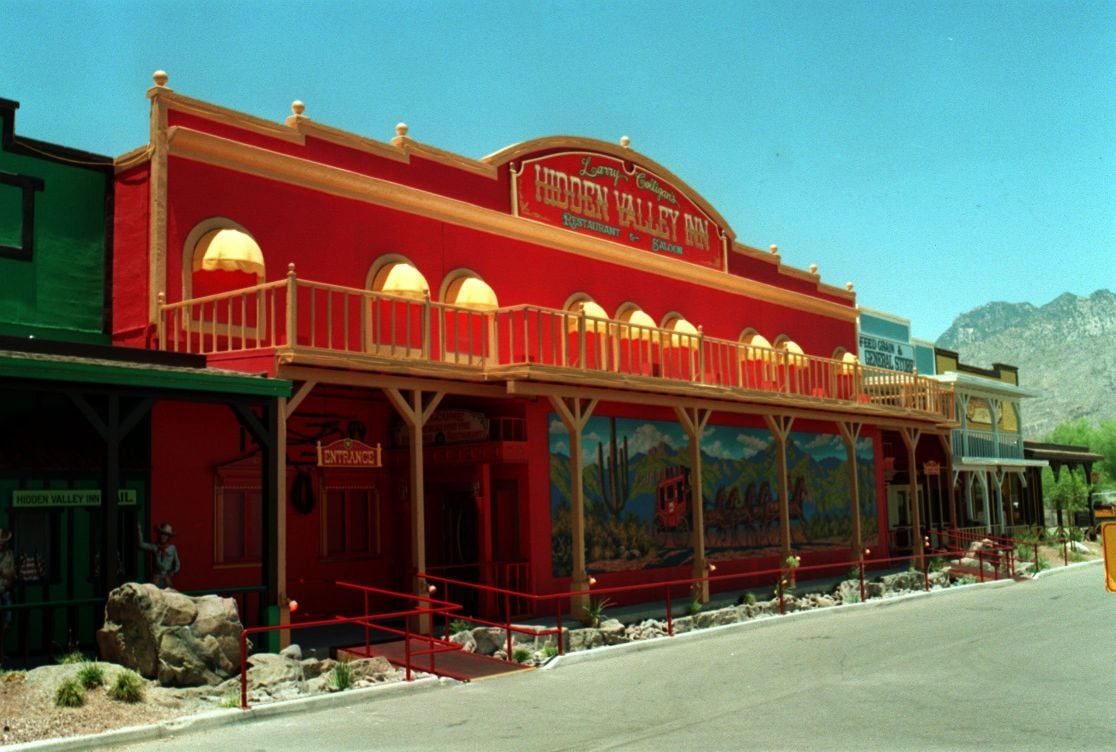
Hidden Valley Inn

Hidden Valley Inn

Hidden Valley Inn, known for its barbecue, is a landmark on North Sabino Canyon Road, rebuilt after a 1995 fire. Founder and owner Larry Colligan reopened his Hidden Valley Inn restaurant in November of 1996, after a fire on August 7, 1995. The 25,000 square foot restaurant seats more than 600 guests. Colligan currently has over 150 employees. Closed in 2006.

Val Cañez / Tucson Citizen

The Home Den Lounge

The Home Den Lounge

Patrons at The Home Den Lounge, converse and watch the University of Arizona basketball game on one of the many televisions set up throughout the bar on Wednesday, November 29, 2007, in Tucson, Ariz. Closed in 2008.

A. E. Araiza/Arizona Daily Star

J-Bar

J-Bar

Diners enjoy themselves during the Primavera Cooks summer dining event at J-Bar Wednesday, May 19, 2010. Closed in 2012.

Jill Torrance/Arizona Daily Star

Level Bar/Lounge

Level Bar/Lounge

Jason Henning, left, Sylvia Strigén, center and Gitane Versakos hang out near a lighted wall on the dance floor of Level Bar/Lounge in St. Philip's Plaza, 4280 North Campbell Avenue, Suite 37, in Tucson, Ariz., Friday Nov. 24, 2006. Closed in 2012.

Greg Bryan/Arizona Daily Star

McMahon's Steakhouse

McMahon's Steakhouse

Smoke Cigar Patio & Bar at McMahon's Steakhouse, Tucson, AZ., Thur. Oct. 25, 2007. Closed in 2015.

KELLY PRESNELL/ARIZONA DAILY STAR

Palomino

Palomino

Jim and Mary Gekas will turn their building and grounds over to another local restaurant family. Palomino shuts after operating for 27 years. Arizona Daily Star file photo taken April 25, 1994. Closed in 1994.

Brian Winter / Arizona Daily Star

Pearl

Pearl

Pearl, features an oxygen bar with a range of scents to eliven or calm. Photo taken Friday, June 1, 2007. Closed in 2011.

Chris Richards / Arizona Daily Star

Seven Black Cats

Seven Black Cats

Al Perry and his band perform at Seven Black Cats Saturday January 2nd, 1999, on Congress Street in downtown Tucson. Closed in 2005.

Ben Kirkby/Arizona Daily Star

Sharks

Sharks

Drummer for the band "Poulain," Todd Wisenbaker from Hollywood, Calif., walks down the sidewalk in front of Sharks Bar on Congress St. in downtown Tucson, Arizona on Friday Sept. 12, 2003. Closed in 2012.

Max Becherer / Arizona Daily Star

Tiki Bob's

Tiki Bob's

Women dancing on the bar is not uncommon at Tiki Bob's. It closed in 2004.

Francisco Medina / Tucson Citizen

Ye Olde Lantern

Ye Olde Lantern

Ye Olde Lantern restaurant at 1800 N. Oracle Rd. is closing Saturday, Feb. 25, 2006. Closed in 2006.

Jeffry Scott/Arizona Daily Star

Bobby McGee's

Bobby McGee's

Employee's of Bobby McGee's dressed in costume. Photo taken July 1, 1980. Closed in 1995.

Joe Vitti / Arizona Daily Star 1980

Chances

Chances

New disco and restaurant Chances, 6542 E. Tanque Verde Road, was started by Richard Harrison and Peter Bushhauser. Photo taken Nov. 9, 1978. Closed in 1985 when the building was condemned after an arson fire.

Arizona Daily Star

The Solarium

The Solarium

The Solarium, 6444 E. Tanque Verde Road in 1982. Closed following a fire in 1999.

Tucson Citizen

Related to this collection

Most Popular

Photos: Pima County Fair

Photos: Pima County Fair

Fair goers take in the Pima County Fair, April 22, 2026, Tucson, Ariz. This year's fair is heading into its final weekend, last session is Sunday.

Photos: Catalina Foothills outlasts Canyon del Oro 6-5 in 12-inning marathon, high school baseball

Photos: Catalina Foothills outlasts Canyon del Oro 6-5 in 12-inning marathon, high school baseball

The Falcons couldn't hold a 4-0 lead late, erased a one run deficit in the tenth and finally got past the Dorados with a run in the 12th in a …

Photos: Arizona football holds its Spring Showcase

Photos: Arizona football holds its Spring Showcase

The Wildcats wrapped up their off-season camp with their Spring Showcase, April 25, 2026, Tucson, Ariz.

Photos: Center for Creative Photography announces acquisition of nine photography archives

Photos: Center for Creative Photography announces acquisition of nine photography archives

The Center for Creative Photography, CCP, at the University of Arizona announced the acquisition of archives from nine photographers including…

Photos: Arizona run-rules Houston 9-1, Big 12 softball

Photos: Arizona run-rules Houston 9-1, Big 12 softball

The Wildcats do their damage via the long ball, getting seven runs on four homers, including two shots and five RBI from Sydney Stewart, in a …

Photos: Home Depot Foundation and Habitat for Humanity Tucson team up to build homes

Photos: Home Depot Foundation and Habitat for Humanity Tucson team up to build homes

Two dozen volunteers came together to work on a home in the Angels Crossing neighborhood for a Vietnam veteran and his wife, as part of a work…

Photos: Pima County Fair

April 23 recap: Tucson news you may have missed today

Thursday's news: What you missed while you were at work.

Arizona measure replaces 'West Bank'' with Judea and Samaria

April 21 recap: Tucson news you may have missed today

Get a recap of Tuesday's local news stories from Arizona Daily Star.

Tucson speaks up: Letters to the editor for the week of Apr. 24, 2026

Tucson speaks up: Letters to the editor for the week of Apr. 24, 2026

Our weekly round-up of letters published in the Arizona Daily Star.

Tucson Sugar Skulls end home skid ahead of rematch with San Diego

April 22 recap: Tucson news you may have missed today

Don't miss Wednesday's most popular stories from Arizona Daily Star.

Arizona Daily Star
  • Facebook
  • Twitter
  • Bluesky
  • YouTube
  • Instagram
  • Arizona Daily Star Store
  • This is Tucson
  • Saddlebag Notes
  • Tucson Festival of Books

Sites & Partners

  • E-edition
  • Classifieds
  • Events calendar
  • Careers @ Lee Enterprises
  • Careers @ Gannett
  • Online Features
  • Sponsored Blogs
  • Get Healthy

Services

  • Advertise with us
  • Register
  • Contact us
  • RSS feeds
  • Newsletters
  • Photo reprints
  • Subscriber services
  • Subscription FAQ
  • Licensing
  • Shopping
© Copyright 2026 Arizona Daily Star, PO Box 26887 Tucson, AZ 85726-6887
Terms of Use | Privacy Policy | Advertising Terms of Use | Do Not Sell My Info | Cookie Preferences
Powered by BLOX Content Management System from bloxdigital.com.
  • Notifications
  • Settings
You don't have any notifications.

Get up-to-the-minute news sent straight to your device.

Topics

News Alerts

Breaking News