

‘What are you going to do about it?”
That’s the question the homeless camp in the heart of downtown Tucson is asking of city government and of the local populace in general.
What are we going to do about in-our-face homelessness — homelessness we’d rather not see but can’t avoid?
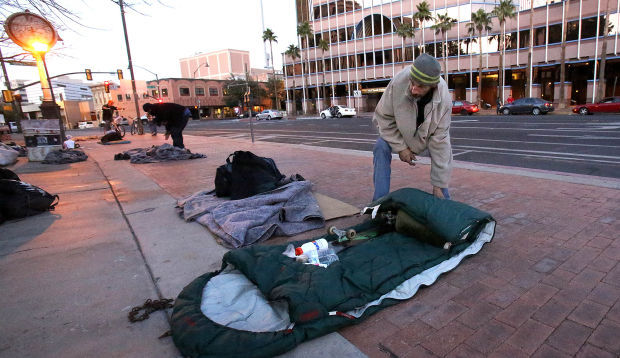
The question has become pointed with the annual Gem, Mineral and Fossil shows about to begin downtown. Understandably, some would prefer not to have a homeless camp in Veinte de Agosto Park, the triangular park on the main route between I-10 and downtown — it could become one of the primary images of the city for people visiting from around the world.
City officials have done what they can under the law: Enforcing the dusk-to-dawn closures of the park and confining homeless sleepers to a portion of the sidewalk, as long as they’re not obstructing the way. But if you look at the scene along Church Avenue between Congress and Broadway on any given night — a row of people covered in gray woolen blankets — I bet you’ll come away with the same feeling I did.
People are also reading…
This is not a solution.
So what are we going to do about it?
Jonathan McLane has been one of the main people happily pushing that question on us. He’s a veteran of the Occupy Tucson camps in the same park, articulate and intelligent. He began promoting the park as a “safe park” and part of a movement called “Occupy Public Land” in the fall. Before that, the park’s homeless population had dwindled.
“We made our sole purpose at the time decriminalizing homelessness,” he told me as we sat at one of the tables along Church Avenue Tuesday afternoon. “Technically, we can be on the sidewalk 24 hours a day because this is a protest.”
This is, of course, a conceit: Talk to any number of the homeless people staying in the park, and they don’t say they’re there expressing their First Amendment rights. How can you protest when you’re asleep? How can you assemble?
But what the park and adjacent sidewalk do offer are relative safety, which is one of the key things McLane is demanding.
“Here we have strength in numbers. Somebody can come and kill you if you’re sleeping behind a dumpster,” Josh Smith told me.
He and his girlfriend have been staying at the park, preferring not to go to shelters because they don’t house couples together, he said.
A 24-year-old woman, Katherine Bliss Hearld, told me she’s happy with the site and even the move to the sidewalks for sleeping.
“It’s a lot more comfortable and good for your back,” she said. “I would recommend it to anybody.”
The Veinte de Agosto site has several advantages: It’s close to services, bathrooms and food during the day. The park is a comfortable place to hang around during open hours. The police come by frequently, keeping away trouble. And the sidewalk is wide enough that you can sleep there without violating the law by obstructing the path.
To kick people off the sidewalk at night would require a change in ordinances, Mayor Jonathan Rothschild and Tucson police Capt. James Webb told me. The city could ban sleeping on the sidewalk, something ordinances currently allow.
“It comes down to the City Council deciding whether they want to put down new ordinances that are more restrictive,” Webb said.
That’s politically unlikely, considering the makeup of the council but would also be shortsighted. Where do we think they’ll go if we remove them from the sidewalks?
Back to the washes, the tunnels and other unhealthy hide-outs.
“This is not a city that doesn’t care,” Michael Keith of the Downtown Tucson Partnership said. “Quite the contrary. It’s almost a city that over-cares.”
It’s not wrong to want to “clean up” downtown — after all, this is a relatively recent camp that was the brainchild of an activist, not some sort of ancestral homeless home. What would be wrong is to try to simply move the homeless out without recognizing their plights and addressing them.
So if we’re not going to make sleeping on the sidewalks illegal, then we have to come up with some other solution.
McLane wants the city to establish a sort of homeless camp site where people can have access to bathrooms, showers, lockers and a place to sleep.
It could work. The city of Phoenix has set up a sort of version of this.
Another alternative: getting more people into shelters and services. Those I interviewed at the park were not big fans of shelters.
There are too many rules, they said, not to mention that the shelters are all filled early in the day this time of year.
“A lot of the shelters are pretty funky, man,” said Cliff Wade, an outreach worker for Old Pueblo Community Services who has been homeless. “Forty people in a dorm. Forty people snoring, funky. It’s not a lot of fun.”
A 62-year-old who called himself Crosby and said he’s a Vietnam vet put it to me this way: “I don’t want to be inside. I’ve grown accustomed to living outside. It ain’t that bad.”
So, if we don’t want homeless people making a camp of Veinte de Agosto Park and sleeping on the adjacent sidewalk — as I don’t — we’ve got to find something to draw them elsewhere. We’ve got to offer something better, be it a nicer site to camp, better services or more plentiful and user-friendly shelters.
Then we need to insist that the homeless take advantage of them, or perhaps face a ban on sidewalk sleeping.
Tucson didn’t create this problem, but we’re being forced to face it.
What are we going to do about it?
Contact columnist Tim Steller at tsteller@azstarnet.com or 807-7789. On Twitter: @senyorreporter
Contact columnist Tim Steller at tsteller@azstarnet.com or 807-7789. On Twitter: @senyorreporter

Tim Steller
Columnist

 Tim Steller's column: New info justifies recall against Sheriff Nanos


