

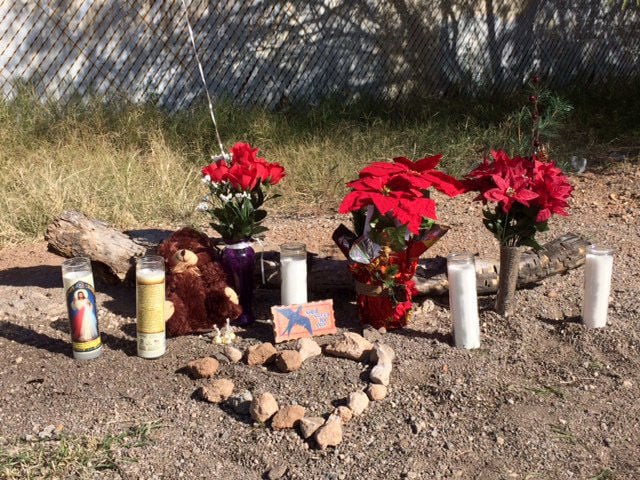
On Tuesday, I walked and jogged the route that Gerald Ramon took before he was killed Sunday afternoon
Ramon, as you may know, apparently stole two cases of Budweiser from a Circle K on the southeast corner of West Grant Road and North Oracle Road. Some witnesses followed him, including a man on a bicycle who pursued him across both of those busy streets and a few doors down Grant before Ramon allegedly picked up a piece of wood, turned and advanced on the man. The witness responded by shooting him dead.
It took me 2 minutes, 40 seconds to walk the route fast between the Circle K and the site of the shooting. It took me 1 minute and 50 seconds to jog the route.
So, we can conclude that the man who ended up shooting Ramon probably followed him for about 2 minutes after he left the Circle K with stolen beer in hand. Police have not released the identity of the shooter, citing the fact that he has not been charged with a crime.
People are also reading…
The 2-minute pursuit makes no sense, and is one of a couple of cautionary aspects of this troubling incident. It also holds warnings about the risks involved with carrying a handgun.
Convenience-store clerks are trained not to chase after shoplifting suspects for a variety of reasons — danger and liability among them. Most fundamental of all, though, is this: It’s not worth it.
“It’s a risk to everyone,” said Rosemary Erickson, a forensic sociologist who has written security guidelines for the National Association of Convenience Stores. “In this case it turned out to be a risk to the thief, but if the thief had had a gun, he could have turned and shot the person following him.”
We in Tucson learned this lesson in 2006, when a Quik Mart clerk named Christopher Cottle left his post to follow three men who were stealing two 18 packs of beer. They shot and killed Cottle.
It’s really, really not worth it.
What do the police want you to do? Tucson police Sgt. Kimberly Bay was reticent to give hard-and-fast rules when I talked with her about it Monday, but she said the most helpful thing would be to get a good description of the perpetrator.
“Every situation is going to be different. We want people to be good witnesses,” she said. “Overall, really what we want is for everyone to stay safe.”
Erickson told me that in robberies and thefts, her advice is to not even stare at the criminal. Getting a good description is what security cameras are for. But stores can’t train anyone except their employees.
“What I always say is it’s easy to train the employees, but how do we train the customers?”
Pursuing a beer thief across two busy streets for 2 minutes or so is much more than needed for a good description. What would convince a person to do that?
Moral outrage would be one factor. We all get sick of crime, and the arrogance of someone walking out undisturbed with a case of beer could be especially galling. But it’s dumb to allow that to turn us into vigilantes.
Another factor in the shooter’s decision to follow Ramon could have been the security of knowing that, if worst comes to worst, he was armed. But this Sunday killing and other recent Arizona events have shown that carrying a handgun brings its own risks.
In fact, Vinson Holck, a concealed-carry instructor and general manager at the Marksman Pistol Institute told me that in these scenarios, “more can go wrong than can go right” for the person carrying the gun. When you point or fire a gun at someone, there’s the risk of criminal charges, and civil suits are a strong possibility in any such confrontation.
In his courses, Holck said, he teaches about four hours on legal issues related to carrying a gun. After taking in all that info, a lot of students decide to leave their firearms at home, not carry, he said. Still, interest in carrying a gun is growing, he said.
“More people are feeling they’re not being protected, so they have to take matters into their own hands,” he said.
There are, of course, cases in which a so-called “good guy with a gun” protects himself or someone else. But this case Sunday and a couple of other recent Arizona incidents seem like cases where the presence of a gun unnecessarily escalated the situation into life-threatening violence.
In the early morning of Oct. 9, Northern Arizona University freshman Steven Jones was punched by someone in a drunken group of students. He went to his car and got his gun, then shot at the group who had attacked him.
Here’s how a prosecutor described what happened: “The defendant had retreated from the fight; he obtained a gun and then went back into the fray. It was at that point that he began firing at the victims.”
Common sense says, if you can get into your car to retrieve your gun, you can drive away from a group of guys on foot.
In Phoenix Saturday morning, a 41-year-old man saw a woman stealing things from his work vehicle, police said. The man, Pedro Sales, fired warning shots in the air, then, when the woman ran away, he followed her in a vehicle and fired shots at her, striking her once.
Sales was jailed and accused of aggravated assault. His case appears to be a clear-cut one of exceeding self-defense needs.
Sunday’s case may not be so clear-cut. I wrote last year about the breadth of Arizona’s 2006 “stand your ground” law, under which you have no duty to retreat from a perceived deadly threat. All you really have to show is a reasonable fear of a deadly danger, not that an actual danger existed.
With that as the law, even a person who follows a beer thief from a convenience store has a good chance of escaping charges, let alone being convicted by a jury. All he’s likely to need to show is that he reasonably feared Ramon would whack in him in the head with that big stick — even if the shooter had unwisely provoked the confrontation in the first place.
Sometimes bad luck puts us in these tricky situations — the first thing we should remember to do is not make them worse.
Contact columnist Tim Steller at tsteller@tucson.com or 807-7789. On Twitter: @senyorreporter

Tim Steller
Columnist


