As his retrial starts Monday, former Drug Enforcement Administration Agent Joseph Bongiovanni can expect a lineup of former colleagues and bosses to testify again in the coming weeks.
For a second time, they will be asked about reported forgeries, curtailed surveillance and suspicious handling of confidential informants that prosecutors point to as evidence of bribery and corruption.

Former DEA agent Joseph Bongiovanni tested positive for Covid on Saturday, as have two jurors, forcing another delay in his retrial on bribery and drug-trafficking charges.
The current and retired agents generally did not provide the kind of explosive revelations or dramatic recollections that drug traffickers, informants and former exotic dancers offered over 23 days of testimony in the first trial.
Indeed, most of his former colleagues testified that they bore no ill will toward Bongiovanni.
People are also reading…
Still, their testimony can be seen as key to the prosecution. What they say during the retrial could affect the outcome on at least eight of the remaining 11 counts against Bongiovanni. So, even if jurors are skeptical about what they hear from former drug traffickers, informants and dancers, the testimony of federal agents who worked with Bongiovanni might give jurors enough reasons to convict him of conspiracy, obstruction of justice and lying to a federal agency – with each of those charges carrying potential prison sentences anywhere from five to 20 years.

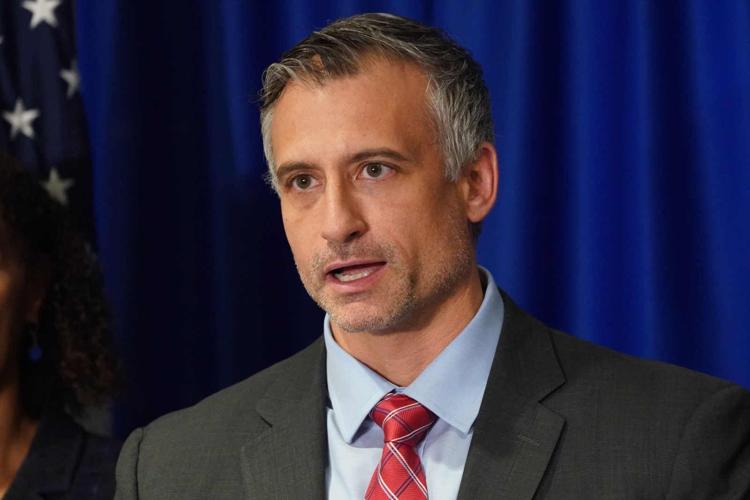
Assistant U.S. Attorney Joseph M. Tripi said at Joseph Bongiovanni’s first trial that his DEA colleagues “had no reason to come here and make things up about whether ... it was their signature or not” on documents.
It will be signatures on DEA forms – not marijuana shipments or reported bribe payments – that some DEA agents will be asked about as prosecutors seek to show that Bongiovanni manipulated them by filing false and misleading reports about investigations to reportedly protect criminal organizations.
“Now, those DEA agents that were called, they were his co-workers and friends, at times,” Assistant U.S. Attorney Joseph Tripi said in his closing argument at the first trial. “They had no reason to come here and make things up about whether ... it was their signature or not.”
Bongiovanni’s defense attorneys Robert Singer and Parker MacKay will cast the agents’ accounts in a different light.
“One thing they have in common is they’re company guys, right?” Singer in his closing argument. “Another thing they have in common is they were all in the same office when the Office of Inspector General and the Office of Professional Responsibility and everybody else came in to investigate what was going on at DEA. And they came in and those investigators were heavy, right? In that environment, when you have something to lose, it becomes a lot easier to claim you didn’t sign a document that you don’t recall signing from 10 years ago.”
The jury in Bongiovanni’s first trial did not reach a verdict on 12 bribery and corruption counts, but found him guilty on one count of obstruction of justice and one count of lying to federal agents over a case file kept in his home after his retirement. Jurors acquitted Bongiovanni, 60, of deleting data on his DEA-issued cellphone when he retired. Last week, U.S. District Judge Lawrence Vilardo acquitted him on the charge he was paid an undetermined amount by strip club owner Peter Gerace Jr. to help him and his Pharaoh’s Gentlemen’s Club avoid federal narcotics investigations and induce the FBI to abandon an investigation.

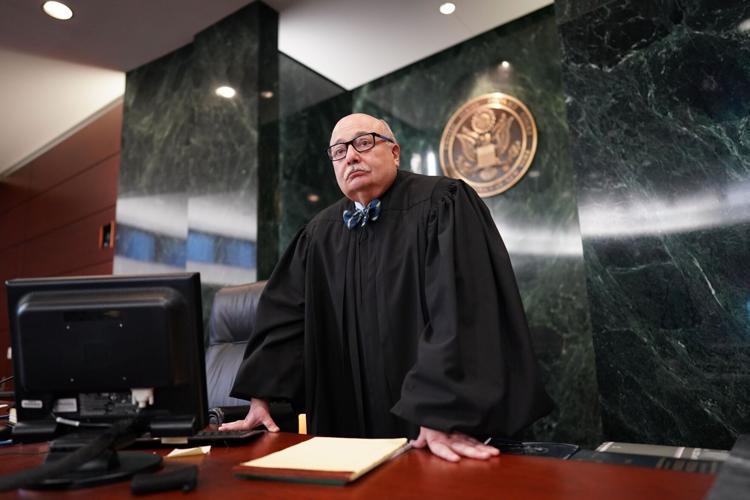
U.S. District Judge Lawrence Vilardo will decide whether to vacate another judge’s “bad faith” finding.
In Round 2 of the United States v. Bongiovanni, the former federal agent faces 11 charges, including protecting members of the Ron Serio drug-trafficking organization from arrest and alerting them of informants, in exchange for monthly payments totaling at least $250,000.
Disputed signatures
Mark Gentile, a DEA supervisor in Buffalo, testified previously that he sometimes assisted Bongiovanni, but not in the Serio investigation.
A signature resembling his handwriting appeared on a confidential source deactivation form. Prosecutors contend that Bongiovanni deactivated the informant to keep the informant from providing information about Serio.
But Bongiovanni needed a witness to sign off on deactivating the informant.
The signature line on the form was for an agent, Shane Nastoff, but the signature appears to be Gentile’s handwriting, prosecutors say.
At the time the form was signed in 2013, Gentile sometimes filled in as an acting supervisor, taking over for a vacationing or ill boss.
In that role, he would sign documents. Agents had a practice of signing documents for other agents at times, and when Gentile did so, he would sign his name, followed by a slash and then the letters F-O-R.
That showed he was signing for the agent who was not available, but whose signature was required on the form.
Gentile said he had no involvement in drafting the deactivation form, and did not know the confidential informant.
He said the first time he saw the form was during an interview with the Department of Justice’s Office of Inspector General.
“Somebody must have signed my signature, and I say that because the first thing that popped out at me was the fact there wasn’t a slash and F-O-R when I saw the document,” Gentile said.
Nastoff testified he did not sign the document.
That was not the only disputed signature.
When Serio was added to the case file as someone to investigate, Nastoff was listed as a co-case agent on a form he purportedly signed.
Nastoff testified that it was not his signature.
And a December 2012 form in a Bongiovanni investigation was purportedly signed by Nastoff, but the signature resembled Agent David Leary’s, according to prosecutors.
“Did you sign this document?” Tripi asked Leary at the first trial.
“I don’t believe so, no,” Leary replied.
On Thursday, the judge presiding over Bongiovanni’s trial ordered the DEA to turn over to Bongiovanni’s lawyers additional samples of Leary’s signature from 2012, to be gleaned from reports or other documents he signed, if they are available in the agency’s Buffalo office.
The defense lawyers have retained a forensic document examiner to determine whether Leary signed two documents related to the Serio investigation.
The examiner determined that Leary signed one of the two documents, but could not render an opinion about the signature on the second form because the examiner had only five samples of Leary’s signature, according to a defense filing.
Hating Italians?
For Anthony Casullo, a retired DEA agent, a contentious encounter with Bongiovanni brought him to the witness stand at the first trial.
After his 2015 transfer to the Buffalo office, he subpoenaed Gerace’s phone records.
Casullo testified he gave his boss a heads up that it was possible Bongiovanni’s phone number might appear in the records, because he said he knew Bongiovanni “was friends” with Gerace. Bongiovanni’s DEA cellphone number placed among the top 10 most frequently called numbers in Gerace’s phone records, Casullo testified.
“Within a couple of days, I noticed that Joe wasn’t speaking to me anymore, and he looked like he was upset,” Casullo said.
So Casullo asked Bongiovanni to meet him in a conference room – just the two of them – to clear the air.
The first thing Bongiovanni said was Gerace called him when a stripper overdosed at Pharaoh’s, Casullo testified.
“And I told him to get her out of there,” Bongiovanni said, according to Casullo.
Casullo said he was shocked a fellow DEA agent would advise a strip club owner to do that.
He was also taken aback by what Bongiovanni reportedly said next.
“He asked me if I hated Italians,” Casullo added. “I said ‘No. I’m Italian. My family’s Italian. My wife’s Italian.’
“He said we should be investigating Black people and Hispanics,” Casullo said, but noted Bongiovanni used derogatory epithets for them.
Casullo did not report Bongiovanni’s comments to his supervisors until a couple of years later, only after federal officials began investigating Bongiovanni when Serio alleged Bongiovanni had provided him information about informants and investigations as a way to shield Serio’s drug operation.
Why wait?
Casullo said he feared the reaction from co-workers.
His fear wasn’t unfounded.
“I have people that I knew for 20 years, police officers that I worked with, one in particular, that crossed the street when she saw me outside the office,” he testified. “I had people ignore me in the office.”
Casullo said he volunteered to work nighttime surveillance assignments to avoid going into the office.
Singer, Bongiovanni’s defense lawyer, said Casullo was the only agent to testify about any racial animus.
“No one came to back up the story he told,” Singer said.
What’s more, Singer said, there’s no proof Casullo stopped a Gerace investigation based on anything said in the conference room.
“Bongiovanni wasn’t even involved in that investigation,” Singer said. “Casullo wouldn’t let him.”
Breaking off surveillance
Bongiovanni did lead the Serio investigation.
Leary, a DEA agent for 15 years, testified that he saw the Serio file every time he walked past Bongiovanni’s desk. It was always there.
The whereabouts of Serio’s warehouse was another matter. Leary said Bongiovanni told him in June 2013 he couldn’t find it.
“So I said, ‘I’m pretty good at finding people’s locations and vehicles,’ “ Leary said at the first trial, recounting how Bongiovanni approved his offer to find the warehouse.
Leary found the warehouse in one day – on Sycamore Street, three blocks from the DEA’s offices in the Electric Tower.
Leary said he called Bongiovanni, telling him he spotted two people getting ready to leave the warehouse.
Leary thought they could be moving narcotics.
So he was surprised when Bongiovanni told him to return to the DEA office.
“I came back to an office full of agents,” Leary said. “We could have done the surveillance. But it wasn’t my case. I went back to work.”
A few weeks later, Leary asked about setting up surveillance at the warehouse.
“He said his informant told him that they moved the warehouse,” Leary said.
Singer said the marijuana-grow operation at the warehouse had ended in 2010.
“Dave Leary could have sat outside that place till kingdom come,” Singer said. “He wasn’t going to find any grow operation in 2013.”
But agents might have found bundles of marijuana, Tripi said, because Serio’s crew unloaded truckloads there, Tripi said.
When Leary discovered the warehouse, he could have followed the people he spotted there, Tripi said.
“What Leary wanted to do that day was follow the car and then sit up on the next place,” Tripi said. “That would have been a good investigation.”
Patrick Lakamp can be reached at plakamp@buffnews.com