

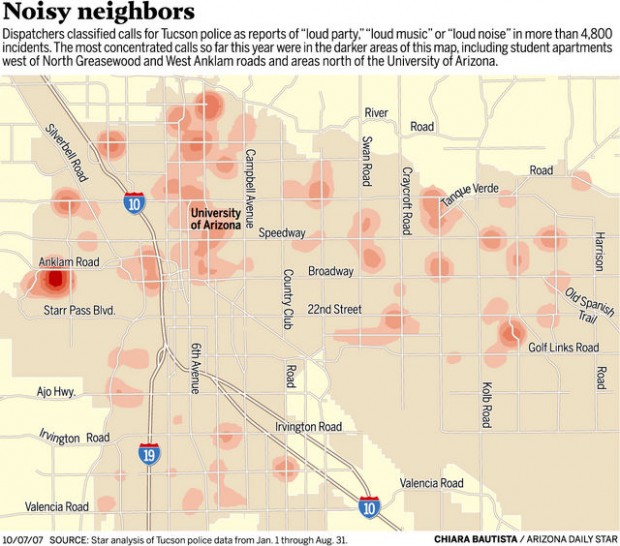
A cluster of apartment complexes on the West Side has become the most concentrated source of loud-party complaints to Tucson police.
Police get about 7,500 calls a year from people complaining about music, parties or other loud noise throughout the city.
The most widespread cloud of complaints snakes from around the University of Arizona north to Wetmore Road, mostly around North Euclid and North Stone avenues.
A blanket of complaints that is smaller, but the most intense, is about four miles west of the UA near West Anklam and North Greasewood roads.
Besides disturbing neighbors and wasting the resources of police, unruly parties often breed fights, sexual assaults or other violence, police say.
"If it was just people having fun, it wouldn't be that big a deal. But more often than not they turn violent," Detective Richmond Holley said of the unruly gatherings he sees on the West Side.
People are also reading…
The Star examined data on calls to police from Jan. 1, 2006, through Aug. 31, 2007.
So far this year, police were called more than 100 times to quell noise at apartment complexes built in recent years southwest of West Anklam and North Greasewood roads, mainly in the 2500 block of Anklam and the 1800 block of West Broadway.
Records show nearly half the callers complained about music or parties at University House at Starr Pass, 2525 W. Anklam Road.
"The early history of the building (complex) was that there were a lot of calls for complaints in the last three or four years," said Erin Allsman, a spokeswoman for the owners. "In the last 90 days or so it's actually gone down a bit."
Philadelphia-based Campus Apartments Inc. assumed ownership and management in early June and is enforcing rental agreements that provide fines or eviction for renters who get out of hand, she said.
A video called "Star Pass Pool Party," which features students drinking and dancing on what it calls a "typical Saturday" at University House, has been viewed more than 6,700 times since it was put up Aug. 30 on YouTube.com.
At some huge parties around the city, the host claims to police that he invited perhaps 25 people. Then everybody started text-messaging and he wound up buried in guests he didn't know. Sometimes members of rival gangs show up.
The police practice of aggressively tagging homes and apartments with red stickers and citing the owners or renters for an unruly gathering appears to at least prevent loud follow-up parties.
"I've only had two recurring red tags in the last year. So once they get red-tagged, they quiet down," said Officer Jeannie Nagore, who processes the tags for the Midtown area.
UA officials who studied the 104 red-tags issued around the city in the first five months of this year said one or more UA students were involved in 50 of those incidents. They said more than half of the parties involving UA students included underage drinking, but only a handful involved drugs or violence.
In the UA area, where houses that once held families have increasingly been taken over by student renters, loud parties are one reason the Tucson City Council is considering changes to the zoning law to let neighborhoods have a bigger say in regulating the construction of so-called "mini-dorms."
The higher concentration of calls to police north of the UA may be partly due to neighborhood associations that urge members to call 911.
"We don't have very much tolerance any more for wild parties," said Dyer Lytle, president of the Jefferson Park Neighborhood Association.
He said many student renters are good neighbors, and the red-tag program has helped with those who are not, but the zoning overlay proposal is not strong enough.
"We'll have cute mini-dorms, but we'll still have mini-dorms," he said.
Chelsea Kerzner, a UA journalism junior who lives in a mini-dorm near East Grant Road and North Highland Avenue, said the area has so many students who are well-behaved or tolerant of loud parties that noise and mini-dorms shouldn't be an issue.
"The police have more important things to worry about than noise," she said. "This area has had a lot of issues with break-ins" and prowlers. "This is a high-crime area and … it shouldn't be."
A few blocks south on Highland, Justin Stern, a UA senior in media arts, stood on his porch and gestured around the neighborhood that he estimates is 80 percent students.
He said families who live there should move if they don't like the noise because students already dominate the neighborhood.
He said he suspects fraternity houses make more noise than the mini-dorms.
Through August, loud-party and -music complaints citywide numbered 4,806, 72 complaints more than the same period last year.
Scott Weiner, an accounting senior, recalled complaints at his previous house.
"Ever since then we've made it a point to try to be on good terms and be good neighbors," he said.
"If it was just people having fun, it wouldn't be that big a deal. But more often than not they turn violent."
Detective Richmond Holley
on loud parties at West Side complexes


