

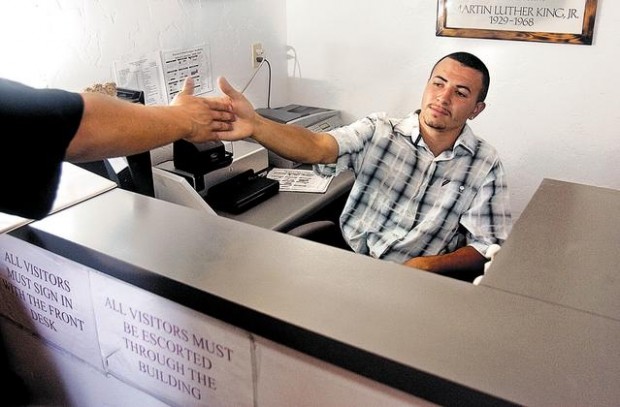
If you had visited the juvenile lockup in Pima County a decade ago — at the height of the adult-time-for-adult-crime campaign — you'd have seen young people sleeping in the cafeteria because of overcrowding.
If you'd visited five years ago, you'd have seen nearly 200 juveniles held each day.
If you visited on Monday, you would have counted 78.
In annual numbers, there were almost 3,500 youths detained in Pima County in 2003, a number that plummeted to 2,583 last year and is still dropping.
In year four of a wide-scale transformation of Pima County's juvenile-justice system, troubled kids are being diverted into other alternatives.
"We're responding to national research which negates some commonly held beliefs that you can scare them straight," said presiding Juvenile Court Judge Patricia Escher. "More frequently, when you detain young people inappropriately, what you do is send them on a path of criminality."
People are also reading…
Lower-risk youths might be influenced by higher-risk ones they meet in detention.
And then there's the power of the self-fulfilling prophecy, Escher said.
"If you have youths wondering, 'Am I a good person or a bad person?' and you put those young people in detention, you're confirming this is who they are and this is who we expect them to be," she said.
How states treat their kids, including those in the juvenile-justice system, is getting attention today with the annual release of the Kids Count report by the Annie E. Casey Foundation in Baltimore, a private charitable organization "dedicated to helping build better futures for disadvantaged children in the United States."
The latest Kids Count report says Arizona still has too many young people getting pregnant and dropping out of school.
There are too many children going without health insurance and performing pretty abysmally on test scores, it says.
On the other hand, Arizona's juvenile-crime-arrest rate is lower than the national average.
Arizona's minority youths are in the juvenile-justice system at twice the rate of white youths, but that's still better than the nationwide rate.
Abraham Richards, 18, was one young offender here who got another chance.
He said he'd done every bad thing you might come up with if you were making a list of the stereotypical juvenile delinquent: guns, drugs, robberies.
He was first busted in eighth grade on a marijuana charge. His parents were furious. He was kicked out of his school. But it didn't stop him. His freshman year in high school he was arrested on armed robbery and grand theft charges. Charges were dropped, followed by more arrests. And a stint in rehab.
He remembers a Juvenile Court judge crying when she sentenced him to a boot-camp program for four months. "She said she saw something special in me and she said she knew what I could be capable of," he recalled. "I felt like crying, too."
It was at the boot camp, where he met with military-style discipline and hard physical work, that something started switching over in his head.
That was followed up with a program offering an alternative to detention, run by the Tucson Urban League, and that's when he finished his journey.
"I wasn't all the way straight. I was still slipping up, still not handling my anger the right way, still not talking to my mom the way I should," he recalled. His mentor there gave him the skills he needed to address problems maturely and walk away from trouble.
Richards said college wasn't in his long-term plan, since he thought he'd be dead or in prison by the time he was an adult. Now he plans to attend college next year to work toward a degree in finance.
He impressed his mentor so much that he's now working full time at the Urban League, helping steer youths who are in the same place he was a few years ago. "I tell them I lost three years to the system and it's not worth it," he said.
The courts are also working with partners in the community to try to clamp down on the pipeline that sends kids to them in the first place, with a big focus on the schools.
Jim Fish, a principals supervisor for the Tucson Unified School District in charge of student-equity issues, said he's made some efforts to train principals on ways to cut down on suspensions. There's a strong correlation between juvenile referrals and school disciplinary problems.
He said he's had principals call police on elementary-school children. "It's not appropriate in my eyes to have kids committed to Juvenile who could have been handled in the school system," he said — especially since it's his instinct that police are more often called if the child causing problems has more melanin in his skin.
On Monday, black youths made up 10 percent of Pima County's juvenile detainees, although blacks are about 3 percent of the overall population.
Hispanic youths make up 45 percent of the youth population but 53 percent of detainees.
White youths make up about 30 percent of detainees, although they are 44 percent of the overall population.
Black youths also are detained longer than those from other races.
The courts have been tweaking assessments to make them as race- and gender-neutral as possible while making sure that public safety remains paramount, Escher said.
There has been no increase in youth crime even though fewer juveniles are locked up, the judge said. Back in 2003, less than 3 percent of the juvenile population was in for violent crimes against other people. That was still true in 2007.
Some offenders are just going home to wait for trial. Others, on intensive or standard probation or arrested for misdemeanor domestic violence offenses, go to evening programs that provide not only tutoring, life skills and dinner, but perhaps as importantly, a structure that keeps them off the streets.
"What we're seeing is that supervised treatment for kids in their own communities is really effective and a better use of tax dollars than just incarcerating kids," said Dana Wolfe Naimark, president of the non-profit Children's Action Alliance.
WHERE WE STAND
How Arizona compares to the rest of the nation in this year's Kids Count report, the nonprofit Annie E. Casey Foundation's assessment of how states care for their children:
39
Arizona's overall ranking among states
6.7
Infant-mortality rate (deaths per 1,000 live births; national rate is 6.9)
18
Percentage of those age 16-19 who are school dropouts (National: 11)
23
Percentage of children in poverty (below $20,444 for a family of four in 2006) (National: 17)
33
Percentage of children in single-parent families (National: 31)
24
Percentage of 4th-graders at or above proficient reading levels in 2007 (National: 32 percent)
16
Percentage of children without health insurance, 2005 (National: 11)
241
Juvenile violent-crime arrest rate (per 100,000 youths in 2005) (National: 283)


