

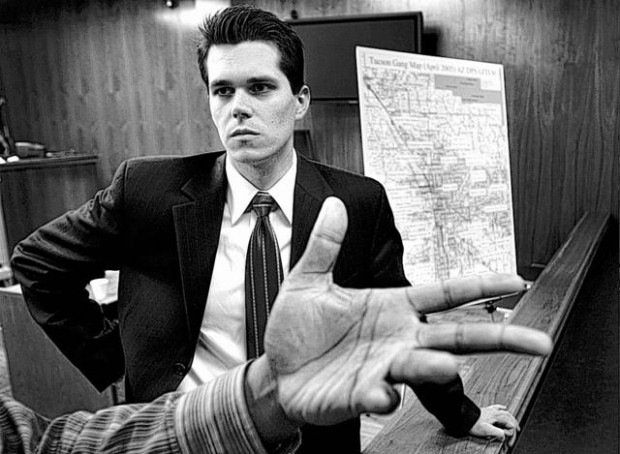
For a few minutes Wednesday, Michael Kelly was Carlos Chavez.
As more than 20 University of Arizona students watched avidly, Kelly became a 16-year-old with an attitude.
He explained, using slang, how "he" grabbed a shotgun and shot at a rival gang member because he was "flying his colors" and had called him a "slob."
Dropping the attitude, Kelly told the crowd that Chavez missed and struck an innocent bystander instead.
As a deputy Pima County prosecutor, Kelly, 27, persuaded jurors last April to convict Chavez of drive-by shooting and aggravated assault with a deadly weapon.
Kelly spoke at the UA's James E. Rogers College of Law as part of a speaker series sponsored by the law school and the Eller College of Management.
He's one of three prosecutors who present cases against gang members accused of everything from low-class felonies to first-degree murder.
People are also reading…
Chief Criminal Deputy Attorney David Berkman said Kelly's talk to the students is an example of the office's successful mentoring program.
While young doctors learn their craft during a residency program, nothing similar exists for young attorneys.
So for the past several months, inexperienced attorneys have been paired with more seasoned lawyers to learn firsthand how to prepare cases, question witnesses and conduct themselves in front of judges and juries.
"You can send a person to a million and one seminars and training sessions, but ultimately it's about what you learn from the other people in the office," Berkman said.
Although his parents, John and Virginia Kelly, are Pima County Superior Court judges, Michael Kelly said his future wasn't preordained.
"I actually wanted to play third base for the L.A. Dodgers," Kelly said.
By the time Kelly was attending Catalina Foothills High School, he was convinced that he wanted to be an actor, and he appeared in several plays.
When he started at the UA, he majored in theater arts. He later switched to finance.
When he announced to his parents that he wanted to go to law school, they were taken by surprise, Virginia Kelly said.
She and her husband had made a concerted effort to avoid work discussions at the dinner table ever since Kelly's younger sister — at the age of 9 — said she was sick of hearing about "boring" law stuff, Virginia Kelly said.
She could think of only one instance in which Kelly asked for her help while in law school. He wanted her opinion when he pretended to argue a case.
"He got so many suggestions, he didn't want to do that again," Virginia Kelly said with a laugh, noting that she once taught public speaking.
Michael Kelly graduated from law school in December 2003, passed the bar exam in February 2004 and was hired by the Pima County Attorney's Office in June of that year.
He spent six months prosecuting misdemeanor suspects before moving up to the vehicular-crime unit, where he spent nine months prosecuting felony drunken-driving suspects.
He's been in the gang unit for about 18 months.
Kelly said he knew from the first day of law school that he wanted to be a prosecutor. His parents always had stressed to him the importance of giving back to the community, and he figured that taking criminals off the street was a good way.
His parents weren't surprised that Kelly would choose to spend his days in a courtroom rather than in a law office, Virginia Kelly said.
"My husband and I both thought he should try trial work because of his theater background," she said. "A prosecutor should be able to communicate to people who are making the decisions, and Michael seems to like being in front of people."
Virginia Kelly remembers the first time she saw her son try a case.
"It was just like watching him in fifth-grade Little League," she said. "I was a nervous wreck."
To avoid the appearance of impropriety, Kelly's parents avoid his trials now and don't discuss him with other judges, even in social settings. He's not allowed to practice in their courtrooms.
Family members still try to avoid law-related discussions whenever they get together, but they acknowledge that it's become more difficult, especially since Kelly married fellow prosecutor Kristen two years ago.
Since Kelly moved up to felony prosecutions, he has tried 32 cases by himself, securing 28 convictions. Last month he helped to persuade a jury to convict Peter Massinga, 21, in connection with a triple shooting.
Teresa Godoy, Kelly's supervisor, said he keeps getting better and better at his job.
"Mike is extremely talented; he's probably beyond his years in terms of trial skills," Godoy said. "His accomplishments last year, in my mind, were significant. He got some incredible results and took some truly dangerous people off the streets."
Godoy doesn't believe Kelly's skills have anything to do with the fact that he grew up with two judges. She thinks it's related to his drive.
"He's got boundless energy," Godoy said. "He makes it fun to come to work. Energy just comes out of every pore, and he reminds me every day why I love the job."
Defense attorney Brick Storts was on the losing end of the Massinga case.
"I think he's a very bright attorney, and he was a real pleasure to work with," Storts said. "He's got a fair and sincere approach. I think he's got a real future."
Kelly concluded Wednesday's talk by saying that prosecutors are not the opposite of defense attorneys. "Any prosecutor who wants to win is a bad prosecutor. A good prosecutor wants to do justice," Kelly said. "He wants to do the right thing and be fair, regardless of how much he wants to convict someone or thinks they're guilty."
"My husband and I both thought he should try trial work because of his theater background. A prosecutor should be able to communicate to people who are making the decisions, and Michael seems to like being in front of people."
Superior Court Judge Virginia Kelly
Mother of Pima County prosecutor Michael Kelly


