

What a difference a highway can make.
And not just any highway.
The one East Side resident Joe Maierhauser fondly remembers didn't include motorists speeding from one destination to another, but instead led them along leisurely routes through towns and to unique tourist attractions.
For Maierhauser, who has been the director of Colossal Cave Mountain Park since 1956, the original, coast-to-coast Old Spanish Trail meant steady business.
That highway, also called U.S. 80, was one of the country's first cross-country roadways. It ran from Jacksonville, Fla., to San Diego and was called the country's shortest year-round route.
Today, the Old Spanish Trail is being remembered locally and nationally.
This year marks the 90th anniversary of the Old Spanish Trail's beginnings. The highway, which some historians believe was fashioned partly along routes Mexican and American traders traveled by foot and horse in the early 1800s, was completed in 1929.
People are also reading…
New exhibit at ranch
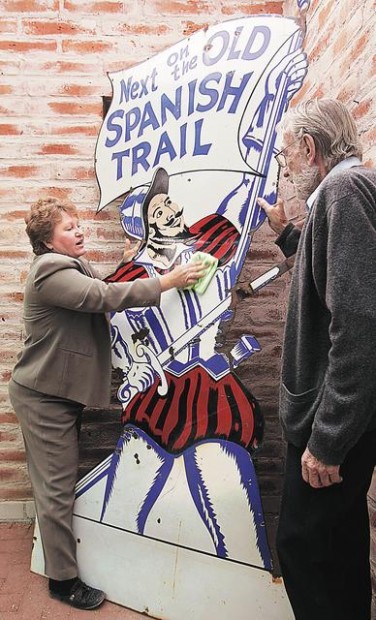
Locally, the roadway is being remembered in a new exhibit in La Posta Quemada Ranch in Colossal Cave Mountain Park. The exhibit will feature an Old Spanish Trail highway sign of an armor-clad Spanish Conquistador and information about the highway, said J.J. Lamb, the park's education director.
The heavy metal signs were used to mark the roadway and announce towns and tourist attractions, according to Maierhauser, whose friend designed them. Generally, towns and tourist sights featured signs facing both east and west as a way to mark the roadway and the particular stop.
Maierhauser said many motorists traveling along the Old Spanish Trail would stop for a visit at Colossal Cave Mountain Park, which was along the way.
But in the early 1960s, that changed when President Dwight Eisenhower's vision reached Arizona in the shape of Interstate 10.
"The difference between the pre-interstate days and modern times was staggering,'' said Maierhauser, who was president of the national Old Spanish Trail Inc. in 1956 and 1957. "I'll tell you, it was absolutely incredible."
The mindset of motorists changed from relaxed and laid back to go, go, go, he said, and many of the roadside attractions lost business.
"When you've got a good road, you get in a hurry,'' he said.
For Maierhauser and other locals who relied on the tourists, the change in roadways meant changing advertising tactics.
"The only way we were going to survive was to get them in Benson or Tucson,'' he said, explaining that park information was left at hotels. "A lot of roadside businesses went belly-up."
Maierhauser said he immediately visited many of Tucson's "ma and pa" hotels and motels, suggesting that if they promoted local businesses, they could make more money by getting people to stay on another night or two.
Advertising fliers from the late 1950s urge Old Spanish Trail travelers to "stay awhile longer" and visit Colossal Cave as well as the Arizona-Sonora Desert Museum, Old Tucson and Mission San Xavier del Bac.
Business declined for a while, Maierhauser said, but eventually the new way of attracting visitors began to catch on.
In addition to this year's anniversary, a motorcade grand finale will be held in 2029 to celebrate completion of the roadway 100 years earlier, Lamb said.
Don't get confused
The Old Spanish Trail is not to be confused with Pima County's modern roadway of the same name that winds from East Broadway through the Southeast Side and on into the scenic Rincon Valley.
The modern Old Spanish Trail was once a dirt road, said John Murphey, a historian in Santa Fe, N.M. Murphey said the dirt road may have once provided motorists with a shortcut into town from the original Old Spanish Trail.
Arizona Historical Society archives show the Old Spanish Trail was established in February 1950 from East Broadway to Freeman Road.
Maierhauser said what is certain is that the modern roadway was not part of the original highway.
One of the largest stretches of what's left locally of the original Old Spanish Trail is an access road that stretches east from Vail to Benson alongside Interstate 10, he said.
Murphey said the story of the Old Spanish Trail deserves more appreciation and recognition.
It required a "herculean effort" to build the highway, he said, and entailed crossing once impassable swamps between Florida and Louisiana and then harsh deserts in Arizona and California.
For more info
● More detailed information on the Old Spanish Trail's Arizona history can be found at http://www.drive theost.com/az.html


