

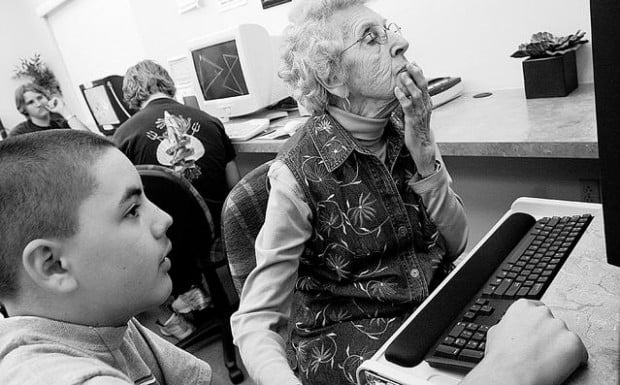
A handful of teenagers in an East Side youth employment program have taken on the challenge of getting seniors up to speed with computers.
While the life experience and wisdom of residents at the Fellowship Square Tucson retirement community could fill volumes at a vast library, many of them find the seat before a computer screen unfamiliar terrain.
Every Tuesday, from 6 to 8 p.m., the teens work toward getting those folks comfortable using high-tech machines.
The seniors benefit from the tech-savvy youngsters' knowledge, and the teens develop life skills and personal relationships with those from an older, wiser generation.
Twenty-year-old Robert Parrett, the program's technical director, has worked with seniors for more than six years. Now, he supervises the teens and helps them out when needed.
People are also reading…
Most residents who come in for lessons start off learning basic computer skills, he said.
"A lot of people just haven't seen a computer, but they want to get with the times and get in touch with their family," Parrett said.
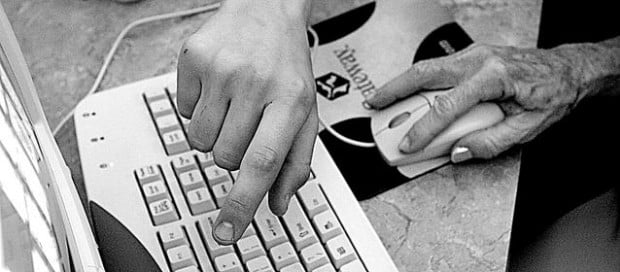
Those residents will start off playing solitaire on the computer. This gets them familiar with using the computer's mouse and other controls, Parrett said.
The residents will then move on to surfing the Internet to find news about their hometown, or using e-mail to stay in touch with their grandchildren.
Lilli Hamilton, 79, said she's taken advantage of the young instructors for the 3 1/2 years she's lived at Fellowship Square Tucson, 8111 E. Broadway.
When she first came in, she had little experience using computers. Now she volunteers at her church and uses a computer frequently.
Her latest accomplishment: sending an e-mail with an attachment that included driving directions from the Web site Mapquest.com.
"Even though I'm almost 80, I have both feet in the 21st century," Hamilton said.
Now more familiar with computers, she still takes pride in new accomplishments.
"Every day I do something new, I feel like I've conquered a little bit of Mount Everest," she said.
Parrett said he's watched as Hamilton's confidence using the computer has grown.
Cecelia Owen, 83, came in for her third visit to the computer room on March 14. She said she stops in to learn more about computers and because she has good relationships with the kids.
She said the teens are very patient and honest with her. They've even restored her hope in future generations.
"It renews my enthusiasm and faith about what's in the future," she said.
Her tutor for the day, 15-year-old Jon Wineinger, said he often has to teach the seniors the same lesson day after day. He stays interested because he's making a difference in the community.
"I know they really want to learn the computer," he said. "But they have to start somewhere."
He said he also enjoys listening to their stories and gaining from their life experiences.
Jean Sabo, the coordinator of the Vista del Sahuaro Neighborhood Youth Employment Enrichment Program, said not all kids who apply to work with seniors on computers get the job. They must exhibit communication skills and a desire to work with members of an older generation.
Sabo said she started the program at Fellowship Square about four years ago because she saw a need for those in older generations to learn how to use computers.
Sometimes, retirement communities can be apprehensive about allowing teenagers on the property, but Sabo said her program quickly proved successful.
The teens in the program gain work and communication skills. More importantly, they develop relationships with their elders, Sabo said.
"They become very attached to the people they work with," Sabo said.
Some seniors at Fellowship Square are quite knowledgeable with computers, but they still come in to ask the teens some questions.
Parrett said he's even set up wireless networks for some residents.
Occasionally a resident will come in with a problem for which Parrett doesn't have the answer. In those situations, the computer techs work together to find a solution.
"Usually if I'm stumped, between the collective brainpower we have in here, we can figure it out," he said.
"A lot of people just haven't seen a computer, but they want to get with the times and get in touch with their family."
Robert Parrett
The computer program's technical director


