

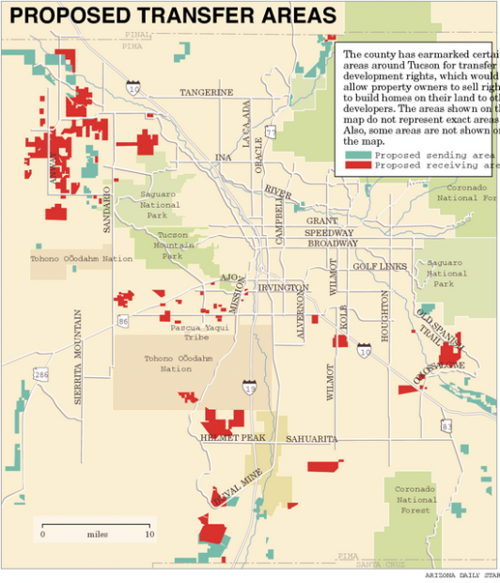
A proposed ordinance that would allow landowners to swap development rights for cash wouldn't cause massive growth in rural areas outside of Tucson, officials say, despite residents' concerns that it would encourage high-density neighborhoods.
The proposal involves unincorporated areas of Pima County on the Northwest, Southeast and East sides of Tucson.
Planning officials hail the proposal, called transfer of development rights, as another tool that would help them curb development in areas the county has targeted for conservation.
The plan is supported by developers, who say the program allows for preservation of ranch and farming lands while accommodating area growth.
However, some residents in the Rincon Valley, on Tucson's Southeast Side, have concerns about the proposed ordinance. Those include:
People are also reading…
• Its impact on some environmentally sensitive areas.
• A lack of opportunity for people who live near areas affected by the program to speak out against it.
In addition to residents' worries, it's unclear whether the program could even get off the ground.
Planning officials have yet to find landowners and developers willing to participate in the voluntary program, which would last until 2010.
The measure doesn't involve land in Tucson, Marana, Oro Valley or Sahuarita, making the program limited in its impact, planning officials said.
It still has to be approved by the Pima County Board of Supervisors, which probably won't consider the matter until January.
The transfer program, which has been used by other governments in Maryland and Pennsylvania, was created by planning officials as an alternative to purchasing land targeted for conservation outright — something the county doesn't have the money to do.
The receiving areas (see box at top right) were chosen because they were already slated for development.
Residents' concerns
Many residents living in designated receiving areas — especially those on Tucson's Southeast Side — are concerned that the program would allow developers to create super-high-density subdivisions that would choke the landscape.
Some of those residents spoke last week at a public hearing convened by the county Planning and Zoning Commission. The commission voted 4-2 with one abstention to send the proposal to the Board of Supervisors. The board probably won't consider it until January, said Supervisor Ray Carroll.
Carroll said last week that he's sympathetic to residents' concerns, and he's willing to consider proposing changes to the program.
"There's a lot of work that needs to be done on this," he said. "There's always going to be bugs in any initial presentation."
Planning officials said the fear of large, unruly developments on environmentally sensitive land is unfounded.
The program has strict guidelines that determine how many additional homes could be built in rural areas that actually support conservation efforts, said Arlan Colton, a county planning official.
The rural areas included in the program were already slated for low-density development, Colton said. Even with the transfer, the number of homes in any one development would increase minimally.
For example, a developer in a rural receiving area could have 50 acres zoned for 12 homes. The developer could buy the rights to develop three more houses on the property.
Officials estimate that if the pilot program were successful, between 4,000 and 10,000 homes would be transferred from sending areas to receiving areas.
The transfer would allow land in both sending and receiving areas to be preserved, as the extra development in receiving areas also would be limited, Colton said.
Is small increase wrong?
But even a small increase in the number of houses built in environmentally sensitive areas is wrong, said Lynn Sonneman, a Rincon Valley resident.
Many housing developments already are under way around the Rincon Valley, including Coyote Creek, where Sonneman lives. That area, just north of Old Spanish Trail between Camino Loma Alta and X9 Ranch Road, is "lush, prime wildlife habitat" — and yet it's a designated receiving area, where development rights could be transferred.
Adding more homes in that area would further deplete the area's groundwater supply and disrupt wildlife habitat, Sonneman said.
"I know there's going to be development, but there are so many other areas that could be developed as a receiving area besides this one," she said.
Carroll, whose district includes the Rincon Valley, said he agrees that the area north of Old Spanish Trail and south of Saguaro National Park should be excluded as a receiving area.
"I'm for that," he said. "I think the concerns are legitimate. It's a major scenic area."
For its conservation-minded approach, the plan has been given the blessing of two area conservation groups based on Tucson's East Side: Rincon Institute and Sonoran Institute.
Also, the concept is supported by the Tucson Association of Realtors.
The program would give ranchers and farmers an incentive to keep their land, said Ed Taczanowsky, president of the Southern Arizona Home Builders Association.
If the opportunity to sell rights didn't exist, ranchers or farmers might get out of their respective businesses and sell the land for profit. The transfer would allow the landowner to make money off the development rights while continuing to preserve the land, he said.
"It makes sense," Taczanowsky said. "It's another tool that we can have in the development box."
"Fabulous idea," more or less
Barbara Stoddard and Brad Tatham, who own 44 acres just north of Marsh Station Road, near the Pima-Cochise county line, have a more basic concern: the lack of opportunity for people to express opposition to the increased density of housing that would occur in receiving areas.
Otherwise, she said, "I think it's an absolutely fabulous idea … I'm totally for it, in that in theory it can protect areas that should be conserved."
The ordinance would allow a developer who wants to build in a receiving area to skip the rezoning process usually required to increase housing density and skip the requirement to allow public comment.
That's unfair to property owners adjacent to the receiving area, Stoddard said.
Carroll agrees.
"I don't think that's right," he said. "Obviously setting this up so there's no public comment drives people to think there's some kind of a sweetheart deal."
But it's not clear how much impact, if any, the program would have on development.
The program is voluntary, meaning there would have to be a market of buyers and sellers, something Colton said he hasn't seen yet. Also, the program would last only until 2010 when the state legislation that created the program dies.
Officials hope the incentive to avoid rezoning will make developers want to participate.
But requiring developers to go through a public hearing, as Carroll suggests, could kill the only reason developers would have to participate.
Increased restrictions on the program could push developers away, Taczanowsky said.
A market for development rights is possible, though it depends on whether the designated receiving zones were in areas where developers want to build, he said. If the program does work, it could be a boon for developers and conservationists, Taczanowsky said.
"It's a good way to maximize developmental acres that right now may be off limits to developers because of conservation," he said.
Transfer of development rights: how it works
The county's voluntary pilot program would allow landowners in specific areas to sell their rights to build homes on their property, which are called sending areas.
Those rights can then be bought by developers in designated locations — called receiving areas — who can beef up the number of homes they plan to build without going through a formal rezoning process.
For example, a land owner living in a sending area could sell the development rights for three homes to a developer in a receiving area. The developer could then build three extra homes without having to go through a formal rezoning.
The development rights, which would be traded much like stocks, would be overseen by county Development Services.
How people would transfer rights
A property owner in a receiving area would approach Development Services asking that some development rights be severed from the property.
The department would determine how many development rights the property owner has.
The property owner would give up how ever many development rights he chose. The rights would be severed from the property forever, as a restricted covenant would become part of the land deed.
A developer in a receiving area would buy the rights from the property owner.
The developer could then boost the number of homes in a development without going through a rezoning.


