

It's been a tumultuous time in Buffalo Public Schools, and Superintendent Kriner Cash, the subject of a no confidence vote by the teachers union, is out of town.
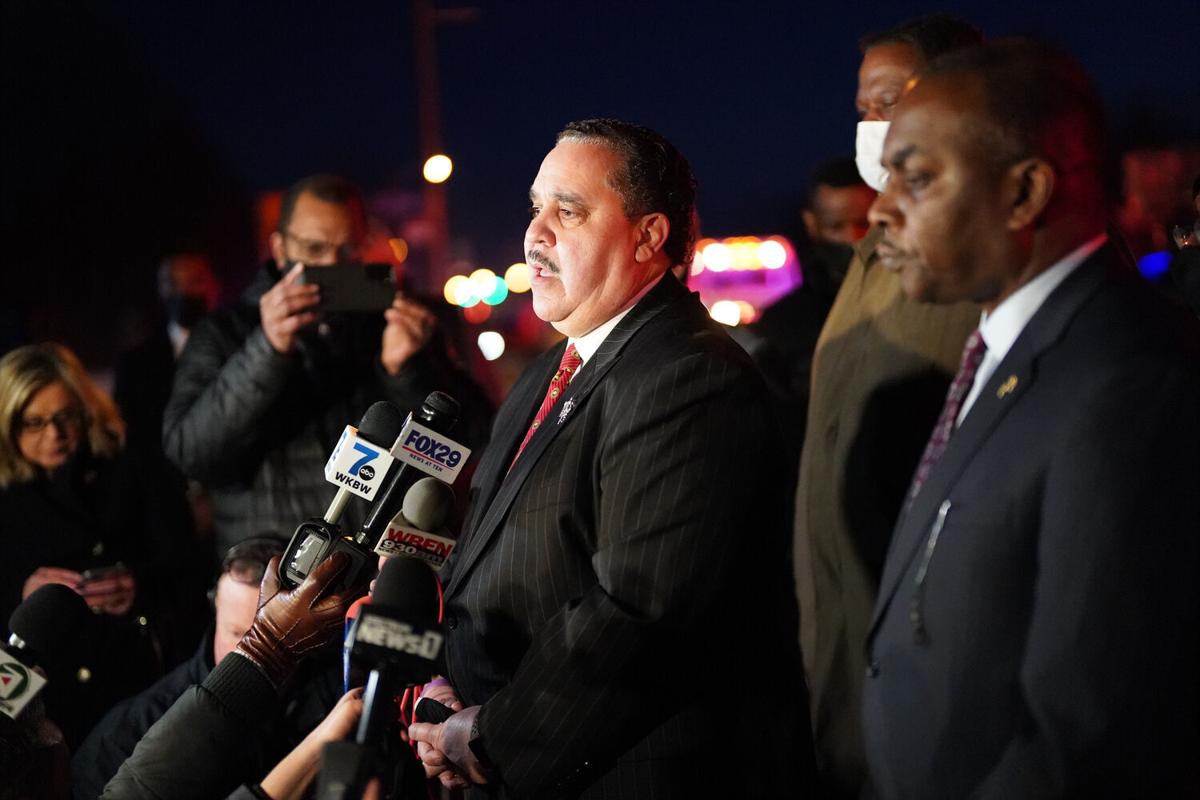
Cash was front and center at news conferences on Feb. 9 after a student was stabbed and a security guard was shot outside McKinley High School.

Security guards and administrators will be strategically placed, and Peacemakers will be stationed at the front corners of the building, helping students with safe passage, said McKinley Principal Moustafa Khalil.
But on Saturday, when the district announced its plans for bringing students back into the school, Cash was nowhere to be seen.
And the district’s letter explaining the plan for McKinley was signed not by Cash, but by Casandra Wright, an associate superintendent. She signed the letter as "acting superintendent," leading some people to wonder about the significance of that designation and Cash's future.
People are also reading…
This week, when Buffalo Public Schools announced its decision to drop its mask mandate, Cash still was not in town.
District officials are downplaying his absence. Cash was on a planned vacation last week, during February break, and will be on a family personal leave this week, General Counsel Nate Kuzma said Saturday.
"And he is entitled to his privacy during this time, so I'm not going to say anything further regarding that," he said.
A member of Cash’s immediate family has been dealing with severe health issues for several months, according to School Board member Sharon Belton-Cottman, who said that Cash’s personal leave was scheduled to end after Friday.
It is standard procedure in a school district for the superintendent to designate someone to act in his or her place when the superintendent is out of town, according to several school officials.
The School Board scheduled a special meeting at 5 p.m. Wednesday, before its regular work session, to discuss the violence at McKinley High School and to consider hiring a private firm to investigate security measures. The board may also go into executive session on Wednesday, according to the meeting notice that the district sent to reporters.

"He knew about violence problems at our school for years and did not provide a safe working and learning environment," states the resolution by BTF's Council of Delegates.
Cash could not be reached for comment, and School Board President Louis Petrucci did not respond to repeated messages asking what the board is likely to discuss behind closed doors Wednesday.
During his first several years in Buffalo, Cash enjoyed strong support both from the School Board and the larger community. In recent months, though, that support has begun to fade.
When Cash arrived in Buffalo in 2015, the graduation rate hovered around 50%. In many schools, less than 10% of students were proficient in math and English. The teachers union contract had long been expired.
Under Cash’s tenure, the graduation rate has increased to 79%. About one-fourth of students are now proficient in math and English. The district negotiated a contract with the teachers union, breaking a 12-year stalemate.
During the pandemic, Buffalo was the last district in New York State to remain fully remote – a decision that Cash said was necessary to protect the health of students and their families. Despite significant criticism for that decision, both within Buffalo and elsewhere, the School Board continued to stand behind him.
In 2020, the School Board gave Cash a three-year extension on his contract, extending it through June 30, 2023.
In June, the board gave Cash an average score of 3.64 out of 4 in its annual evaluation of him, praising him for the district’s collaboration with other community leaders and for the district’s reopening plan during the pandemic.
“Our building operations remained agile, responsive and unfaltering, with Dr. Cash directly engaged on a daily basis with addressing each and every need brought to his attention,” the board wrote.
The next month, Cash’s chief of staff, Darren Brown-Hall, left Buffalo Public Schools to become superintendent of the Williamsville School District. And that was when problems began to surface, according to Cash’s most vocal critic on the board.
“Once Darren left the district, it became apparent how much he was doing,” Belton-Cottman said. “Darren was attending all of the meetings the superintendent should have attended on the local level and on the state level, as well as running the district on a day-to-day basis.”
In recent weeks, the district has come under fire from parents for what many saw as a series of poor decisions.
One evening, for instance, the district announced that classes would be held in person the next day despite inclement weather – only to reverse course an hour later and cancel classes altogether, sowing confusion and leaving many parents in a last-minute scramble for childcare.
Parent discontent with the district peaked in early February, when a student was stabbed and a security guard was shot outside McKinley High School. The incident led to a lockdown in the school, leaving scores of students trapped inside, fearing for their lives. At no point that evening did the school or the district communicate with McKinley families to explain what was happening, leaving them wondering whether their children were in danger.
About a week later, the Buffalo Teachers Federation took a vote of no confidence in the superintendent, citing what the union said was a series of failures to adequately address safety concerns in McKinley and throughout the district.
“Cash has done a lot of good things, but when it comes to all the violence, the buck stops on his desk,” union president Phil Rumore said.


