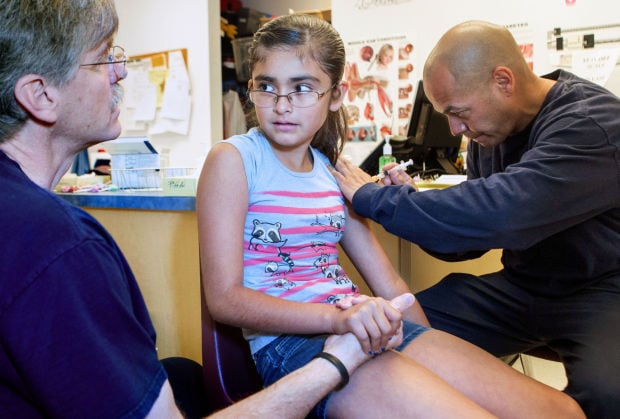
For years, schools have touted academic ratings, specialized programming and athletic feats to woo students onto campuses. A proposal in the Tucson Unified School District seeks to give families one more thing to consider — immunization rates.
TUSD Governing Board Member Mark Stegeman has requested that the district post on an annual basis statistics on students who are up-to-date on state-mandated immunizations at each school.
Starting in 2016, the information would be published on TUSD1.org by Dec. 1 of each year — around the same time parents make decisions about where to send their children for the following school year.
By law, Arizona students cannot attend school without full immunizations, but the state allows “personal belief” exemptions.
People are also reading…
Last school year, an average of 4.6 percent of Arizona kindergartners had personal-belief exemptions and the Pima County average was 2.8 percent. Sixth-graders with personal-belief exemptions were in the same range with a statewide average of 4.7 percent and a county average of 2.9 percent.
The fact that such exemptions are allowed is what compelled Stegeman to propose the change to TUSD’s communicable disease policy. Local outbreaks of pertussis in Tucson-area schools and a measles scare over the last few years also have Stegeman concerned.
“Most states in the U.S. don’t allow personal exemptions but Arizona does and I don’t see that likely to change,” he said. “As a result we have higher rates of parents choosing not to immunize their children, so this is relevant information. We can’t tell parents what to do but I would like parents to have the option to know whether they’re sending their children to a school with high immunization rates.”
Though the information is publicly available through the Arizona Department of Health Services, which posts immunization coverage levels of district, charter and private schools annually, Stegeman wants to make it more accessible.
“We need to lower the barriers for parents getting information across the board,” he said. “They need to know how well students are doing, the state of district finances, what happens at board meetings and everything else. Immunizations are not about education, per se, but it is about helping parents who care make intelligent choices, and in the end that serves our mission.”
Having declared itself a destination district for migrant and immigrant families, as well as embracing a nondiscrimination policy that encompasses ethnicity, sexual identity and gender, TUSD Superintendent H.T. Sanchez says the proposal runs afoul of the reputation the district has worked to build — one of acceptance.
“This proposal is counter to that,” he said. “From a parent’s point of view, those decisions are made based on very personal reasons that they feel strongly about. People are already labeled enough, and to label schools immunized vs those that aren’t, it’s a slippery slope and it’s not a welcoming practice. We don’t want families to feel singled out.”
Sanchez questioned what would come next if such a proposal were to move forward.
“Are we going to have separate water fountains? One for immunized children and one for non-immunized children? We’ve been there as a nation and we’ve moved beyond that,” he said.
TUSD Governing Board Clerk Kristel Foster expressed concerns about the effect on enrollment.
“I understand it is a public record so a parent can come and ask for that information, but when we’re trying to increase enrollment why would we be advertising that?” she said.
Other Tucson-area school districts do not post the kind of information Stegeman is requesting and are not considering such a move.
Though Stegeman does not believe his proposal would have a significant impact on enrollment, that is not his primary concern.
“The health issue is serious enough that parents have a right to know and that transcends any marginal impact on enrollment,” he said. “That’s part of transparency.”
Pima County Health Department Director Dr. Francisco Garcia isn’t as worried about public school districts as he is about charter and private schools.
“Our public school districts are not the problem, they fare relatively well in general,” Garcia said. “The real holes are charter and private schools, where you see big dips in vaccination rates that are problematic and could endanger children.”
Garcia, who had not seen Stegeman’s proposal, said overall it sounds like the recommendation is coming from a good place but will only be effective if the information is disseminated in a meaningful way.
For example, the percentage of kindergartners with personal-belief exemptions at a school like TUSD’s Gale Elementary exceeded the state average of 4.6 percent last year.
While that may be alarming to some, there were enough children vaccinated that an isolated case of infectious disease likely would not have resulted in a full-blown outbreak.
At the same time, some may mistakenly believe that a school with 80 percent of children vaccinated is performing above average — as would be the case on a report card — when 90 to 95 percent is required for herd immunity, depending on the type of disease.
“It’s complicated information to communicate,” Garcia said. “But we support concepts that help parents understand what their children are exposed to.”
Stegeman isn’t the first to propose this idea, which will go before the governing board on Tuesday. Rather, it’s an offshoot of a bill floated in the legislature earlier this year by Randall Friese that failed to get a hearing.
Had it been approved, the law would have required all district and charter schools that maintain a website to post immunization rates.
For Tami Miller, a mother of four, the vaccine issue hits close to home.
Her 4-year-old son Oakes suffers from a disorder that impacts his ability to fight infections on his own. As a result, he cannot get vaccines that contain live viruses, like chickenpox, rotavirus, measles, mumps and rubella; and an illness, even a common cold, tends to be more severe for Oakes than it would be for most.
On the flip side, Miller’s oldest child — now a sixth-grader — had an adverse reaction to vaccines at 2 months old.
“I’ve got really mixed feelings,” Miller said. “I have to rely on other people getting vaccinated for Oakes but I also know children like my own who may react differently. It’s not black and white.”
As important as it is to keep Oakes well, Miller says immunization rates would not be the primary consideration in selecting a school for him.
“It may sound like I’m a bad mom, but the educational side is really important to me,” said Miller, referring to the curriculum, teacher quality and class size.
She acknowledged that she would consider immunization rates, but not in the way that most would think.
“If I were to see a school with a very high vaccination rate, it might scare me a little bit,” she said, explaining that families who put off getting immunizations until the week before school also pose a threat to Oakes because the live viruses in some can be spread for weeks through bodily fluids.
What works for the Miller family is a delayed vaccine schedule, monthly infusions of plasma to build up bodily defenses and lots of communication with the new preschooler’s teacher.
“The teacher knows to do more hand washing with him. He has hand wipes. I brought in extra tissue for the classroom, and Lysol wipes,” Miller said.
And when a classmate is sick, the teacher alerts her to minimize exposure as much as possible.
Ultimately, Miller plans to homeschool Oakes as she has decided to do for her other school-age children over the last year-and-a-half.
“It’s not because of vaccination rates or sickness, it’s because of education,” she said. “I feel what I am doing at home best meets the needs of my children.”
Contact reporter Alexis Huicochea at ahuicochea@tucson.com or 573-4175. On Twitter: @AlexisHuicochea

Alexis Huicochea
Team leader