A team including UA scientists has uncovered evidence of the worship of a deity on Mount Lykaion in Greece 1,000 years before Zeus was worshipped there, giving new insight into early religious worship in the region.
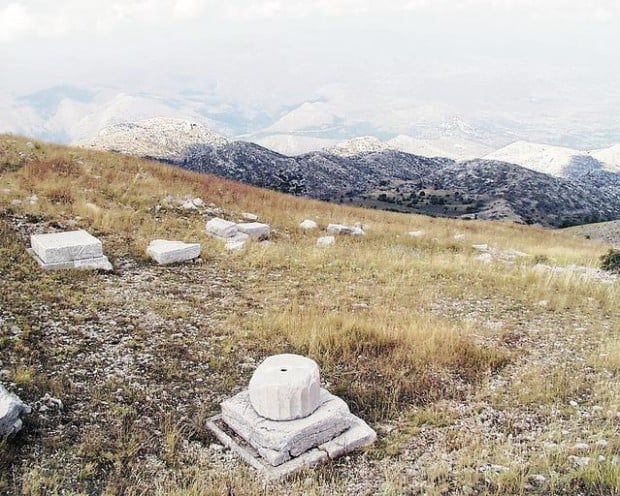
Mount Lykaion, in the Arcadia region of Greece, was known as a site of worship of Zeus, the god of lightning and king of gods in Greek mythology, as early as the second millennium B.C. In some myths, it's even the site of his birth.
But pottery discovered at the site has revealed worship and sacrifice might have been going on "at least 1,000 years before," said Mary Voyatzis, co-director of the project and head of the classics department at the University of Arizona.
"It's an opportunity to see what might have been going on before Zeus," she said. Members of the Mount Lykaion Excavation and Survey Project, including scientists from the University of Pennsylvania and from Greece, have been working since 2004.
People are also reading…
During the time of the worship of Zeus, games "similar to the ancient Olympics were held," said David Romano, a co-director of the expedition and a professor of classical studies at Penn.
His research is to "learn about the beginning of the games," from archaeological evidence.
"We've potentially found the ancient stadium," said Susan Mentzer, a UA graduate student.
Mentzer is helping the researchers by using micromorphology, looking at thin slices of dig samples "to guide them to better areas" for excavation.
The site's altar was excavated about 100 years ago, but not very well, UA researcher Voyatzis said, and did not uncover this evidence. The pottery is from the early Helladic period, about 3000-2100 B.C., much earlier than it was previously thought the site was used.
The myth of Zeus being born on the mountain therefore "may be a memory of the new god coming in," Voyatzis said.
George Davis, a professor in the UA geosciences department, said there is evidence from classical writings that at one point "everyone knew the birth cave of Zeus was in the area." Part of his research this summer will be to try to determine which of several caves that might be.
His emphasis is the geology of the mountain and "connecting geology to archaeology."
Davis has found how the fault lines of the mountain created springs and fountains along their route, which then map directly onto the paths and roads taken up the mountain by pilgrims going to the altar who would need water for themselves and their animals.
The geology of the mountain also means there must have been earthquakes then, as there are today in the area.
Having the earthquakes "affirming Zeusian power," would only have increased belief among ancient worshippers that the site was sacred, he said.
Interestingly, the geology of the region is very much like the geology of Arizona about 20 million years ago, he said.
Another aspect of research is the ash altar of the mountain, where offerings to Zeus and his possible predecessor were offered.
The ash is being examined to determine where it came from, especially as some ancient authors allude to human sacrifice at the altar. So far, ash from goats, sheep and pigs has been found, Voyatzis said.
She said there is still a lot to uncover at the site, and the answers are important to more than just explaining how Zeus was worshipped.
"Religion is fundamental to our humanness," Voyatzis said.
Mount Lykaion is still a place of religion, with a Greek Orthodox Church dedicated to St. Elias near the altar of Zeus.
Another unexpected discovery at the excavation was a rock crystal seal from Crete dating to the late Minoan period, around the 15th century B.C.
This is surprisingly earlier than the current estimation for contact between Crete, birthplace of Zeus, according to other myths, and the area of Mount Lykaion.
The team will continue work at the site for at least two more summers, excavating the mountain to learn about the history of its use by humans.
"We have more questions than we have answers," Voyatzis said.
To Learn More
For more information on the dig, visit lykaionexcavation.org
There will be a talk on the excavation on Feb. 25 at 5 p.m. in the UA's Harvill Building, room 101. It is sponsored by the Archaeological Institute of America (Tucson Chapter) and the UA classics department, and is free and open to the public.