

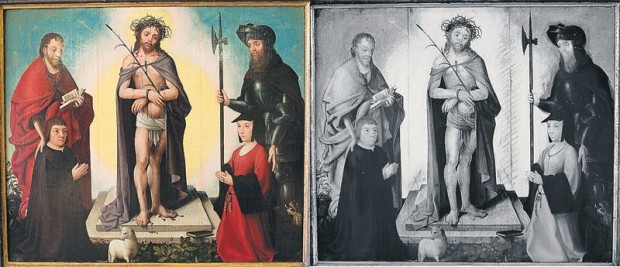
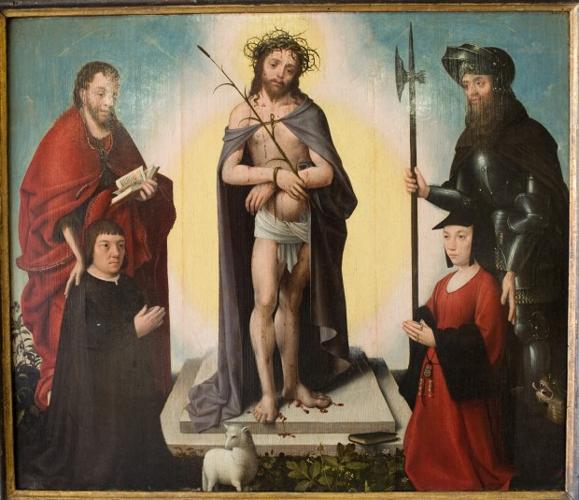
The Renaissance artist who painted "The Man of Sorrows With Saints and Donors" used a pencil to map out dimensions within the painting. Layers of thick paint hid those rough sketches - until now.
Charles Falco, a UA professor of optical science, has inexpensively modified a Canon 30D camera to photograph paintings in the infrared spectrum. In that lighting, pigments in the paint become semi-transparent, revealing drawings hidden beneath.
"When I look at a painting in the viewfinder, I'm the first person since the painter himself 600 years ago to see certain features," Falco said. "That's tremendously exciting."
While infrared technology has been used in the past to study paintings, the exorbitant cost of the high-tech cameras made it inaccessible to most museums and art enthusiasts.
Professional-grade infrared cameras can cost upward of $100,000, while Falco's modified Canon cost less than $1,000 total.
People are also reading…
The modifications are simple enough that most art enthusiasts and museums can create infrared cameras of their own, Falco said.
"For museums, it opens up a whole realm of possibilities," he said.
Falco is well known for a study first published in 2000 with artist David Hockney, showing evidence that many 15th and 16th century artists likely used projections to trace certain features onto canvas.
To get more evidence of that theory, Falco used instructions he found online to convert a normal camera to capture images in infrared.
Typically, cameras are produced with a blocker that inhibits infrared features from interfering with images. Falco began by removing that blocker and replacing it with a visible-light blocker to isolate aspects that were exposed in infrared. He then altered some of the electronics to address focusing issues when shooting in the new spectrum.
Falco first tested his modified camera at the University of Arizona Museum of Art. Curator Lauren Rabb was fascinated by the kind of details Falco's camera uncovered.
"It shows if the artist draws first or just paints directly or if he has some sort of geometric grid that he's following," she said. "Did he start doing one thing and then change his mind and do something different?"
Since that initial testing, Falco has taken his camera to museums around the world photographing paintings. He estimates that in the year and a half that he has been using the camera, he has collected more infrared images of paintings than ever existed before.
In the future, these cameras will allow art enthusiasts to go to museums and conduct their own studies of art collections, said Richard McCoy, an associate conservator of objects and variable art at the Indianapolis Museum of Art.
"You can take a bunch of digital images, examine them and then upload them to Flickr, and all of a sudden everyone can see and have a different sense of what might be happening under a painting."
Falco hopes that as these cameras become more common, it will encourage people to become active participants in a museum rather than passive observers.
"If you have a (infrared) camera with you and you take a picture, you're looking at the picture and trying to discover things that other people haven't seen if they're just walking by looking at a painting," he said.
Contact NASA Space Grant intern Otto Ross at 573-4125 or oross@azstarnet.com


