As the war with Iran is in its fourth week, University of Arizona professors and experts say President Donald Trump was pressured by Israel into joining the war, there is a dangerous lack of clarity about the goals, and civilian casualties won’t be easy to justify.
Since Israeli Prime Minister Benjamin Netanyahu told Trump that Israel would take the lead and expected the U.S. to join, Trump was pressured to get on board, said Richard Eaton, a UA history professor with expertise in the history of Iran, the Persianate world and the Islamic world.
If there was no pressure, Trump wouldn’t have gone into war, Eaton said.
Netanyahu “has come to Washington, D.C., many, many times and (spoken) before the Congress, and he would bring cartoonish images of a big bomb, saying how close Iran was (to building it and) it was a matter of only months or maybe weeks,” Eaton said. “The point is, he’s been extremely anxious about this for many, many years. I don’t know how long — at least 10 years, maybe more — trying to get the American Congress and the American government behind Israel and their extreme anxiety about Iran’s nuclear program, although now it’s their missile program.”
People are also reading…

Richard Eaton, a UA history professor with expertise in the history of Iran, the Persianate world and the Islamic world.
Eaton referred to Netanyahu urging Trump in February to expand the focus of U.S. negotiations with Iran to include its missile program, which the Israeli leader argued posed an existential threat to his country.
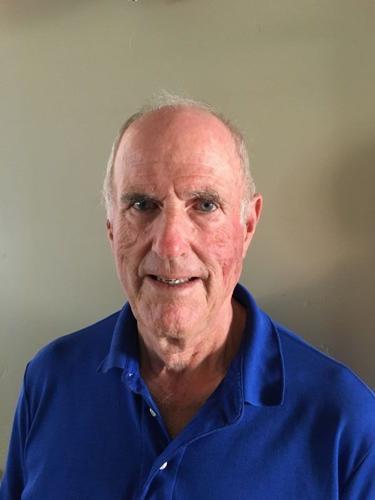
David J. Dunford, a member of the Governing Board of UA’s Center for Middle Eastern Studies and a former adjunct professor, agreed that Israelis sort of forced Trump’s hand by discovering the whereabouts of Ayatollah Ali Khamenei, the second supreme leader of Iran, who was meeting with senior officials the morning he was killed. Dunford was the U.S. ambassador to Oman from 1992 to 1995.

David J. Dunford, a former ambassador and a governing board member of UA’s Center for Middle Eastern Studies.
Ayatollah Ali Khamenei was killed alongside approximately 40 to 48 senior Iranian officials and several members of his immediate family on the first day of the military strikes that started the war on Feb. 28. After his death, his son, Mojtaba Khamenei, was officially named the third supreme leader of Iran on March 8.
“Speculating now, but I imagine the Israelis said, ‘We’re going to take out the leadership. Are you with us or not?’ ” said Dunford, author of the book "From Sadat to Saddam: The Decline of American Diplomacy in the Middle East" and co-author of "Talking to Strangers: The Struggle to Rebuild Iraq’s Foreign Ministry."
“Trump pretty much felt like he had to go, too. That’s how war started. I don’t think there was much of a strategy on the U.S. side, or plan for what would happen afterwards. You have to deal with pretty serious consequences,” he continued. “We had to evacuate our embassies in those areas, something which apparently we weren’t prepared to do.”
UA Distinguished Professor Alex Braithwaite pointed to statements by Joe Kent, Trump's director of the National Counterterrorism Center, who resigned last week after stating, "Iran posed no imminent threat to our nation, and it is clear that we started this war due to pressure from Israel and its powerful American lobby.”
Braithwaite, whose research centers around broad areas of international relations and conflict processes, said Kent’s statement spurred the speculation about Israel’s pressure on the U.S.

Alex Braithwaite, a University of Arizona professor in international relations.
“U.S. and Israel spent all their time convincing us six to nine months ago that they have obliterated Iran’s capacity to build a nuclear weapon with strikes,” Braithwaite said. “So, I think you would need a little bit more evidence at this point in your justification to say that this is about nuclear weapons from a military perspective, because we’re getting mixed messages about whether Iran is on the brink of having a nuclear weapon, or indeed if those prior attacks were highly successful, as was claimed at the time.”
Those previous strikes were during the military operation code-named Midnight Hammer, when the U.S. conducted targeted airstrikes against three major Iranian nuclear facilities in June 2025. While Trump declared the facilities “completely and totally obliterated,” a July 2025 Pentagon report estimated the Iranian nuclear program was set back by two years, but after that, a leaked Defense Intelligence Agency assessment suggested the setback might only be a matter of months.
“Now that the war has begun, he has had to contrive a host of war aims, always careful to avoid acknowledging the war’s actual reason, since he doesn’t want his base to see him as a servant of Israel,” Eaton said in an interview with the Star.

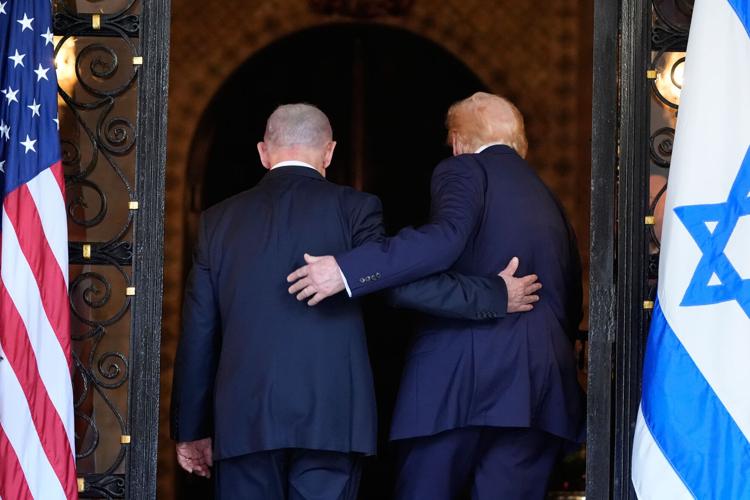
President Donald Trump and Israel's Prime Minister Benjamin Netanyahu walk arm in arm into Trump's Mar-a-Lago club in Palm Beach, Fla., on Dec. 29, 2025.
Lack of clear goals is 'real danger'
Braithwaite said the lack of clear explanation by the Trump administration behind this war is “the danger here.”
“One of the reasons that democratic states tend to deliberate for a long time before they enter wars, is to make sure that everybody understands why we’re fighting,” said Braithwaite. “So, people have been critical of the nature of the origins of this war and the lack of authorization being sought from Congress, for instance. But I would say the danger here is that as an administration, by choosing not to tell people very clearly why they’re doing what they’re doing, and by offering up alternative explanations frequently, what they’re doing is essentially leaving open the possibility that people will explain this their own way.”
Eaton said many powers forget that when they launch a war, the other side has its own options, which the first side may not have considered or known about. “Trump really doesn’t think very far ahead in any way,” he said.
“As military people like to say, ‘Tactics win battles, but strategy wins wars.’ And when it comes to strategy, one is challenged to imagine what on earth Trump might have had in mind, which is why once this war was launched, he’s been flailing all over the place trying to argue — one day we want regime change, the next day it’s because we want to stop their nuclear program, the next day it’s because we (want to) free the Iranians from their own government," Eaton said.
Dunford said he doesn’t think the U.S. is succeeding in changing the regime in Iran, adding that it might change from within but not due to the pressure of the U.S. and Israeli attack.
Dunford was in Saudi Arabia from 1988 to 1992 as deputy chief of mission at the U.S. embassy when Saddam Hussein invaded Kuwait. He said there was a whole period of time spent explaining to the American public why the U.S. needed to drive Hussein out of Kuwait. Congressional legislation and a United Nations resolution authorized the war, he said.
“None of that is happening in this (war) and apparently, only a minority of the American public supports this war,” Dunford said. “So, there was no preparation of the American people.”
Braithwaite pointed to a doctrine under President Ronald Reagan of “Peace Through Strength,” saying, “I think some elements of the Trump administration believe that an important way for the United States to encourage global peace is to demonstrate its military might. So, that’s probably part of it.”
“There is a sort of macho quality to that argument, where people think, ‘Well, if we strike quickly and powerfully, we can demonstrate how impressive we are,’” said Braithwaite. “I would argue the opposite. I think if you’re able to demonstrate restraint and only enter wars when you’ve got clarity around the mission, you’re in a much more impressive position.”
Eaton said while the Iran war shares features of the Iraq and Afghanistan wars, it could also be worse in some respects.
“Iran — like China or India — is not just another country on the map. It’s a civilizational state with a rich 2,500-year history of ethnic, literary, linguistic and cultural continuity,” he said. “Over time, it has learned how to deal with a host of foreign conquerors and would-be conquerors, including the Americans, who in 1953 installed a pliant dictator, the shah (Mohammad Reza Pahlavi). After his overthrow in 1979, the current regime has had to adapt to constant threats and sanctions from beyond its borders, which have only hardened its resolve, and ability to resist.”
The Trump administration has said it’s not sending in troops on the ground in this war, while Trump has simultaneously refused to permanently rule out the option, Eaton noted. “A ground war would be folly against a country the size of western Europe with a population of 93 million," he said.
“The logistical reason for avoiding a ground war is the challenge of accessing a plateau from the rugged terrain along the shores of the Persian Gulf. There’s also the lack of access through the Straits of Hormuz. The political reason is that most voters remember the disasters of our ground wars in Iraq, Afghanistan, and Vietnam,” he said.
Political motivations cited
Braithwaite said if the administration had clearly said in the beginning that its goal is regime change, it could have encouraged people to trust it for a period of time.
“If I had to guess, I would say there’s a great deal more interest in using this as an opportunity to distract, to try and cause people to look away from other things,” including the Epstein Files about convicted sex offender Jeffrey Epstein and his social circle, and the potential to delay holding the 2026 midterm elections in November if the war is still being fought at that time, he said.
Braithwaite referred to Trump’s remarks during an Oval Office meeting with Ukrainian President Volodymyr Zelenskyy in August 2025.
“Trump had said during previous discussions about Russia and Ukraine that if we happen to be in the middle of fighting war, that might mean we can’t hold elections,” he said. “And he said something to the tune of, that sounds like a good idea. It’s led people to speculate about whether there would be foreign intervention timed closer to the midterm elections.”
He said while this isn’t an incredibly popular war at this point, the U.S. has seen fairly consistently over time that fighting wars overseas has the effect of “rallying the public around the flag.” However, Braithwaite said the financial costs to fighting this war until November would be massive and the “growing human cost” would be quite unpopular, as well.
Difficulty for Iranian public to rise up
Since the war has started, Trump has made several claims that the Iranian people should rise up and "take over" their government.
Braithwaite said the Iranians are a sophisticated political population and they understand what opportunities exist and don’t exist for them to protest and try to bring down their government.
“I think if we were to try and empathize with the average Iranian citizen, it’s hard to imagine that the message you would receive at the moment is 'get out on the streets and protest and bring down your own government,' given that ... people in Tehran are currently largely unable to get out on the streets and protest,” Braithwaite said, “and not just because of repression from the Iranian government, but because bombs are falling all around them.”
Eaton said, “Trump apparently did not realize, did not know that, unlike America, Iranians are not armed. They just can’t rise up and have a rebellion, where everyone picks up their weapons and overthrows the Revolutionary Guards. It’s not going to happen. All weapons are with the Revolutionary Guards.”
Military strikes of this kind, especially with atrocities like the bombing of schools and hospitals whether intentional or accidental, aren’t consistent with trying to encourage mass mobilization against the government, Braithwaite said.
Due to outdated intelligence information for targeting, a U.S. Tomahawk missile struck a girls' elementary school in Iran on the first day of the war, killing at least 165 to 180 people, according to a preliminary U.S. military analysis.
“Civilian casualties absolutely should not be thought of as a necessary part of military action overseas at the extreme,” Braithwaite said.
Dunford said that while war is messy, the U.S. used to have a military and Department of Defense that worried about international law and attempted to punish those who committed atrocities.
Following his appointment in early 2025, U.S. Secretary of Defense Pete Hegseth removed key initiatives to protect civilians, including the Civilian Harm Mitigation and Response Action Plan, the Civilian Protection Center of Excellence and the Civilian Harm Mitigation and Response Office, he said. Under Hegseth, the U.S. Department of Defense shifted its primary focus to “lethality” and “warrior ethos.” Hegseth has derided what he calls "stupid rules of engagement."
“Our current secretary of defense, our ‘secretary of war’, seems to think international law is irrelevant and we should not worry about rules of engagement and trying to protect innocent people. So that’s very troubling to me,” Dunford said. “Another issue I would raise is our foreign policy now seems to be diplomacy-free. Our Department of State is pretty well gutted. Dealing with the consequences of this war is going to require a lot of diplomacy and we’re very weak in that area.”
Reporter Prerana Sannappanavar covers higher education for the Arizona Daily Star and Tucson.com. Contact her at psannappa1@tucson.com or DM her on Twitter.

Prerana Sannappanavar
Higher Education Reporter


 U of A international politics experts see red flags in U.S. actions in Venezuela