The University of Arizona Tuesday unveiled Biosphere 2 as its newest laboratory, with ambitious plans for climate-change research and promises to bring a new era of scientific legitimacy to the unique but often-criticized terrarium.
Backed by a $30 million gift, the UA will start two new scientific endeavors to take advantage of the 3.1-acre miniworld, as well as embark on an expanded public-education and outreach campaign.
"UA will develop Biosphere 2 into a center for research, outreach, teaching and lifelong learning about Earth, its living systems and its place in the universe," said Joaquin Ruiz, dean of the UA's College of Science. "The facilities and resources at this new campus will be an inspiring place for researchers to gather and to tackle problems that science and society will face now and in the future."
Originally built for $200 million as an experimental self-sustaining environment, Biosphere 2 was sold for $50 million on June 4 to CDO Ranching & Development, L.P., part of a 1,658-acre parcel already approved for the development of 1,500 homes and a resort hotel.
People are also reading…
The university will lease the Biosphere 2 campus, near Oracle about 35 miles from the UA campus, for $100 a year for three years, Ruiz said, with hopes of acquiring the facility afterward. The $30 million in operating expenses and research funding will come from the Philecology Foundation, led by Texas billionaire and Biosphere 2 creator Edward P. Bass.
"I salute the university's deep commitment to conduct research in the Biosphere that will advance our understanding of the Earth, its biosphere and the impact upon it," Bass said in a written statement. "Biosphere 2 was initially created as a tool to probe the essential environmental questions we must ask in the 21st century, and I look forward with great anticipation to what UA will discover."
Science Foundation Arizona President and CEO Bill Harris was the founding director of the program Columbia University ran at Biosphere 2 from 1996 until 2003. Harris, who left Columbia in 2000, developed the $10 million surrounding campus and said he was frustrated that at the time he couldn't engage the UA in Biosphere 2 research.
"The good news is Columbia transformed the campus from what was once a huge curiosity to one that could focus on serious scientific matters," Harris said.
Science Foundation Arizona will likely fund some start-up research at the Biosphere 2 and also have involvement in K-12 education programs at the facility, which Harris called inspiring to young students.
"I don't think I've seen in my career anything that has impacted students as much as their time here. It turned out to be the transformational experience of their college careers," Harris said. "This is a tool of learning beyond anything else."
The UA's research programs will be split between B2 Earthscience, which will conduct the large-scale climate experiments, and the B2 Institute, an interdisciplinary think tank focused on "grand challenges."
B2 Earthscience director Travis Huxman, a UA associate professor of ecology and evolutionary biology, said Biosphere 2 solves one of the most fundamental problems facing Earth scientists, who can choose between working in highly controlled labs on a very small scale, or field research in which natural processes are influenced by factors scientists can't control.
"The problem is both of these methods fail at some scale," Huxman said. "The Biosphere 2 is an unprecedented instrument that solves this problem."
Despite its critics, Biosphere 2 has in its short history already changed what scientists know about the world, Huxman said. Columbia's studies involving the impact of carbon dioxide on coral reefs and rain forests have both changed the way scientists approach the subjects. Even the failure to engineer natural ecosystems that could thrive in a sealed facility is a demonstration of Earth's unknown complexity, Huxman said.
"It's always been a place to ask questions that are difficult to answer," Huxman said. "The early science done here was experiments that showed us we don't understand how our Earth system works. I see a continuation of those themes."
The control allowed by the Biosphere will provide insights never before possible, Huxman said.
"We can send spaceships to Mars, but we really do not have a fundamental understanding of how water works on this planet," he said.
The first large-scale experiment will convert the agricultural and farm space into an area with large hill slopes, to study how the interaction between water and plants impacts the rest of the ecosystem. As natural filters between rainfall and stream flow, hill slopes can reveal important relationships in ecosystems, researchers said. The UA will test a variety of vegetation and conditions, including simulated drought.
About 25 Biosphere 2 staff members will stay on with the UA, which predicts a staff of about 50, including four new research faculty members and five postdoctoral research fellows.
Pierre Meystre, a UA Regents' Professor of physics and optical sciences, will direct the B2 Institute. Research topics will include sustainable and solar energy, origins of life, prospects for life on other planets and quantum science. The institute will have a strong science-education component and has plans for artist- and journalist-in-resident programs.
"Arizona has strong traditions in interdisciplinary research and a natural next step is to build a think tank around those strengths," Meystre said. "We will engage the city and the region in the great intellectual adventures of the 21st century."
Chris Bannon, who managed Biosphere 2 and is now representing the new ownership group, said the UA showed determination and diligence in pursuing the Biosphere as a research lab.
"We're just thrilled that you can have this landmark, arguably the most famous building in the state, now flying the flag of the University of Arizona," Bannon said. "That combination of brand and potential is phenomenal."
Jane Poynter, one of the original eight "Biospherians," said public perception of the facility started changing with Columbia's management and now the "supremely unique facility" is poised for even greater use under the UA.
"It really does bridge that gap between the lab and the field scales and controls, and you can't say that about anywhere else in the world," she said.
Did you know
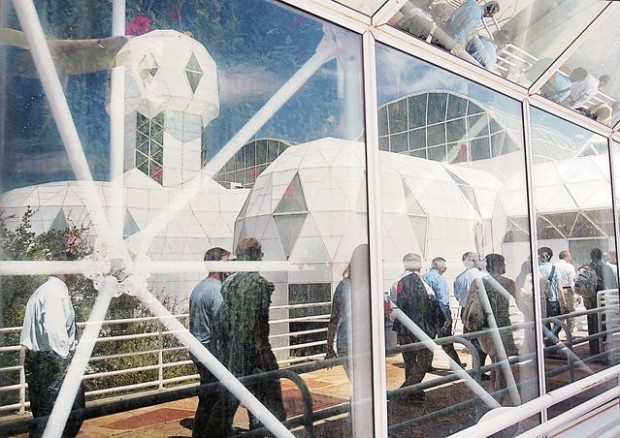
Biosphere 2 is 3.14 acres in area, sealed below by a 500-ton welded stainless steel liner. It has 6,500 windows that enclose a volume of 7.2 million cubic feet and is 91 feet at its highest point.
The Biosphere's human experiments ran from 1991 to 1994 and Columbia University managed the facility from 1996 to 2003. From 1991 to 2007, the facility had 2.3 million visitors.
Online: Learn more about the UA's new Biosphere 2 research at: http://www.b2science.com.