
The University of Arizona receives hundreds of millions of dollars for research each year to work on everything from Mars exploration to global warming.
With more than 100 areas of research, it's safe to say the scientific community at the UA almost never sleeps.
On any given day, students and professors alike are hunched over microscopes, running calculations and filling test tubes in rooms with walls as white as the lab coats they wear.
But just as an omelet requires breaking a few eggs, research often requires hours of hard work to crush, melt and disintegrate in the name of science.
Here's a look at some of the "coolest" labs that are making a difference, and a mess, on campus.
Materials lab
Leave the safety goggles on for this one.
People are also reading…
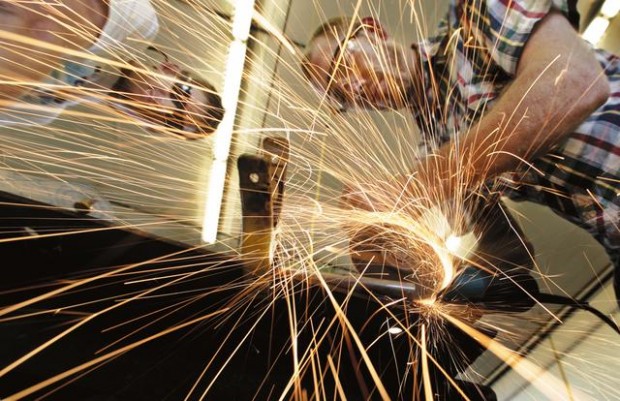
Featuring a 50-ton crusher and lasers that can cut through wood and Plexiglas, projects in the College of Architecture's Materials Lab involve destruction as much as they do construction. Aspiring architects have a plethora of tools to choose from to move their ideas from paper into the real world.
The recently completed lab has a "printer" that creates tangible, 3-D prototypes for intricate computer-designed parts such as buttons, switches and structural connectors that normally would be made of more expensive materials, such as metal. The printer saves money because the designer can test the functionality of an idea without wasting money by casting from a mold.
The printer uses injectors to lay down strings of liquefied plastic as thin as a quarter-millimeter to devise a durable, inexpensive model of objects created using 3-D computer software.
Two cutting lasers are used to carve building schematics and scale models based on computer renderings so the architect and the public can see what the structure will look like when completed. The lasers can accurately etch brick patterns, carve out arches or cut all the way through an object to create a door or window.
Despite the ominous reputation of laser beams, lab coordinator Scott Baker said it's impossible to get hurt by these lasers unless you intentionally remove the safety guards — and even then the machine would probably just shut off.
"It could probably only burn you badly," he said. "You would have to chop your arm off and stick it in there and close the door."
The "crusher," technically a load tester, is a computer-controlled vice that can slowly exert vertical pressure on prototypes to determine their structural integrity. Basically, it crushes things.
"Students work (on projects) in teams and two or three times during the semester they bring them in and we crush them," Baker said. "It's sort of a contest to design something with a minimum amount of weight and get the most amount of strength out of it."
The lab also has an array of saws, routers and other standard tools to work with wood, ceramics, metal and plastics.
Steel Structures Lab
The students in this lab one day will be responsible for designing roads and buildings that can withstand extreme conditions and natural disasters.
Although most of the research done in the civil engineering building right now involves running computer simulations, a massive bay in its structural lab is dedicated to earthquake simulation.
A full-scale, bare-bones replica of a typical multistory office building (30 feet wide by 13 feet high) is bolted to a 3-foot solid concrete floor. Hydraulic actuators are used to apply up to 220,000 pounds of pushing and pulling power — enough to simulate the swaying effect a powerful earthquake would have on a tall building.
The system most recently was used to test the tolerance of frame connectors, typically the weak spots that can send a building or bridge crashing to the ground in an earthquake.
Professor Robert Fleisch-man, who has been on the project for six years, said the goal of the tests is to market high-strength connectors to builders, and ultimately change the way buildings are constructed. Although the connectors developed within the past few years far exceed architectural requirements, Fleisch-man said, the team needs to find a way to reduce the cost before seeking a patent.
Running physical tests can be expensive, so Fleischman said meticulous analytical work is the most important, and most time-consuming, component.
"Each test is about $15,000, so you have to choose them very wisely," he said.
After all the nerd work is done on the computers, it's time to fire up the machines, put on the safety goggles and sit back while $50,000 worth of hydraulics try to tear apart your creation. Fleischman and three graduate students are now working to produce computer simulations for physical testing that will help determine standards for upcoming 2012 international building codes.
The project is part of the Diaphragm Seismic Design Methodology venture, a collaboration with Lehigh University and the University of California-San Diego. The team of researchers is using a $1.4 million budget to produce an industry-standard method for making precast concrete structures (such as parking garages) that can withstand earthquakes.
Bug Brother is watching
The aircraft structures lab is a hobby shop with a college education.
At first glance, it looks like pretty standard remote-controlled airplane stuff — wings of varying sizes and shapes, foam and balsa wood fuselages.
Upon a closer look, it becomes apparent that this isn't just a weekend project. Gobs of wires and circuit boards are scattered among the airplane parts. One fuselage is stuffed with electronics, including a video camera and GPS device.
At one workstation, a glass case holds rows of 4- to 6-inch airplanes with buglike cellophane wings.
Researchers in the Aerospace and Mechanical Engineering Department call them micro air vehicles (MAVs), and the goal of the project is to make autonomous, small-scale aircraft capable of short-range stealth reconnaissance. How small? Researcher Dmytro "Bill" Silin says the technology they're developing now will someday be scaled down to objects as small as a housefly.
But they're still a long way from creating an army of robot bugs with spy cameras.
The planes now range in size from several inches to several feet. Some resemble hobby-store airplane models, while others look like overgrown bugs.
Silin works on the smallest aircraft, bird- and buglike creations called ornithopters, named so because their wings flap like birds.
A team of about 20 graduate students and professors is assigned to the program, which is funded by the U.S. military, among others.
The goal is to give troops in the field a safe way to plan short-range missions or to assist the U.S. Border Patrol with border surveillance.
"All the controls involved can be easily carried," Silin said. "You just throw it. Pick a point on the map and it goes to that point."
The plane can be equipped to follow preset programs, and the video feed is transmitted back to hand-held controls.
The biggest problems right now are electrical interference and obstacle avoidance.
Steering around sudden unexpected hazards not projected in the flight program is especially important because the planes are fragile and usually won't survive a crash.
"When these things crash, they crash. There is not much left," Silin said.
The fuselage of the plane is packed with cameras, batteries and other surveillance equipment, and the tight space can cause problems.
All this technology isn't cheap, so don't plan on spying on the neighbors or sneaking into movies for free just yet. A launch-ready MAV costs about $10,000.
On StarNet: Read more science-related news and information at azstarnet.com/science
Pretty cool, too
Materials science and engineering metallurgy lab: Turn metal into butter, play with hot liquid magma.
Arizona Laboratory for Immersive Visualization Environments (AZ LIVE): A virtual reality room that lets you walk in 3-D environments, from molecules to desert landscapes.
Space engineering laboratory: Build space robots, launch small rockets.
Aerodynamics laboratory: Wind tunnels, water tunnels and an anechoic chamber (a special room with angled walls, ceilings and floors that eliminates echoes).
Lunar and planetary lab: Numerous ongoing endeavors, including the Phoenix Mars Mission.