

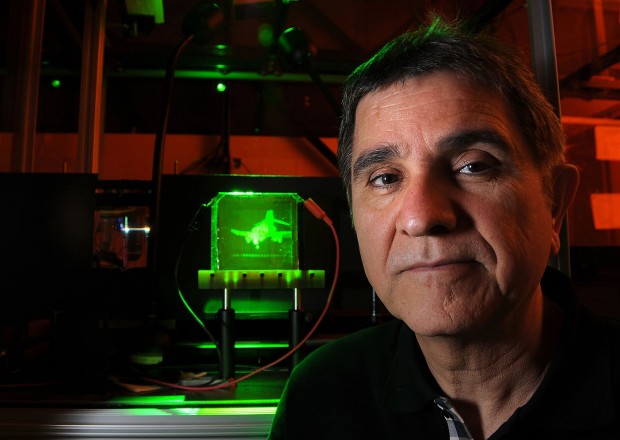
If holographic TV ever gets into your bedroom, don't expect the images on the screen to walk over and tuck you into bed.
University of Arizona scientists have developed moving holographic images that promise to be nearly as good as that scientific fantasy of projected 3-D holograms, but they will need a screen to appear, something dictated by the laws of physics.
The images on the screen, though, will look very real, scientists say, and will provide the same depth of field that our eyes give us.
That's when we say goodbye to 3-D glasses and the two-dimensional pixel and welcome its three-dimensional cousin, the hogel, into our lives.
Researchers at the UA's College of Optical Sciences, reported their progress Wednesday in a paper featured on the cover of the scientific journal Nature.
People are also reading…
They say:
• The rate at which holographic images are refreshed increased 100-fold in the past three years.
• Images have been created in three colors instead of just one.
• Images have been transmitted over an ethernet line, like the one that links your computer to the Internet.
• The images appear in "full parallax." Move to the right, and you see the left side of a head facing forward. You can even check out an actor's double chin or bald spot by moving up and down.
The early proofs of concept are not that visually impressive, compared with, say, James Cameron's "Avatar," but the technology has the potential to make current 3-D movies ultimately seem amateurish.
The purpose of the research, though, was not to make a better movie, or a TV set.
"We're not targeting the consumer market," said Pierre Alexandre Blanche, lead author of the paper. "This is a research project."
Blanche expects the technology to be first used in video teleconferencing and for specialized purposes such as surgeries and 3-D battle maps for the military, but he also expects it will ultimately prove irresistible to the entertainment industry.
It will require a screen, he said - in this case a photorefractive polymer film developed for the UA by scientists at the Oceanside, Calif., research arm of Japanese company Nitto Denko. Scientists at Nitto Denko Technical are listed as co-authors of the study.
That screen could lie flat and horizontal for a battlefield map or a virtual operating table.
In your living room, it would look like any other flat-screen TV, but images would have depth - they would appear to extend in front of and behind the plane of the screen.
The full parallax view would be fun in video games, Blanche said.
Imagine, he said, a video-game setup where your opponent can see behind a wall that blocks your view because of your position in the room.
"It has the potential for full immersion and virtual reality without goggles," he said.
A movie theater, in parallax view, would be more like a stage show. You'd get a different view of the film in the balcony than you would sitting up front. "It is closest to what we see in our surroundings," said Nasser Peyghambarian, UA optical sciences professor and principal investigator for the project.
It would be a vast improvement over current technology, he said.
The illusion of depth, in the typical 3-D system, is created by filming a scene with two cameras, spaced as far apart as the human eyes. Those two views appear on the screen together, and polarized 3-D glasses allow each of your eyes to see a different one. The depth you appear to see is created by your brain.
In a holographic system, the scene is photographed by multiple cameras. For this project, 16 were arrayed in an arc around the object being photographed.
Those images were combined by a computer and sent as data over an Internet line to a receiver where they were translated into an optical signal and written onto the screen medium with lasers.
So far, the UA team has created images that "refresh," or change, every couple of seconds. It will require speeds of 30 times per second to successfully mimic live action, but that goal is in reach, Blanche said.
Two years ago, the refresh rate was measured in minutes, the image was not fully parallax, it was only one color, and the screen was a 4-inch square.
The Nature study reports faster refresh rates on a 17-inch receiving screen and in multiple colors. The images are not yet as bright or as clear as they need to be, but the progress made in the last two years convinces Blanche that the team can clear all those hurdles in a similar time period.
The system needs to get better and quicker, Peyghambarian said, "by a factor of about 50 to 60."
He won't guarantee ultimate success but doesn't see any roadblocks. "I don't see any physics preventing us from getting there.
"In five to 10 years, it is going to be available for some customers. For what application and what size, I don't know."
On StarNet: Find more science, technology and health stories at azstarnet.com/news/science
IF YOU GO
Nasser Peyghambarian, principal investigator for the holographic project described in the accompanying story, will be one of the speakers at Flandrau Science Center's upcoming lecture series on lasers, sponsored by the UA College of Science and the College of Optical Sciences.
• On Monday, Nobel laureate Nicolaas Bloembergen, professor emeritus in the College of Optical Sciences, will talk about the history of the laser.
• On Nov. 15, Peyghambarian will talk about his group's laser hologram project.
• On. Nov. 22, Brian Anderson, associate professor of optical sciences, will talk about the widespread use of lasers in scientific research.
• All talks are free and begin at 7 p.m. The center is on the northeast corner of North Cherry Avenue and East University Boulevard.
Contact reporter Tom Beal at tbeal@azstarnet.com or 573-4158.


