
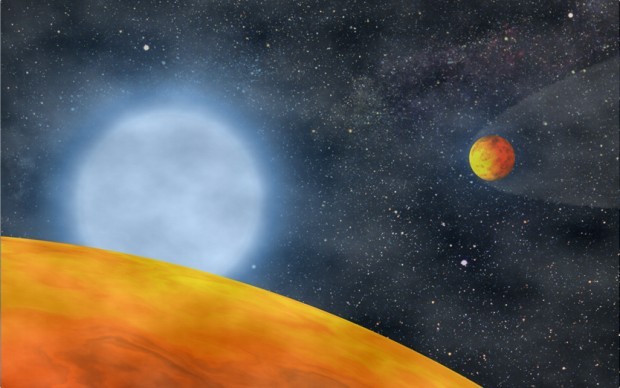
NASA bragged Tuesday that its Kepler Space Telescope had discovered the two smallest planets ever found orbiting a distant star, but a UA astronomer and colleagues may have discovered even smaller planets using the same telescope - without even trying.
Elizabeth "Betsy" Green, an astronomer with Steward Observatory, first used telescopes on Kitt Peak and Mount Hopkins to measure the pulsations of a star dubbed KOI 55, an object well on its way to fading away, having passed its "red giant" phase and headed, theoretically, to the "white dwarf" stage.
When Green and an international team of scientists, led by Stéphane Charpinet of the University of Toulouse in France, analyzed data from Kepler, they discovered recurring pulses that led them to posit the presence of two small planets so close to their sun that they orbited every 5.76 and 8.23 hours.
That leads researchers to believe they were once much larger planets, orbiting farther out.
People are also reading…
During the star's red giant stage they were probably engulfed in its thermonuclear explosions and subjected to intense heat for 100 million years or so - leading the scientists to describe them in news releases as the "deep-fried" planets.
Like french fries stuck in the frying basket for multiple dips in hot oil, they shriveled to a fraction of their former sizes.
Planets that might have once been much larger than Jupiter are now only 0.76 and 0.87 the size of Earth, said Green.
The discovery provides the asteroseismologists who study pulsating stars with new clues about the evolution of stars, said Green.
As KOI 55 burned off most of its hydrogen in its red giant phase, it would have expanded, engulfing any planets as close as Mars is to our own sun, said Green.
The planets, in turn, would have plunged through the edges of the star, "plowing up streamers that drifted away," allowing it to shed its mantle, said Green.
"This is the first time it has ever been shown that a planet has a significant influence in the later evolution of its star," Green said.
Steve Howell, deputy project scientist on the Kepler team at NASA Ames Research Center, said the discoveries, if verified, mark a new technique for planet discovery.
"This is the first time a planet has been discovered this way. That makes us all a little skeptical," he said.
Howell said the team has clearly ruled out all of the known explanations for the signals they received and could, indeed, have found planets.
For now, the two suspected planets bear the titles of KOI 55.01 and KOI 55.02. "KOI" stands for "Kepler object of interest."
Green said the same qualities that make Kepler such a "superb planet-finder" - it is outside Earth's atmosphere, pointed away from the sun for 24-hour viewing and fixed on a slice of the sky with 100,000 stars in it - make it handy for studying the sub-dwarf B stars that have been her major interest for the past two decades.
Did You Know?
Subdwarf B stars are objects that burn helium, rather than hydrogen, in their cores. With the hydrogen mantle burned off, their helium cores are exposed for study by astronomers.
A subclass of the stars, which oscillate on longer time periods, was found in 2003 by Elizabeth Green and undergrads with UA's Steward Observatory. They're known as "Betsy stars" in her honor.
Contact reporter Tom Beal at tbeal@azstarnet.com or 573-4158.