


Art DeFilippo feels younger every day.
"I feel great. I feel like a kid again," said DeFilippo, principal of Davidson Elementary School, near East Fort Lowell Road and North Alvernon Way.
DeFilippo traces his rejuvenation to the five-year process of getting a replacement built for the aging, rambling, ill-lighted and badly ventilated school that once sat just south of his new campus.
Dave Burns, design principal at Burns Wald-Hopkins, architects for the first certified "green" school in Tucson, said he'd love to claim that architecture changed DeFilippo's life. Only one problem, he said. "He was already a kid."
Now, at age 57, DeFilippo is a kid with a brand-new career.
In August, DeFilippo will become project principal of an international school in South Korea. He'll start his new life in an entirely new city being planned and built to standards established by the U.S. Green Building Council in its Leadership in Energy and Environmental Design program, known as LEED.
People are also reading…
Five years ago, DeFilippo said, he knew little about the principles of sustainability and nothing about applying them to building design. Doug Crockett, who then worked for the Tucson Unified School District and now is energy manager for the city of Tucson, asked DeFilippo if he would be interested in seeking LEED certification for the school.
It was an easy sell to the teachers and the parents on the planning committee, DeFilippo said.
Some parents blamed the old school and its mold problems for the illnesses of their children.
DeFilippo learned that building to LEED standards didn't just mean saving energy. It also meant making his school healthier.
"I thought, 'What a way to take a problem I inherited and make a statement — build a state-of-the-art, one-of-a-kind school that creates a better environment.' "
In its first year, the new campus saved $57,092.63 on utility bills, according to a district comparison with schools of equal size, DeFilippo said.
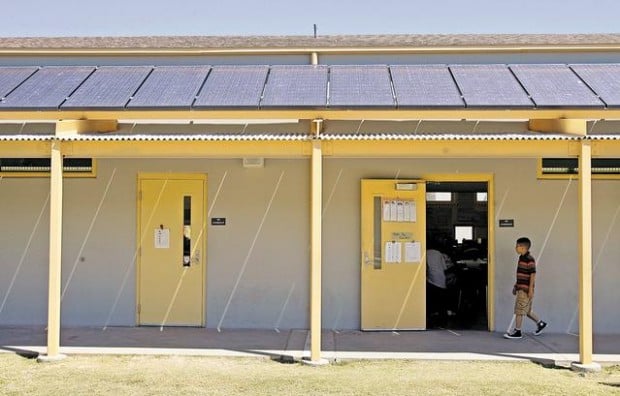
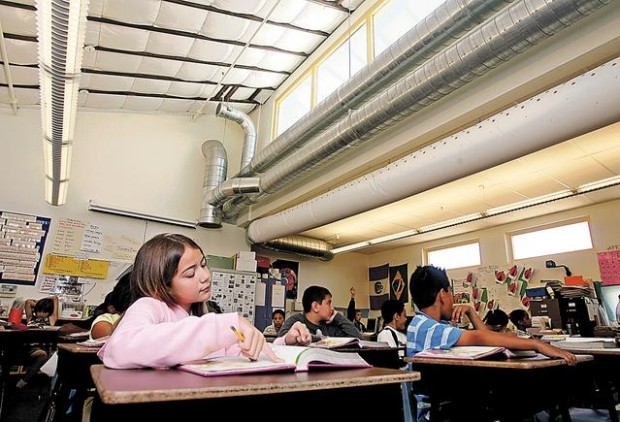
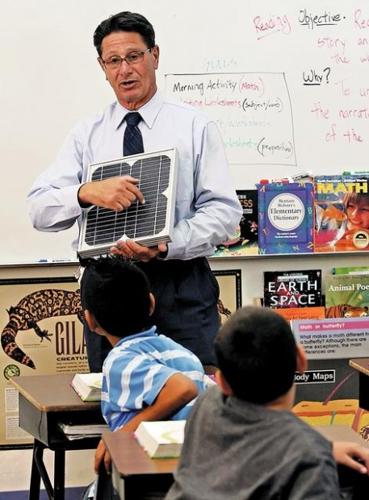
The building is well-insulated, Burns said, and it takes advantage of ambient air temperatures to heat and cool. Electricity is saved by "daylighting" the classrooms through high windows. The school also generates up to 30,000 watts of power from 60 solar panels. Tucson Electric Power Co. donated the panels through its GreenWatts program.
Air in the buildings is continually changed and filtered, Burns said.
Careful selection of building materials reduced the volatile organic compounds that could contaminate the air, and the school's cleaning program also relies on environmentally beneficial products.
The effectiveness of those strategies is tough to measure, though DeFilippo said absences due to colds and respiratory problems are way down during the school's first year of operation.
Burns said he has read studies that claim a number of beneficial effects from "green" construction — increased sales in stores that rely on daylight; less absenteeism and greater productivity in offices; and higher test scores in schools.
He doesn't discount the studies, but he said the findings are obvious.
"When we come in and replace an old, run-down facility, it really changes the way people feel," Burns said.
Dominic Robertson, 11, a fifth-grader at Davidson, agrees.
"We had some situations over there," Dominic said. "This school is a lot better."
"We are now one of the best schools in Tucson," said fifth-grader Zahra Mohammadpour, 11. "We're the only 'green' school in Tucson," added Alexandra Tally, 10, also in fifth grade.
Walk around the campus with DeFilippo and you'll find the students are knowledgeable about the school's environmental aspects and are eager to explain the details. You'll also learn that DeFilippo is seldom called by his title or his last name.
He's "Mr. Art" to the kids, or, as Zahra said in a single breath: "Mr.-Art-the-best-principal-in-the-world."
Which makes him a bit sad to leave and worried that his kids will feel he's deserting them.
DeFilippo said he recently ran into a young man at a grocery store — "a great big guy with a beard" — who asked if he was "Mr. Art." The man told DeFilippo that he had felt abandoned when the educator disappeared from Jefferson Park Elementary School. He had been hired away in the summer 16 years ago and didn't get a chance to say goodbye.
So DeFilippo said that he'll be saying goodbye this time, and he already has talked to one of his new school's sponsors, Microsoft Corp., about setting up a computer feed between his new school and his old one. He wants to "virtually" attend the ribbon-cutting for a new garden, and he wants to keep the Davidson kids updated on his new school and city.
New Songdo City, according a recent New York Times story, is a $30 billion project aimed at luring international businesses to a suburb of Inchon, South Korea.
It will be pedestrian-friendly, with tree-lined boulevards and canals where water taxis will be propelled by a current created by wind-driven turbines. Its overall design and all of its buildings will meet LEED standards.
DeFilippo said he always intended to spend five years at Davidson and then seek employment abroad.
He has a motto above the door of his office: "Always do your best and reach for the stars."
It's one that he repeats often to his staff and his students. He hopes the students at Davidson will perceive his leaving as an example of his motto — inspiration, not abandonment.
DID YOU KNOW
Parts of Davidson Elementary School, on East Fort Lowell Road just east of Alvernon Way, were 87 years old when the Tucson Unified District Governing Board voted in 2002 to replace the school.
Parents blamed their children's illnesses on recurring mold problems at the old school.
The original portion had been built as a Mormon church and school in 1915.
The new school was built with $718,204 set aside for the old school's renovation and $3.9 million from a developer, who also swapped the new school site to the north for the old Davidson site and two other parcels owned by the district.


