

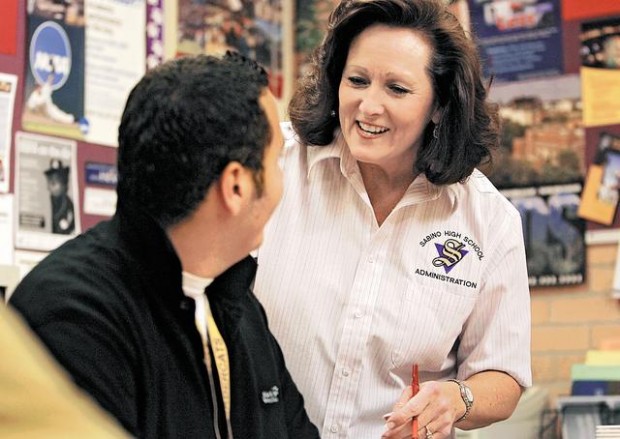
Sabino High School Principal Valerie Payne knows what it's like to grow up in a country that isn't one's own.
She spent her primary and high school years in South America, traveling with her father, who was in the oil business, and missing home.
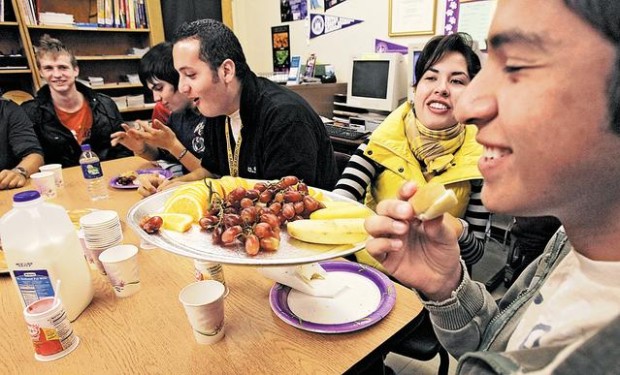
That's why one recent Friday found Payne at school before dawn, peeling bananas, slicing oranges, arranging doughnuts and cutting up fast-food sausage-and-egg sandwiches for a breakfast with the foreign-exchange students attending her Northeast Side school.
This year Sabino had 16 foreign-exchange students, double the number it had last year and more than in all other Tucson Unified School District high schools put together.
Payne calls the group her "little United Nations." Ghana is represented, along with Egypt, Belgium, China, Chile, Italy, the Netherlands, Kyrgyzstan and more.
People are also reading…
Payne said she sees each of those students as an educator.
"There's a perception out there that the students who come to this school are from well-to-do families, but there are many students who have never left the state of Arizona. For them to come in contact with students from other places and hear about some cultural differences, it really opens the world to them."
At the breakfast, the group members initially exhibited very un-teenager-like behavior. They sat awkwardly, quietly, in a small room, nibbling at the food. But then Payne apologized, saying the food choices may not be what they'd have at home, and that got laughter and a few protests that they really loved it. Soon, the more typical scarfing behavior exhibited by adolescents of the species began.
"I really liked the breakfast. It was really good," said David Marquez, a junior visiting from Bolivia, who said back home he'd probably just have cereal or tea with bread.
With Western movies being the only exposure he'd had to Arizona, Marquez said he expected a city with large swaths of barren desert. Most shocking to him was how organized things are here — and he acknowledges that sometimes he misses the chaos of home, with traffic snarls, crowded public transportation and pedestrians haphazardly crossing the street.
Marquez, who is now considering coming back for college, said he also was surprised that people are so friendly.
"My first day of school was really good," he said. "People were helping me find my classrooms, and also with my locker — I had no idea how to open it."
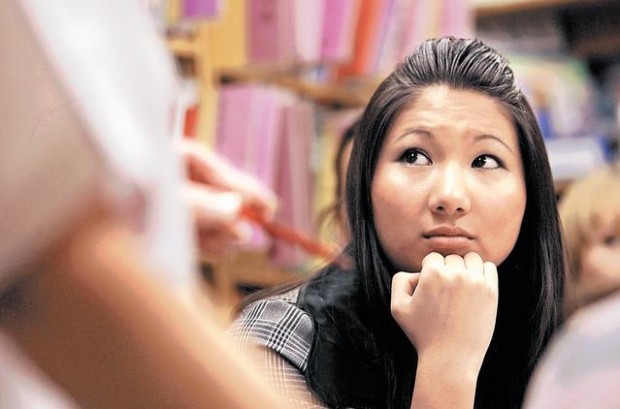
Adriana Nogales, also from Bolivia, said that even though she loves American doughnuts about as much as she loves Halloween parties here, the adjustment to a new city and new customs can be hard, and the difficulties are compounded by language issues. It helped that she had a ready-made group of friends from other countries who knew what she was going through, she said.
"And it's great to be exposed to different countries and different ideas."
Martina Suardelli, from Italy, said she likes changing classes every period. In Italy, students stay planted and teachers come to them.
"It's more like college this way," she said. And, she said, she likes having Saturdays free. While the school day is shorter back home, they make up for it by going to school on Saturday.
It's hard telling exactly how the economy has affected foreign-exchange programs nationally, although The Oregonian, a Portland newspaper, recently ran a story noting that placement agencies were scrambling to find homes there for students, with host families backing out because of economic concerns.
John Hishmeh, executive director at the Virginia-based Council on Standards for International Educational Travel, said the placement deadline for this year was Aug. 31 — a time when gasoline prices were horrendous but the economic news wasn't at a fever pitch. The numbers for this year won't be finalized until January, but he's hoping that people who are hosting out of a sense of volunteerism won't be put off by a sagging national bottom line.
His agency asks states to host a number of exchange students that's equivalent to 1 percent of their high school populations. Montana comes the closest, at 0.7 percent. So given that Arizona last year limped in at 40th in the nation for foreign-exchange placements — a drop from the previous year, when it was 35th — Sabino, he said, "appears to be doing a really good job for our community."
Bob Dohse, founder of the Gadsden Project, a local non-profit organization that promotes international education, said Payne has had so much success with foreign-exchange students because she works at it. One Egyptian student last year, for example, wanted to play on the basketball team, but she was worried about the uniforms. The school gave her a special uniform with long pant legs and shirt sleeves, and found a way to attach a head covering that didn't impede her play.
"Small things like that, coupled with a strategic plan, go a long way toward building a big program," Dohse said.
Lisa Reed, 41, a community relations specialist, said that when she became interested in hosting a student, she called Sabino to ask about it and found the staff very open. She is hosting Nogales, and she was impressed when she took her new Bolivian exchange student to parent-teacher night at Sabino. Each of the teachers knew Nogales' name and were familiar with her work.
Payne sought out host families in the school newsletter and encouraged her staff members to participate. Two did.
Julie Martin, a special-education teacher at Sabino who is the Student Council adviser and a mother of two, said that when she first got Payne's e-mail about hosting a student, she hit delete.
"I'm a really busy person," she said.
But then she happened to open a subsequent e-mail that had pictures, and she got a look at Gerrit Oehm of Germany.
"Never look at their pictures," she jokingly warned.
Martin said Oehm has brought the world to her home.
"I think we've learned some more tolerance, and we've learned more about accepting others," she said.
DID YOU KNOW
Sabino High School was named after nearby Sabino Canyon. It opened at 5000 N. Bowes Road in 1972 and has about 1,400 students.


