



PHOENIX — State lawmakers and Tucson educators on Thursday wrestled with questions about what kind of political speech, if any, is appropriate in public schools.
And to the ire of Democrats and school officials, some Republican lawmakers hinted at potential legislation to cure what they see as "political indoctrination" occurring in Tucson schools — a concern that's gained national attention in the wake of high school immigration protests earlier this month.
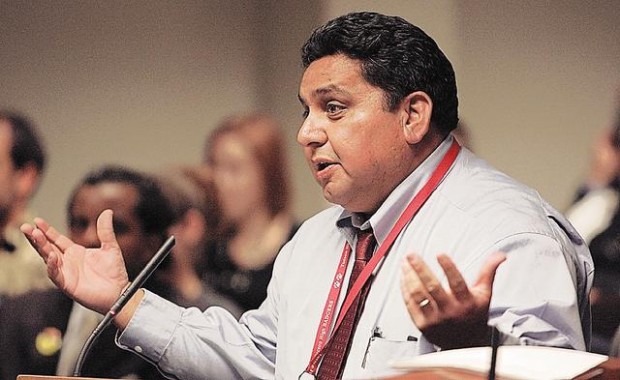
Before a legislative committee, Tucson Unified District School administrators defended a decision to allow an April 3 speech by labor activist Dolores Huerta, who told students "Republicans hate Latinos." Huerta also discussed abortion, gay marriage and taxes in the speech at Tucson High Magnet School, 400 N. Second Ave.
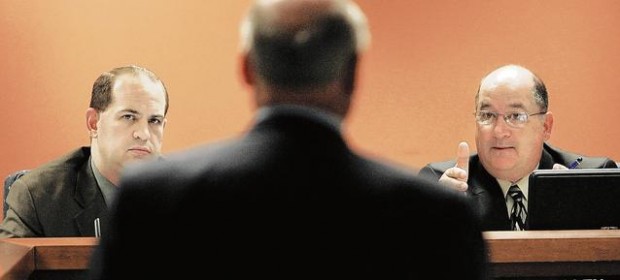
Members of the House Select Committee on Government Operations, Performance and Waste questioned TUSD Superintendent Roger Pfeuffer and Tucson High Principal Abel Morado on the appropriateness of the speech while raising other concerns about actions and events at TUSD's largest high school.
People are also reading…
The hearing, which became heated at times, underscores a debate that's concerned educators across the country. Some people argue that political speeches in schools mark a trend being driven by a greater student interest in politics, and one that has viable educational benefits. But some members of the committee saw a deeper problem Thursday.
"This school district has decided that indoctrinating students is one of its top priorities," said committee Chairman John Allen, a Scottsdale Republican. He said TUSD seems to be "running this kind of sweatshop for liberalism."
But committee member Steve Gallardo, a Phoenix Democrat, said the Legislature is stepping way outside its jurisdiction.
"This is an area best dealt with on the local level," he said. "If it's an assembly done at a high school that's inappropriate, then the school board should be looking at it."
Tucson Republican Jonathan Paton, who brought the speech to the attention of the Legislature, raised two new issues, too.
As Morado confirmed, the school's Teenage Republican Club apparently was told to take down advertisements at some point this year or last because a group of teachers found them inflammatory. The posters read, "Be a good American. Join the Teenage Republican Club."
Also, in an October speech, apparently geared toward black students at Tucson High, a speaker "dropped the F-bomb," Morado said.
Paton, who praised Pfeuffer's overall leadership of TUSD, said he would like for all high school speeches to be videotaped and archived on district Web sites, to give members of the general public firsthand access to them.
A larger issue?
Huerta's speech came amid thousands of student walkouts over national immigration reform. Nearly 15,000 students and more than 500 teachers were absent from class April 10 to participate in Downtown demonstrations. Thousands more students walked out several days the previous week, too.
Educators and sociologists say the protests and the subsequent controversy might be the awakening of something larger: A rising student interest in civic participation, driven by the "Millennial Generation," or those roughly age 5 through 25.
Their attitudes and tendencies are a throwback to those born at the start of the 20th century and a stark contrast to the likes of Baby Boomers and Gen-Xers. Immigration was the issue at hand here, but this generation's hunger for political engagement has been documented for years.
And with that craving comes growing pains, experts say, for educators who haven't seen heightened civic involvement in more than 20 years. So figuring out how to address major issues, it seems, is becoming as challenging as teaching kids how to pass AIMS.
But even as the immigration protests ebb, it's not an end to this newfound civic activism among students, experts say.
"I think that it's definitely not an isolated incident," says John Della Volpe, a pollster who tracks political trends among young people for Harvard University's Institute of Politics. "It's really just a hint of what's to happen in the future."
But activism doesn't necessarily mean liberalism. While the millennials now old enough to vote have gone Democrat, William Strauss, the author who is responsible for coining most of the generational terminology, says: "I don't think it's a done deal."
Some students agree.
"I think this generation is just more interested in politics than previous ones," said Mike Drum, 16, a Tucson High sophomore who identifies with Republicans. He didn't leave class for the protests but says he identifies with the activism of those who did.
And while there's been much attention to how the recent school walkouts and protests — are a re-emergence of the activism of the '60's, Strauss says it's strikingly different.
"It's much more organized, more polite, more mannerly," he said. "It's more of a building up than a tearing down."
Objectivity in the classroom
If anything, Paton and Allen say they hope Thursday's hearing opens the public's eyes to the issue of what kind of speech is appropriate in the classroom.
The issue even produced a visit from nationally known author David Horowitz, a vocal critic of political speech in the classroom. At Thursday's hearing, he called for Pfeuffer and Morado to be fired for not taking action on Huerta's speech.
Parents, students, community members and activists also spoke during Thursday's hearing, including Mon-yee Fung, president and founder of Tucson High's Republican Club.
And local educators who weren't at the hearing said they're ready to meet the challenge — and objectively, too.
"I know you have teachers who really push their views, but I try to be fair and balanced. I try to let kids find their own opinion," says George Parra, a social-studies teacher at Cholla High Magnet School. "I'm not pushing to be a Republican or Democrat."
Parra says he brought up the immigration issue as a discussion, with students talking about some of the arguments for and against open borders.
"For me, it's not really difficult," he said. "I really try to put my personal opinions away." And, he said, at the end of the day students still need to stay focused on regular curriculum.
But even with a culture shift, Huerta's speech on its own crossed the line, said Syd Golston, dean of students at Alhambra High School in Phoenix and a board member on the National Council of the Social Studies.
"If I had Dolores Huerta, the next day I would have had J.D. Hayworth," he said.
And while TUSD's Pfeuffer says he doesn't believe in shielding students from controversial ideas, he also sees some room for improvement.
He said there might be a need to clarify the importance of "balance in the classroom"
Court lays down law on T-shirts
Page B6
On StarNet: Find complete coverage of the walkouts, including slideshows and video, at azstarnet.com/border
"This school district has decided that indoctrinating students is one of its top priorities."
Committee Chairman John Allen, Scottsdale Republican


