

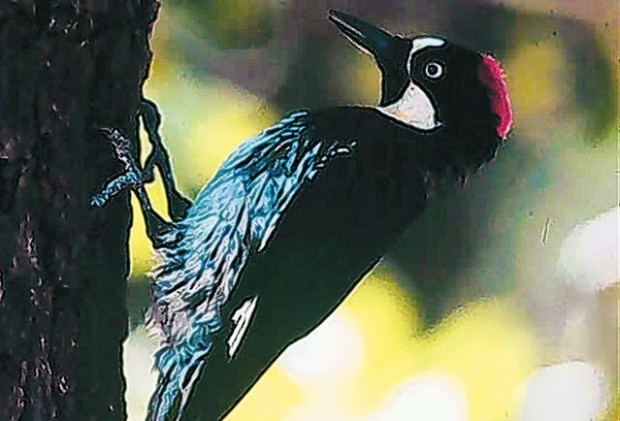
It was unmistakable, that sound: ritcha-ritcha-ritcha. It had to be an acorn woodpecker, a bird with which I am very familiar. I had not heard it for more than four years, since moving to Tucson.
I looked all about in the backyard, where I was standing. Sure enough, from a nearly dead mesquite across the way there came the characteristic undulating flight. I could just barely make out the black-and-white feathering and patch of red on the back of the head. My heart pounded with joy as I ran to the reference books and the Internet.
We have a good population of Melanerpes formicivorus in Southeastern Arizona, although this was my first sighting. I'll be looking out for these birds from now on — they are probably the most feisty of the woodpeckers, though our ubiquitous Gila gives them a run for the money. I had assumed that since we have a dearth of oaks hereabouts, I wouldn't see my favorite clowns. Not so.
People are also reading…
When I was rescuing wildlife in California, the area where I lived was filled with redwoods and oaks. I saw acorn woodpeckers every day and assumed because of their name they depended upon acorns as a main source of food.
Not so, it seems — though these birds dearly love to stash acorns in any available receptacle for nourishment during lean times. A familiar sight to many Californians is a tree or utility pole filled with symmetrical holes: stash holes.
I knew, of course, that acorn woodpeckers ate other things, among them insects. In fact, many people try to eradicate these useful and amusing birds because they think they are killing trees. They are not. They are drilling just below the outer bark in order to eat all of the insects that are actually killing the tree.
The first clutch of acorn woodpeckers I received from California Fish and Game numbered seven. Now that I think about it, I raised a lot of birds whose clutches numbered seven — a lucky number?
These birds most often live in colonies: They're very social. When there are that many chicks in one nest, it usually means at least two mothers. Young are fed by both sexes. My seven were very young. They were completely featherless and their eyes were closed. First and foremost was warmth, then food.
I had a special room for my wildings. Baby birds were raised in sturdy boxes with heating pads on one side. Nests were the smallest baskets I could find, filled with facial tissue … changing babies is universal, I think. Food for almost all species of birds was a formula I still call "glop." It's very successful, when fed from a whittled-down Popsicle stick.
Glop was baby cereal mixed with mashed egg, pureed fruit and meat. Baby birds thrive on glop, especially when mixed with vitamins.
Once my woodpeckers' eyes were opened, I realized a terrible truth. These, more than any other species I raised, "imprinted" on the feeder. I was Mama. Developing a method for feeding these lively birds, who all thought Mom should give them first attention, was interesting.
At each feeding I would line them up. Glop a few times in the top beak; back in the box. Glop in the second beak; back in the box, and so on until it was time to change the "bedding."
When it came time to release my fledglings back into the wild, I learned another lesson. Acorn woodpeckers stay right with you. They are all over you like bees the minute you step out the door. I learned after my first clutch that I had to take them far away, preferably near water.
I will leave you with this. Soon after releasing my first clutch on my property, I became used to having them all over me, often making nasty little "donks" on my head. One day, while I was cleaning a shed, a car pulled up and a man stepped out. He was immediately covered with acorn woodpeckers. The poor man flailed his arms and yelled, "What is this, lady?"
It seems he was a neighbor's attorney. I apologized while extricating the noisy birds from his person. When he drove off, I admit, I laughed.
I do wish you all a sighting of a clown-faced ritcha-ritcha. It'll make your day.
Desert corner
By Lee Reynolds


